What Is Meta Andromeda? Creative Is Now Targeting
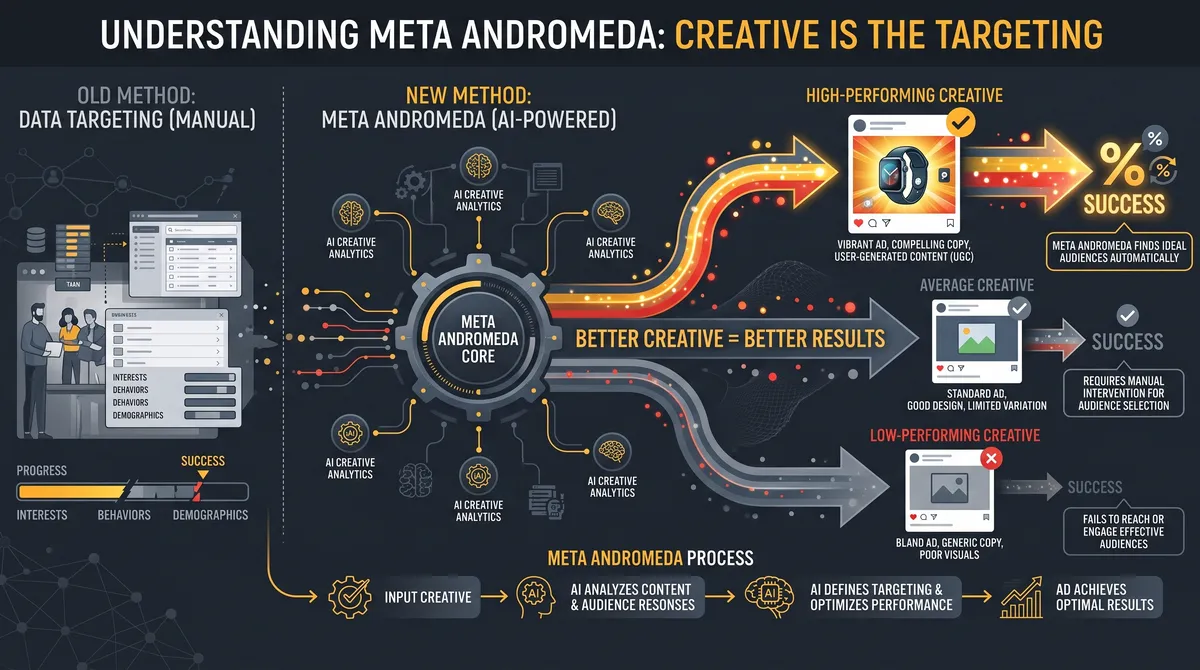
Meta's ad system no longer waits for you to tell it who to reach. It reads your ad and decides who should see it.

4 min read
In short
The shift, in plain terms
Before: you picked an audience, and Meta showed your ad to that audience. Now: you describe who you help through the ad itself, and Meta finds the people who match.
| The move | What it means | Source |
|---|---|---|
| Advantage+ became the default | Now the standard setup for Sales, Leads, and App campaigns, with manual and Advantage+ creation merged into one flow | Secondary reporting of Meta's changelog, early 2026 |
| Meta built a model for ads | The Generative Ads Model, GEM, trained across both ad and organic interactions | Meta announcement, November 2025 |
| Full automation is the stated goal | Meta wants ad creation and targeting automated end to end by the end of 2026. Buyers see that goal as further off, with mixed reviews of the tools so far | Wall Street Journal, June 2025. Marketing Brew, April 2026 |
That shift changes what you control. The levers left in your hands are what your ads say, how many distinct ideas you test, how clean your conversion data is, and how you measure results.
Why your ad is now doing the targeting
Picture two roofing ads.
- The first says Quality Roofing Since 1998 over a logo. It tells the system almost nothing.
- The second says Leak after the first rain? over a photo of a stained ceiling. It tells the system a great deal: homeowner, urgent problem, local service.
When your creative is vague, the system has little to match on. When it is specific, the system can find the people who recognize themselves in it.
A vague ad is more than a weak ad. It is a targeting mistake.
Five changes to your campaigns
The guidance below reflects practitioner consensus across vendor guides rather than published Meta rules. Treat it as estimated operating guidance and test it against your own account.
Consolidate
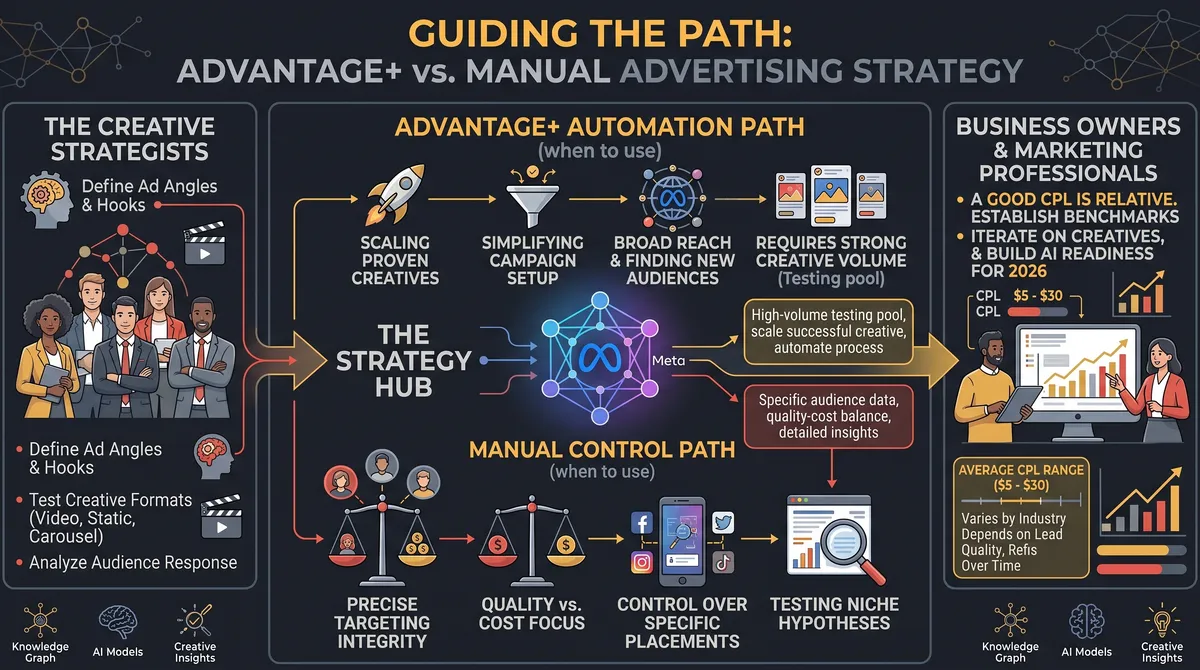
One campaign per objective with broad targeting and Advantage+ on. Splitting into many ad sets spreads your learning signal thin and can put your own ads in competition with each other.
Build real variety
Plan 8 to 15 genuinely different creatives per campaign, with 2 to 3 variations of each. A new headline on the same idea still counts as the same idea.
Plan your refresh
Creative tends to wear out faster under Andromeda, often within 2 to 3 weeks instead of 6 or more. Put refreshes on the calendar before results drop, not after.
Fix your signal
Run the Meta Pixel and the Conversions API together so the system learns from real outcomes rather than guesses.
Report by creative
Judge each ad on its own cost per lead. Campaign averages hide your winners and your drains.
Creative is not a design task anymore
The strategy inside the ad is what does the targeting: who it speaks to, which problem it names, and what proof it shows. A beautiful ad with a vague message still fails at targeting.
The same rule now applies outside Meta. AI search tools like ChatGPT and Perplexity build their answers about your business from what is published about you. Clear content gets understood and recommended. Vague content gets passed over.
A machine can only recommend what it can understand. That is true of an ad system and an answer engine alike.
Sources
Meta Business News, The Creative Advantage. Wall Street Journal via Marketing Dive, June 2025. Marketing Brew, April 7, 2026. Pixis, citing Meta, on the Generative Ads Model, November 2025. Advantage+ default and unified campaign creation reported secondhand from Meta's changelog rather than from a primary Meta post. Campaign structure, creative volume, and refresh cadence guidance compiled from vendor sources including Atria, Logical Position, Jetfuel, and Segwise, and labeled estimated operating guidance rather than published platform rules.