
Strategy & Leadership6 min read
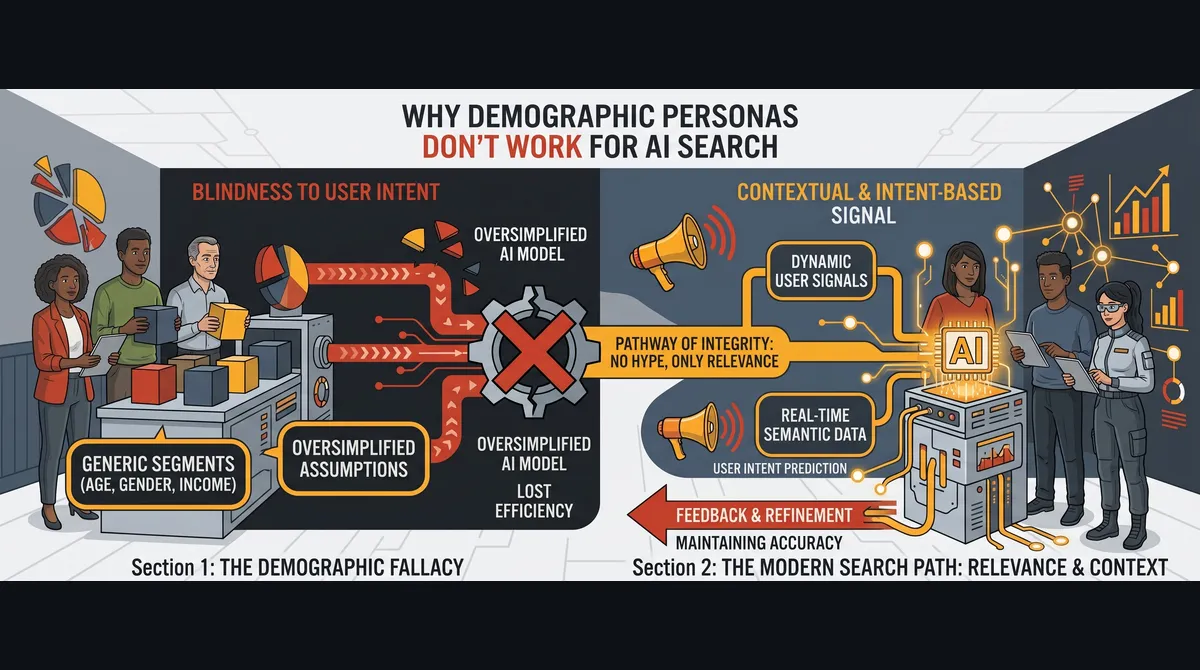
Why Demographic Personas Don’t Work for AI Search
Demographics describe who someone is, not what they'll ask AI. Learn why niche audience research beats standard personas for real AI engine citations.
Updated ·25 min read ·By Izzy Gregorio
In short
The shortlist is set before you are invited. In 6sense's 2025 B2B Buyer Experience Report, a study of about 4,000 buyers, 94 percent of buying groups had already ranked their preferred vendors before making first contact, and 77 percent bought from that preliminary favorite.
That changes what a persona is for. The persona you build today is not only a guide for your team. It is the brief an AI engine uses when it decides whether your brand belongs in the answer.
Most persona templates still in circulation were built for a journey your brand controlled: a name, an age, a stock photo, a job title, and a set of pain points. The room has gotten bigger, the research now starts inside a generative engine, and the questions buyers type are longer and more specific than any keyword you tracked.
This guide covers what a buyer persona needs to contain in 2026, how to build one in five layers, how to turn those layers into a campaign plan, and how to judge whether it worked.
What you will take away
A note on the numbers before you read further. Every statistic on this page carries a named source and a year. Several of the most repeated persona statistics on the internet trace back to a single 2015 survey or to case studies with no disclosed method, so they are not here. CCG cites what can be traced.
An ideal customer profile describes the company worth serving. A buyer persona describes a person inside that company's buying group, including what they need to believe before they say yes. The ICP tells you where to aim. The persona tells you what to say, to whom, and in what order.
The two get used interchangeably, and that is where most persona work goes wrong. A team builds an ICP, calls it a persona, and ends up with messaging aimed at a logo instead of a human being.
| Artifact | Unit of analysis | Question it answers | Typical inputs |
|---|---|---|---|
| Ideal customer profile | The company or account | Which organizations are worth our time and budget? | Closed won data, revenue band, vertical, geography, deal size, retention |
| Buying group map | The room | Who influences this decision, seen and unseen? | Win and loss interviews, sales call transcripts, procurement patterns |
| Buyer persona | The individual | What does this person need to believe, and what proof gets them there? | Qualitative interviews, reviews, support tickets, sales call language |
| Negative persona (do not chase) | The individual you should not chase | Who looks like a fit and is not? | Churn analysis, lost deal reasons, support burden by segment |
The negative persona earns its place on the list. Gartner's survey of 632 B2B buyers, fielded in 2024 and released in June 2025, found 73 percent of buyers actively avoid suppliers who send irrelevant outreach. Targeting the wrong person does not simply waste budget. It costs you the right people, too.
A working rule: if a line in your persona could not change a decision about messaging, channel, proof, or sequence, take it out.
Traditional personas fail because they describe one imaginary individual in a static file while real decisions get made by a group. Forrester's State of Business Buying 2026, drawn from a survey of nearly 18,000 buyers, found the typical B2B decision now involves 13 internal stakeholders and 9 external influencers. One persona leaves most of that room unaddressed.
Four failure patterns show up again and again.
Persona work tends to end at the moment of publication. Directional history from the Cintell 2016 Benchmark Study, a correlational survey of 137 B2B marketers fielded in December 2015, found only 21.2 percent stored personas in any format other than a static PDF or printout, and only 52.6 percent could account for the full buying committee. The study is a decade old and its subgroups are small, so treat it as color rather than proof. The pattern it describes has not gone away.
Age, title, and a set of hobbies do not tell you what a person is trying to finish this week. Gartner's buying jobs research, published in 2018 and still in use, identifies six jobs buyers work through: problem identification, solution exploration, requirements building, supplier selection, validation, and consensus creation. Validation and consensus run throughout, and buyers revisit nearly every job at least once. A persona that ignores the job describes a demographic, not a buyer.
Edelman and LinkedIn's 2025 B2B Thought Leadership Impact Report, based on responses from nearly 2,000 professionals, named the hidden buyers in finance, legal, procurement, compliance, and operations who shape outcomes without ever appearing on a call. They rarely appear in persona decks either. Internal misalignment inside buying groups stalls more than 40 percent of B2B deals, a figure Edelman and LinkedIn cite from Matt Dixon's The JOLT Effect (2022).
The persona describes what a buyer wants and says nothing about how they ask for it. That gap is the expensive one, and the rest of this page is largely about closing it.
There is a cost to getting this wrong that shows up on your own website. Gartner's 2024 survey found 69 percent of B2B buyers report inconsistencies between what a seller's website says and what its reps tell them. Inconsistent facts confuse buying groups, and they confuse generative engines the same way.
Buyers now start with a generative engine and finish with a human. Forrester's State of Business Buying 2026 found genAI tools were the single most cited meaningful interaction type in purchase research, while Gartner's May 2026 release, from a survey of 645 B2B buyers, found 69 percent of buyers prefer to validate AI generated insights with a sales rep before deciding.
Both halves of that sentence matter. The research starts somewhere you do not control. The decision still runs through people, proof, and memory.
Gartner's March 2026 release, from a survey of 646 B2B buyers, found 67 percent prefer a rep free experience, up from 61 percent the year before, and 45 percent used AI during a recent purchase. 6sense's 2025 report found the point of first contact moved from 69 percent of the journey to 61 percent, roughly six to seven weeks earlier than the prior year, while the global average buying cycle shortened to 10.1 months from 11.3 months.
6sense (2025) found buyers reported prior personal experience with at least one shortlisted vendor 97 percent of the time. In the same study, 94 percent of buyers used large language models to summarize reviews or analyze data, and still averaged 16 interactions per person with the winning vendor. AI compresses the reading. It does not replace the relationship.
Forrester (2026) found only 36 percent of buyers felt more confident in their decision because they used genAI. Gartner (May 2026) found buyers used an average of seven information sources. The engine opens the question. Third party validation closes it.
45% of consumers used AI tools to find local business recommendations in the past year, up from 6 percent (BrightLocal, Local Consumer Review Survey 2026, panel of 1,002 US adults).
In the same BrightLocal survey, adults aged 30 to 44 lead at 64 percent, while those over 60 sit at 24 percent. ChatGPT was used by 31 percent of consumers for business recommendations and Google AI Mode by 23 percent, while use of Google to read reviews fell from 83 percent to 71 percent.
The SOCi Local Visibility Index 2026, reported via BrightLocal, found that fewer than half of the businesses leading Google local results also appear in AI local recommendations. Two systems, two sets of rules, one brand caught between them.
That is the whole argument for building infrastructure before content volume.
The gap closes with infrastructure, not more content alone. Consistent entity facts, clean technical foundations, extractable answers, and third party mentions are what decide whether an engine can cite you. Publishing more pages on a broken foundation just adds more pages.
Start with the GEO audit, or read how Generative Engine Optimization works across a full engagement.
Build the persona in five layers: the ideal customer profile, the buying group map, role personas, buying jobs, and the prompt set. Most published templates stop at layer three. The last two layers connect a persona to the work a buyer is trying to finish and to the exact questions they put into an AI engine.
| Layer | Question it answers | Inputs | Output |
|---|---|---|---|
| 1. Ideal customer profile | Which companies are worth serving? | CRM closed won data, revenue band, vertical, geography, deal size, retention | A one page ICP with fit criteria and disqualifiers |
| 2. Buying group map | Who is in the room, seen and unseen? | Win and loss interviews, sales call transcripts, procurement patterns | Champion, economic buyer, technical validator, hidden buyers, external influencers |
| 3. Role personas | What does each person need to believe to say yes? | 6 to 10 qualitative interviews per core role, reviews, support tickets | Goals, fears, success definition, objections, trusted validators |
| 4. Buying jobs map | What job is each person trying to finish right now? | The six Gartner buying jobs laid over each role persona | The content and proof required, per job, per role |
| 5. Prompt set (the layer most templates skip) | What does each person ask AI engines, and who gets cited? | Real buyer phrasing from calls, emails, reviews, long tail search queries, People Also Ask | 20 to 50 tracked prompts per persona, tested across five engines |
Six to ten conversations per core role is enough to find the pattern. Record them, and keep the exact phrasing.
Questions worth asking, organized by buying job:
| Buying job | The buyer's internal question | What the persona needs | Content and proof that fits | GEO implication |
|---|---|---|---|---|
| Problem identification | Do we have a problem worth solving? | Language for the problem, cost of inaction | Diagnostic articles, benchmarks, original data | Own the definitional questions engines answer first |
| Solution exploration | What is out there? | A category map, approaches compared | Comparison guides, best for pages, frameworks | The word best appears in roughly one in four prompts (Search Engine Land, June 2026); be citable there |
| Requirements building | What do we need it to do? | Criteria, checklists, fit questions | RFP checklists, calculators, requirement templates | Structured, extractable lists and tables |
| Supplier selection | Does this vendor do what we need? | Specific proof for their situation | Case studies by vertical, pricing signals, clear scope | Consistent entity facts everywhere |
| Validation (always on) | Are we sure? | Third party confirmation | Reviews, analyst and peer mentions, trials, references | Third party mentions drive citations more than your own pages |
| Consensus creation (always on) | Can everyone agree? | Material the champion can forward | Business case one pagers, ROI framing for finance, risk notes for legal | Thought leadership hidden buyers trust |
That last row has support behind it. Edelman and LinkedIn (2025) found 71 percent of hidden decision makers consider thought leadership a more trustworthy basis for evaluating a vendor than product sheets or marketing materials, 86 percent prefer content that challenges their assumptions, and 79 percent are more likely to champion vendors with consistently strong thought leadership. For a challenger brand, one finding in that report matters most: 53 percent of decision makers say strong thought leadership makes brand recognition matter less.
Layer five is where the persona stops being a document and starts being a test. It records the exact questions each role types into a generative engine, tested across all five major engines and re run on a schedule. The next section covers how to build it.
Stock photos. A fictional first name as the headline. Hobbies unrelated to buying. Long invented backstories. Research on AI generated personas, covered below, found that added fictional detail makes predictions worse, and the same logic applies to the ones your team writes by hand.
A persona should record the exact questions its owner types into an AI engine. Semrush's AI Mode study (July 2025) found the average Google AI Mode query runs 7.22 words against about four words for traditional search, with ChatGPT prompts averaging around 23 words. Buyers put budget, location, and evaluation criteria inside the prompt itself.
Those extra words are your persona fields, written by the buyer.
Search Engine Land's June 2026 survey analysis found the share of keyword shaped prompts fell from about 50 percent in August 2025 to about 30 percent by January 2026, with the rest growing longer and more contextual. In the same study, 24.5 percent of prompts included the word best, 28 percent mentioned price or budget, and 16 percent were location based. Map those three directly onto your persona: evaluation criteria, budget reality, geography.
65 to 85% of ChatGPT prompts have no matching keyword in Semrush’s keyword database (Semrush data, April 2026, reported by Position Digital).
Most of what your buyer actually asks has never appeared in a volume report.
A Peec AI study by Ehrlinspiel, Landwehr and Rudzki (June 2026), reported by Search Engine Journal, tested prompt wording against brand visibility. Keyword style prompts produced up to 25 percent higher average brand visibility than persona engineered prompts that began with instructions like "You are an IT consultant." Added filler words had close to zero effect on which brands appeared.
The lesson for persona work is direct. Capture how your buyer actually talks and test that phrasing. Do not simulate a persona inside a prompt and call the output research.
The same study found constraints behave differently by engine. In ChatGPT and Perplexity, budget or feature constraints reduced the number of brands shown. In Gemini and Google AI Overviews, they increased it. One prompt set, tested in one engine, tells you very little.
This is layer five, and it is the layer almost no persona template includes. It is also the one that tells you whether the rest of the work is reaching anyone.
AI generated personas sharpen research. They do not replace it. Maier and colleagues (2025) reached about 90 percent of human test retest reliability simulating consumer survey responses using a validated semantic similarity method across 57 surveys and more than 9,300 human responses, but that result holds for structured tasks with a defined method, not for open ended discovery.
The evidence on where synthetic personas break down is unusually clear.
Group dynamics is exactly what a B2B buying group is made of. A tool that is weakest at consensus behavior is the wrong tool for modeling a room of 13 internal stakeholders and 9 external influencers (Forrester, 2026).
The honest use case: run synthetic personas between real interviews, to pressure test message variants, stress an objection, or rank a list of claims before you spend production budget. Then go talk to people. The interviews are still the source of truth, and the prompt set still has to be tested against live engines.
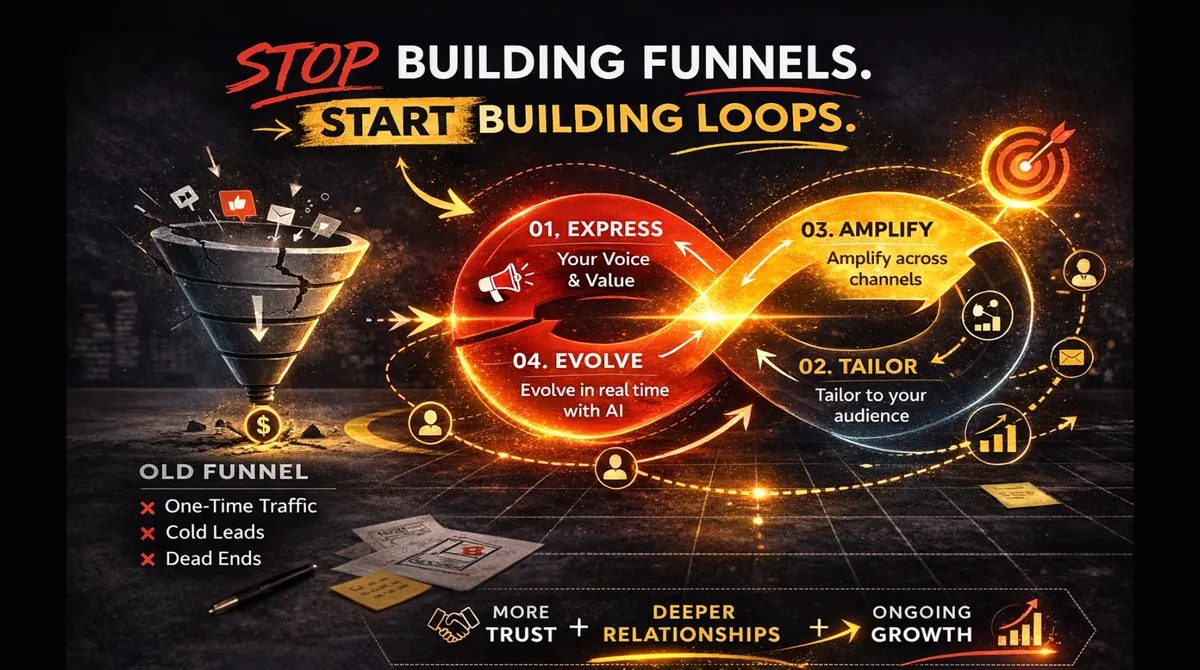
Campaign planning turns persona evidence into sequence. Express sets the point of view, Tailor matches the message to the buying job, Amplify places it where each persona discovers and validates, and Evolve feeds what you learned into the next cycle. The persona is the input at every stage, not a document you consult once at kickoff.
HubSpot introduced Loop Marketing, built on Express, Tailor, Amplify, and Evolve, at INBOUND 2025 as a replacement for the funnel and the flywheel. CCG runs client engagements on that Loop inside a 90 day structure, with GEO infrastructure built first.
| Loop stage | Planning question | Persona input | Output | Business measure |
|---|---|---|---|---|
| Express | What do you stand for, and what point of view will you be known for? | ICP, role persona beliefs and objections | Positioning, voice, message house, GEO content pillars | Can every stakeholder state the point of view in one sentence |
| Tailor | Who hears what, and in which buying job? | Buying group map, buying jobs map, prompt sets | Persona by job message matrix, content calendar, offers | Engagement quality by persona, not total clicks |
| Amplify | Where does each persona discover and validate? | Platform behavior, trusted validators, AI prompt sets | Channel plan across owned, earned, paid, and generative engines | GEO visibility on tracked prompts, qualified pipeline |
| Evolve | What did you learn, and what changes next loop? | Win and loss data, sales call patterns, citation shifts | Persona refresh, budget reallocation, next loop brief | Leads, revenue, GEO score change |
See how the Loop runs inside a 90 day engagement, and what the 90 day GEO retainer covers.
Research from Binet and Field with the LinkedIn B2B Institute points to a near even split between brand building and activation, with B2B leaning slightly toward activation. The reason is arithmetic. Most of your market is not buying this quarter, and the ones who are buying already formed their preferences earlier.
John Dawes of the Ehrenberg-Bass Institute, writing for the LinkedIn B2B Institute in 2021, modeled the share of buyers in market at any given time. His formula:
In market share per quarter = (1 / average years between purchases) / 4| Average switching cycle | In market per year | In market per quarter | Out of market per quarter |
|---|---|---|---|
| 3 years | 33 percent | about 8 percent | about 92 percent |
| 5 years (Dawes B2B example) | 20 percent | about 5 percent | about 95 percent |
| 10 years | 10 percent | about 2.5 percent | about 97.5 percent |
Source: John Dawes, Ehrenberg-Bass Institute, for the LinkedIn B2B Institute, 2021.
Dawes describes this as a mental model, not a law, and that distinction matters. Run the formula against your own contract length rather than repeating a number you read somewhere. A category with a three year cycle behaves very differently from one with a ten year cycle.
A plan built only for in market buyers competes for a small, expensive slice of the market against everyone else chasing the same slice. Campaign plans need two tracks running at the same time:
Binet and Field's work with the B2B Institute also found that brands setting share of voice above their share of market tend to grow. That is a useful sizing input when you are deciding how large the memory track should be.
Gartner's 2026 CMO Spend Survey, fielded January to March 2026 with 401 respondents skewed toward companies above 1 billion dollars in revenue, put average marketing budget at 7.8 percent of company revenue, up slightly from 7.7 percent in 2025 and roughly 18 percent below the mean four years earlier. The CMO Survey (Deloitte, Duke Fuqua and the AMA) reported 9.0 percent of revenue in Spring 2026 across a broader mix of companies. The two figures measure different populations, so read them side by side and never average them.
In the same Gartner survey, CMOs allocated 15.3 percent of marketing budgets to AI, and 56 percent said they lacked the budget to deliver their 2026 strategy. Budgets are tighter than the ambition attached to them, which argues for planning tighter rather than louder.
Judge a campaign on the clock that matches the effect you are measuring. Binet and Field's IPA Databank analysis, published as The Long and the Short of It in 2013, found brand effects overtake short term sales effects at around six months. Anything evaluated sooner than that is measuring activation, which is useful, but it is not a verdict on brand building.
| Window | What it can honestly tell you | What it cannot tell you |
|---|---|---|
| 0 to 30 days | Delivery, reach, early engagement, prompt citation baseline | Brand effect, pipeline impact |
| 31 to 90 days | Lead quality, conversion trends, GEO visibility movement on tracked prompts | Long term pricing power, full brand lift |
| 6 months and beyond (the true test) | Brand effects overtaking activation effects | Nothing. This is the true test. |
The pull toward shorter windows is real and getting stronger. Peter Field's analysis of the IPA Databank, reported by Marketing Week, found the share of campaigns evaluated over six months or less rose from about 10 percent in 2002 to 25 percent by 2018. Short termism has been building for two decades, usually because the reporting calendar, not the evidence, sets the deadline.
A 90 day loop is a learning and optimization cycle. It is not a final judgment on brand building, and CCG does not present it as one. Each loop resets at a higher baseline: clearer infrastructure, a sharper point of view, a better prompt set, a more accurate persona. Brand effects compound across loops, and the six month evidence still applies.
Saying that plainly protects you from two mistakes. The first is killing work that was on schedule. The second is claiming a brand win from a 60 day activation result.
Measure in business language. Lead quality, pipeline, revenue, and GEO visibility on tracked prompts tell you whether persona work is paying for itself. HubSpot's 2026 State of Marketing, a survey of more than 1,500 marketers, found lead quality is the top KPI at 39.4 percent, ahead of conversion rate at 33.9 percent and return on marketing investment at 31.1 percent.
| Loop stage | Primary measure | Supporting signals | What does not count |
|---|---|---|---|
| Express | Message clarity across the team and the site | Consistent entity facts on every property, sales and marketing saying the same thing | Number of brand documents produced |
| Tailor | Engagement quality by persona and buying job | Time with high intent content, assisted conversions, sales call feedback | Total pageviews |
| Amplify | Qualified pipeline and GEO visibility on tracked prompts | Citation share by engine, third party mentions, branded search volume | Impressions, follower counts |
| Evolve | Revenue and retention by persona, GEO score movement | Win rate by role, sales cycle length, persona accuracy against closed won | Reach without pipeline context |
Two measurement habits are worth building in from the start.
Track citations, not just rankings. Fewer than half of the businesses leading Google local results also appear in AI local recommendations, according to the SOCi Local Visibility Index 2026 reported via BrightLocal. A page one ranking and an engine citation are different outcomes, and you need both numbers.
Audit your own consistency. Gartner's 2024 survey found 69 percent of B2B buyers report inconsistencies between a seller's website and what reps told them. Run a quarterly check that your pricing language, service names, locations, and claims match across your website, your profiles, your proposals, and your sales conversations. Generative engines are reading all of them.
There is a confidence gap worth watching here as well. HubSpot's 2026 State of Marketing found 69.2 percent of marketers say they can effectively use customer data to create personalized experiences, while Gartner (June 2025) found 73 percent of buyers actively avoid suppliers sending irrelevant outreach. Marketer confidence and buyer experience are not moving together, and your data should tell you which side of that gap you sit on.
Refresh personas on the Loop, not the calendar. Review the prompt set monthly, refresh role personas every loop with new win and loss evidence, and rebuild the buying group map whenever the shape of the deal changes. Personas decay fastest at layer five, because prompt behavior and engine citations move every month.
A cadence that holds up:
| Layer | Refresh cadence | Trigger for an out of cycle rebuild |
|---|---|---|
| 1. Ideal customer profile | Annually | A new vertical, a pricing change, or a shift in retention patterns |
| 2. Buying group map | Every two loops, or roughly every six months | Procurement enters earlier, or deal size moves a band |
| 3. Role personas | Every loop, with fresh interviews | Win rate drops in one role, or objections change |
| 4. Buying jobs map | Every loop | Sales reports buyers arriving at a different stage than before |
| 5. Prompt set (decays fastest) | Monthly | An engine update, a competitor appearing in citations, or a citation drop |
Two signals should pull a persona forward regardless of the calendar: a change in the language buyers use on sales calls, and a change in which sources generative engines cite when your prompt set runs. Both mean the map no longer matches the territory.
Personas built for a journey you controlled will not hold up in a market where the shortlist forms before the first call and the first answer comes from an engine. The fix is orderly: map the whole room, name the job each person is finishing, capture the language they use, and build the infrastructure that lets an engine cite you when they ask.
Strategy & Leadership6 min read
Demographics describe who someone is, not what they'll ask AI. Learn why niche audience research beats standard personas for real AI engine citations.
Strategy & Leadership5 min read
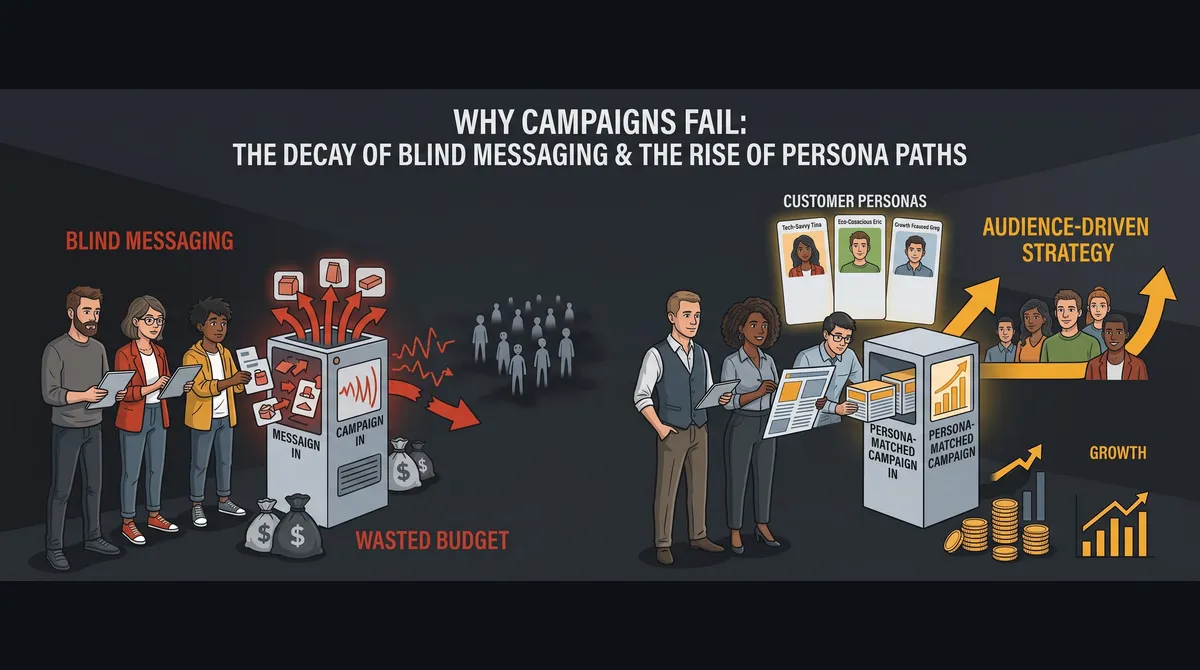
Marketing persona development is the most common reason campaigns fail. Learn what a real persona includes, what skipping it costs, and how to fix it.
Strategy & Leadership7 min read
The funnel did not become wrong, it became incomplete. How Loop Marketing works, the play for each of its four stages, and where to start.
Start with a free GEO Snapshot: your score across six dimensions, three AI engines and three named competitors, emailed within 1 business day.
Nobody can honestly promise an AI placement or a timeline.
What we do promise: your Day 90 GEO Score is measured against your Day 1 baseline, and reported in leads and revenue.