

AI Visibility & GEO11 min read
What Is Generative Engine Optimization? GEO Explained
Generative Engine Optimization is how brands get cited inside AI answers. What GEO is, how it differs from SEO, and what it changes about your content.
Your rankings held. Your traffic did not. Buyers now ask a question and read one answer that names a few companies. GEO is how you become one of them.
What it is
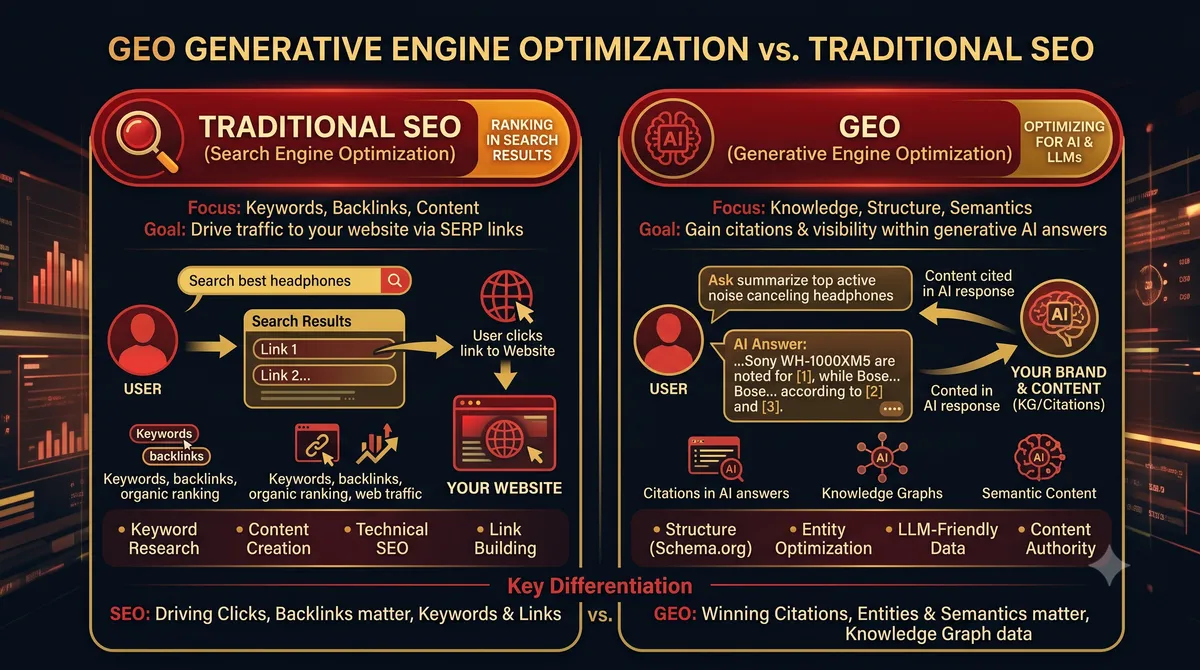
SEO earns a ranking. GEO earns a citation.
Because ranking and being cited are two different outcomes, chosen by two different systems. Traditional search returns a list of links and lets the buyer choose. A generative engine returns one answer and names a few companies. A site can hold its rankings and still be absent from every answer in its category, and nothing shows up in your analytics, because there was never a click to lose.
The gap closes with infrastructure, not more content alone. Publishing more articles into a site that engines cannot parse, verify or trust returns nothing. Order of operations matters more than volume: foundation first, then authority, then distribution.
Every engagement opens with a GEO Score, a single figure from 0 to 100 built from six measured dimensions. It is the baseline everything after it is measured against, and the visibility part is tested live across AI engines rather than estimated. A person at CCG reviews every audit and ranks the fixes by impact.
| Dimension | The question it answers | What a low score means for you |
|---|---|---|
| Entity Clarity | Does AI know who you are and describe you accurately? | Engines are unsure who you are, what you sell or where you work, so they name a competitor they are sure about. |
| Content Authority | Does your site answer the questions your buyers ask? | Your pages read as marketing rather than as a source. Engines cite sources. |
| Structured Data | Is your site labelled so machines can read it? | Your best information is trapped in long paragraphs and images that machines cannot lift a clean answer out of. |
| Citation Worthiness | Do trusted sources point AI back to you? | Your claims are general and nobody else confirms them. Engines quote specifics and corroborated positions. |
| GEO Visibility Test | When buyers ask AI, are you named, and how often compared with your competitors? | You are absent from the answers your buyers are reading today. |
| Technical Foundation | Can AI crawlers reach and read your pages? | A single server setting can block every AI crawler at once. Until that clears, nothing else can work. |
The score is not a report. It is the build order.
Below 40 = Critical · 40–59 = Weak · 60–79 = Moderate · 80–100 = Strong. Below 40, Technical Foundation and Entity Clarity get built first. From 40 to 79, the work moves to Content Authority and Citation Worthiness. At 80 and above, it shifts to distribution and defending your position. A low first score is not a verdict on the business; it reflects a site built for a system that picked links, not one that picks sources.
Foundation is infrastructure first. Nothing else in the plan can be proven, or can work, until these five pieces hold.
Authority puts citation-worthy content on that foundation. Engines can only cite pages that exist, and every page maps back to a gap the audit found.
Amplify builds the sources engines read about you, then re-tests to prove what moved. What an engine says about you is assembled mostly from sites you do not control, so off-site presence is not a bonus; it is most of the input.
AEO is the page-level half of the same job: shaping each page so an AI tool can lift a clean answer from it and credit you. GEO decides which questions you need to own and builds the entity, authority and citations behind you. AEO makes sure the page that answers each question is easy to quote.
In practice that means three habits on every page CCG builds: answer the question in the first sentence, use question-led headings with short paragraphs and lists, and mark the page up with FAQ and Organization structured data. AEO is part of every GEO engagement here, not a separate line item.
| Topic | Traditional search | Generative engines |
|---|---|---|
| What the buyer receives | A list of links to choose from | One answer naming a few companies |
| What wins | Ranking position | Being quoted as a source |
| What it rewards | Relevance and links | Extractable answers, specifics and off-site corroboration |
| Where you see the loss | Traffic reports | Nowhere. There was no click to lose |
| How often it refreshes | Continuously and visibly | On its own cycle, out of sight |
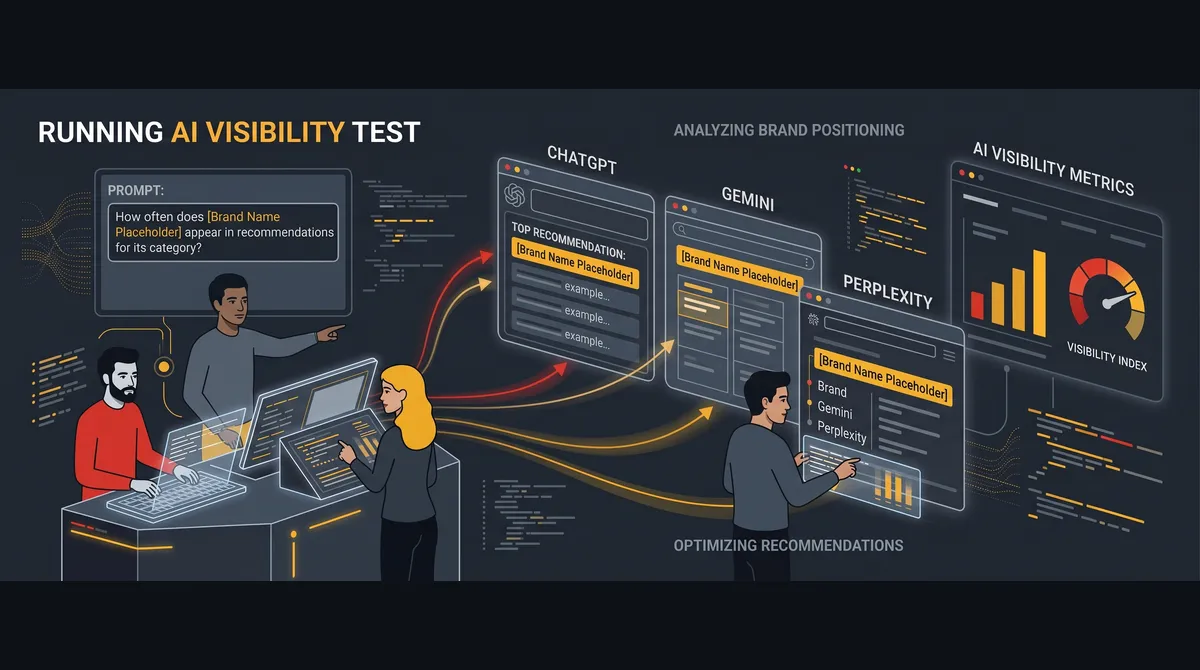
Open ChatGPT, Claude, Gemini and Perplexity. Run each prompt against your own category and city, and watch which companies get named, in what order, and which source each engine pulled from. It is the same test that opens every CCG audit.
Whatever came back was one run, on one day, on engines that update on different cycles. Many brands find at least one engine that does not know they exist. That result is a starting line, not a verdict. A scored baseline is the version of this test that holds up.
Every engagement starts with the audit: a scored baseline across six dimensions, emailed within 1 business day, with no call required.
68%
of US Google searches ended without a click in early 2026
[1]SparkToro, 2026 zero-click study (Similarweb clickstream data, US, Jan–Apr 2026)
1.2%
of more than 350,000 locations across 2,751 multi-location brands were recommended by ChatGPT
[2]SOCi, Local Visibility Index, 2026
4.4×
conversion rate for AI search visitors compared with standard organic search traffic
[3]Semrush, June 9, 2025
Rock Valley Christian Church · Murrieta, CA
6%→27%
website conversion rate
…we went from being completely unknown to being the top organic Google search for our keywords in our area.”
SourcePlatform native analytics and HubSpot, over a three-year partnership.
AI Visibility & GEO11 min read
Generative Engine Optimization is how brands get cited inside AI answers. What GEO is, how it differs from SEO, and what it changes about your content.
AI Visibility & GEO7 min read
You do not need a platform to find out you are invisible. Four engines, one prompt set, a spreadsheet, and thirty minutes. Here is the method.
Search & SEO5 min read
GEO and SEO overlap, but they measure different things. Here's the honest breakdown of where they diverge, and the data that proves it.
Answer engine optimization (AEO) is the work of shaping your pages so AI tools can lift a clean, direct answer from them and credit you as the source. It covers answer-first writing, question-led headings, FAQ sections and structured data. At CCG, AEO is part of every GEO engagement rather than a separate service.
SEO earns a ranking on a results page; GEO earns a citation inside an answer. The measurement differs too: you track where your brand is named and quoted, not where you sit in a list of links. GEO builds on SEO fundamentals rather than replacing them.
Three things have to be true at once. The engine must be able to reach and read your site. Your pages must answer the specific question in a form it can quote. And credible third-party sources must back up what you say about yourself. Miss one and the answer gets built from a competitor who did all three.
The work runs in a fixed order: foundation first, then authority, then distribution and measurement. Early weeks clear crawler access, entity clarity and structured data. Then come pages built for your buyers' questions, then off-site citations. Your Day 90 GEO Score is measured against your Day 1 baseline. Nobody can honestly promise an AI placement or a timeline.
GEO work is priced after your audit, because the size of the gap decides the scope. You start with the Free GEO Snapshot. The Full AI Visibility Report and 90-Day Plan is $497, credited in full toward your engagement. The 90-Day GEO Engagement is then priced on the gap and the number of channels involved.
No, that is normal. AI engines re-read sites on their own schedule, and new pages take time to settle before they show up in answers. The first weeks of GEO work are measurement and technical clearance, so the Day 90 re-test against your Day 1 baseline is the comparison that counts.
Early citations are unstable until your authority is established, so this is expected. One answer from one run proves very little either way. The trend across repeated re-tests, using the same prompts on the same engines, is what tells you whether the work is moving.
Usually not; it is an entity clarity problem, and it is fixable. Engines piece together who you are from your site, your business profiles and directories. When those sources describe you differently, the engine guesses. Making your name, description and services match everywhere is the fix.
Each AI engine pulls from different sources and updates on a different cycle, so uneven progress is the norm, not a warning sign. That is why the GEO Score tests several engines rather than one, and why CCG reports each engine separately.
Not necessarily; if they started earlier, they are ahead for now. Position in AI answers is contested all the time rather than awarded once. The citation gap in your report shows exactly which questions they win and which sources the engines use, which is where the work aims next.
Start with a free GEO Snapshot: your score across six dimensions, three AI engines and three named competitors, emailed within 1 business day.
Nobody can honestly promise an AI placement or a timeline.
What we do promise: your Day 90 GEO Score is measured against your Day 1 baseline, and reported in leads and revenue.