
Advertising & Paid Social5 min read
How Many Ad Creatives Do You Need in 2026?
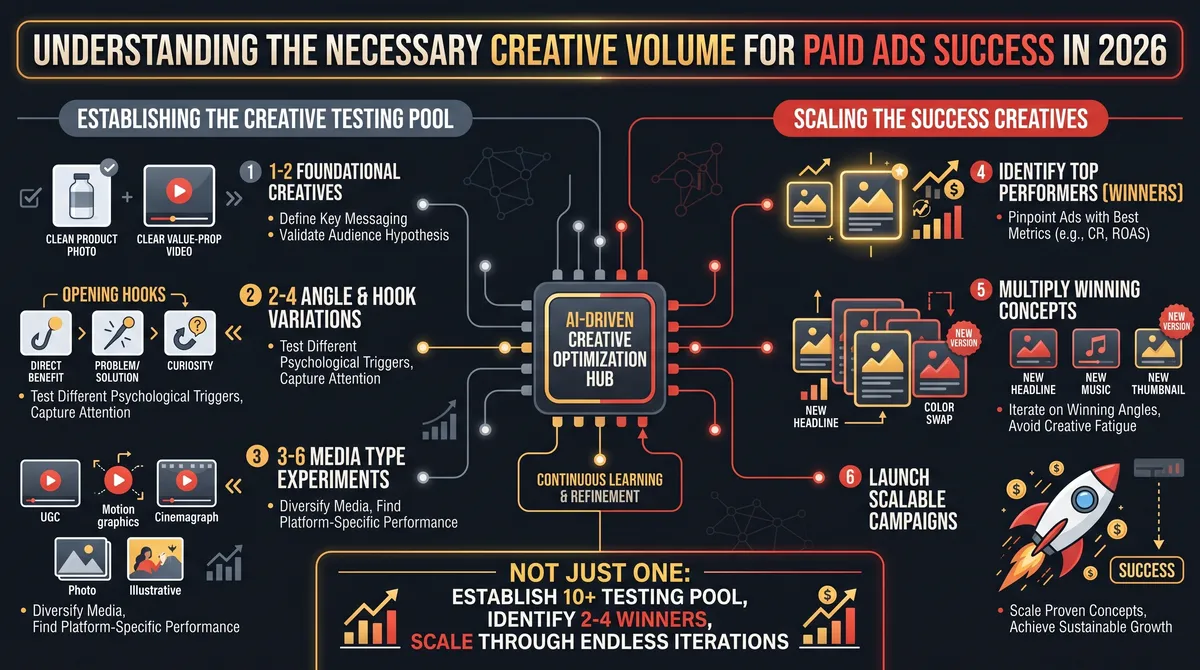
Motion's 2026 benchmarks show how many new ads winning Meta accounts test each week at every spend level. Here is your number.
Updated ·21 min read ·By Izzy Gregorio
In short
The rest of this page is the proof, the numbers, and the part where you find out where you sit.
| Figure | What it measures | Source |
|---|---|---|
| 49% | Share of incremental sales driven by creative. Targeting drives 11%. | NCSolutions, Five Keys to Advertising Effectiveness, 2023 update, nearly 450 campaigns |
| ~5% | Share of ad creatives that become winners on Meta | Motion 2026 Creative Benchmarks, 578,750 creatives |
| 55% | Share of all ad spend that lands on those winners | Motion 2026 Creative Benchmarks |
| 6.6 | Distinct creatives tested weekly by accounts spending 50K to 200K USD per month | Motion 2026 Creative Benchmarks |
| $27.66 | Average cost per lead on Facebook lead campaigns, up 21% year over year | WordStream / LocaliQ, Sept 2025, 1,180 US campaigns |
In Motion’s 2026 benchmarks, about 5 in 100 ads win, and those 5 absorb more than half the money.
Two of those numbers sit next to each other and tell the whole story. The businesses that grow on social in 2026 are not the ones with the best single ad. They are the ones with a production engine that ships enough genuinely different ideas to find the 5.
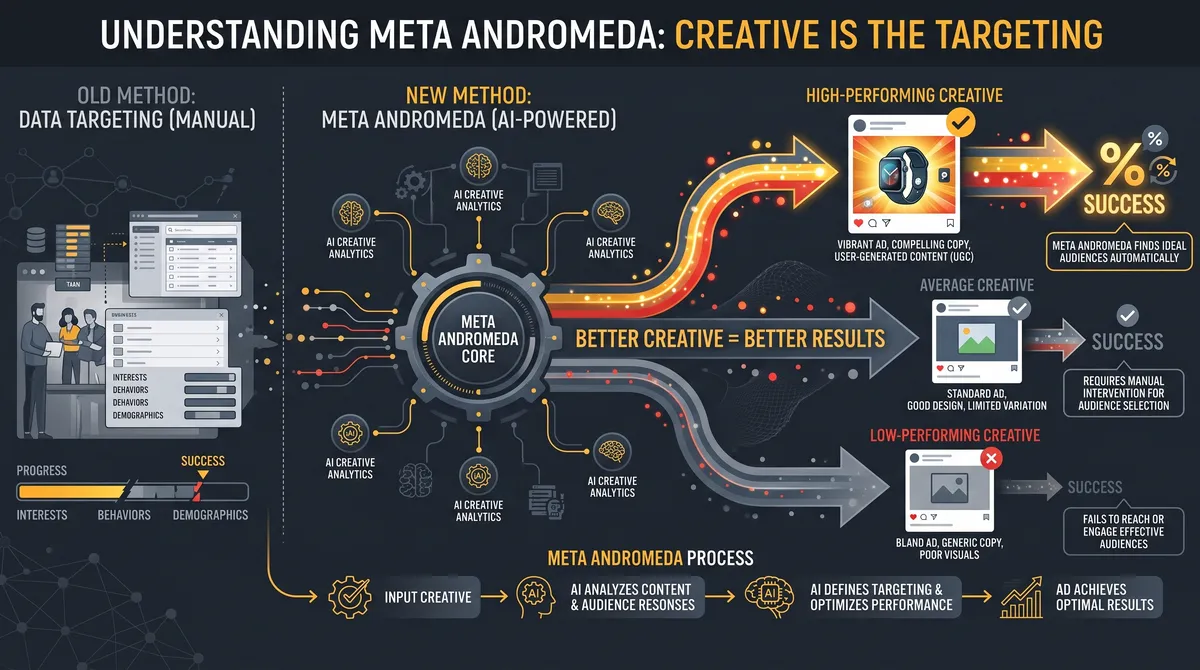
Meta’s Andromeda retrieval system evaluates the creative itself to predict who will respond, which replaced interest targeting and lookalikes as the primary routing mechanism. TikTok’s Smart+ did the same thing through a single automated buying flow, announced on the TikTok Newsroom in October 2025. LinkedIn moved the same direction with AI bidding and Predictive Audiences.
Here is what that means in practice. You used to compete on who you could find. Now you compete on what you make, because the system finds people by reading what you made. An ad is no longer a message pointed at an audience. The ad is the audience selection.
Marketers have been slow to accept this because the research says the opposite of what the industry believed. NCSolutions studied nearly 450 campaigns in its 2023 update and found creative responsible for 49% of incremental sales while targeting accounted for 11%. Marketers surveyed separately by Advertiser Perceptions believed targeting was the biggest driver. That study is CPG data rather than social specific, and it is worth naming that caveat, but it is the most rigorous public quantification available and it now matches how the ad systems themselves behave.
| Driver | Share of incremental sales |
|---|---|
| Creative | 49% |
| Reach | 22% |
| Brand | 21% |
| Targeting | 11% |
| Recency | 5% |
Source: NCSolutions, Five Keys to Advertising Effectiveness, 2023 update. CPG campaigns across digital and TV.
| Platform | What changed | What it costs you if you ignore it |
|---|---|---|
| Meta | Andromeda reads creative to route audiences. Advantage+ became the default for Sales, Leads, and App campaigns, and manual and Advantage+ creation merged into one flow by early 2026. | Fragmented ad sets split your learning signal and bid against each other. |
| TikTok | Smart+ consolidated buying into one flow with module level control. Symphony generates and enhances creative variants inside the platform. | Variant production is close to free now. Paying an agency for editing hours is paying for the part that got commoditized. |
| Thought Leader Ads, sponsored from a real person’s account, and Document Ads became the formats that work. AI bidding manages the majority of spend. | Manual bidding accounts are losing the auction arithmetic. Brand account creative is losing to founder creative. |
Meta and LinkedIn operating details are drawn from convergent vendor and practitioner reporting through 2026 and should be treated as directionally reliable rather than as published platform specifications. TikTok Smart+ and Symphony details are from TikTok’s own October 2025 newsroom post.
Meta has stated a goal of end to end automated ad creation, where you supply a product URL and a budget and the system builds the creative, the audience, and the spend plan. The Wall Street Journal reported that ambition in June 2025. Marketing Brew reported in April 2026 that buyers see full automation as further off and reviews of the early tools as mixed.
Both things are true and neither one saves an agency that sells button pushing. If your media partner’s value is campaign setup and daily bid babysitting, that value is on a clock.
What does not automate is knowing which ideas are worth making.
Most pages about social advertising explain the topic. This section is built so you can locate your own account in it. Bring your last 90 days of numbers.
Motion analyzed 1.29 billion USD of realized Meta spend across 578,750 creatives and 6,015 accounts between September 2025 and January 2026. Volume, not per ad brilliance, is what separates the tiers.
| Your monthly Meta spend | Creatives the tier tests per week | Average hit rate |
|---|---|---|
| Under $10K | 2.8 | 4.0% |
| $10K to $50K | 4.1 | 6.4% |
| $50K to $200K | 6.6 | 8.1% |
| $200K to $1M | 11.2 | 8.6% |
| $1M and up | 18.8 | 8.8% |
Source: Motion 2026 Creative Benchmarks. Window includes Black Friday and Cyber Monday, so promotional formats are over represented.
Read the table carefully and the punchline appears. In Motion’s 2026 data, enterprise accounts test roughly 6.7 times the weekly volume of the smallest accounts and their hit rate only about doubles. They are not better at making ads. They are better at making more chances. Inside every tier, the top quartile tests about 2.4 times their tier average.
Your score: count the conceptually distinct ads you launched last week. Not variations. Distinct. If you spend 10K to 50K per month and the answer was 1, the table says your peers ran 4 and your best peers ran closer to 10.
Cost per lead is not one number. It is three numbers wearing a trench coat. The standard industry math breaks it apart.
CPL = CPM / (1000 × CTR × CVR)
Three inputs. Three different fixes. Not interchangeable.
| Input | What fixes it | What does not fix it |
|---|---|---|
| CPM too high | Broader targeting, consolidated campaigns, creative the system wants to serve | Bid tinkering |
| CTR too low | Hooks, first frames, offer clarity | More budget |
| Conversion rate too low | Message match between ad and page, page speed, form length | Better ads |
Benchmarks to measure yourself against, split by business model, because a lead gen brand and an ecommerce brand read these numbers differently.
If you sell leads: home services, healthcare, real estate, professional services
| Metric | Benchmark | Confidence |
|---|---|---|
| Facebook lead campaign CTR | 2.59% | Verified |
| Facebook lead campaign CPC | $1.92 | Verified |
| Facebook cost per lead | $27.66, up 21% year over year | Verified |
| Lead conversion rate | 7.72% | Verified |
| Google Ads search CPL, same dataset | $70.11 | Verified |
If you sell products: ecommerce and direct to consumer
| Metric | Benchmark | Confidence |
|---|---|---|
| Facebook traffic campaign CTR | 1.71%, up from 1.57% | Verified |
| Facebook traffic campaign CPC | $0.70, down 6.7% | Verified |
| Shopping and gifts CPC | about $0.34 | Verified |
Source: WordStream / LocaliQ Facebook Ads Benchmarks, published September 15, 2025, covering 1,180 US campaigns from April 2024 to June 2025. The industry spread is wide and it matters: finance and insurance pay about $1.22 per traffic click at the lowest CTR in the dataset, 0.98%, while dentists pay about $9.78 per click on lead campaigns. Benchmark against your vertical and your spend tier, never a blended average.
Meta’s system treats near duplicates as one entity. Five ads with the same idea and a different headline is one ad with extra steps, which is the single most common and most expensive mistake in a mid sized account.
Motion’s hit rate leaderboards for the 2026 window:
| Dimension | Highest hit rate | Highest spend capture | How to read it |
|---|---|---|---|
| Visual format | Unboxing 9.8%, Offer First Banner 8.6%, Demo 8.1%, Testimonial 6.5% | Celebrity 2.1x, Letter, Unconventional Text Placement, Post It, Offer First Banner, Unboxing | Offer First Banner and Unboxing appear on both lists. Safest bets. Demo, Testimonial, and Headline are the workhorses. |
| Hook tactic | Newness, Sale Announcement, Price Anchor, Urgency, Announcement, Offer Only, FOMO, then Confession, Exclusivity, Curiosity | Giveaway, Price Anchor, Announcement, Event Announcement, Offer Only, Confession | Two clusters. Promotional hooks answer “why now” and belong at the bottom of the funnel. Pattern interrupt hooks like Confession and Myth Busting belong on cold traffic and carry higher variance. |
| Asset type | Text only, product image with text, lifestyle product image, UGC. High production sits mid pack. Animation and carousel at the bottom. | Text only, product image with text, illustration, UGC | Text forward and UGC win on iteration speed. High production is a scaling layer for proven ideas, not a discovery layer. |
Source: Motion 2026 Creative Benchmarks. Top formats diverge sharply across the 16 verticals measured, so treat this as a starting portfolio rather than a universal answer.
Your score: tag your last 20 ads by format, hook tactic, and asset type. Count the unique combinations. Under 5 and you are not testing, you are repeating.
Enough to test at the volume your tier requires, which is a creative capacity question before it is a budget question. A 15K per month Meta budget spread across 2 new creatives per week is worse than the same budget across 4, because the account never generates enough learning to find a winner.
Start from the math instead of a percentage of revenue. If your target cost per lead is $50 and you need 40 leads per month, you need $2,000 in productive spend plus a testing allowance on top for concepts that have not proven out yet. Then check the volume table above and ask whether your production capacity can actually fill that testing allowance with distinct ideas. If it cannot, the budget is not your constraint.
Use the split tables under “Where is your cost leaking?” above. The short version: 1.71% CTR and $0.70 CPC on traffic campaigns, 2.59% CTR and $1.92 CPC on lead campaigns, and $27.66 average cost per lead, per WordStream’s September 2025 dataset of 1,180 US campaigns.
One number deserves emphasis because it changes the conversation with any business considering search instead. Facebook’s average CPL in WordStream’s 2025 dataset is under half of Google Ads search CPL of $70.11. Cheaper leads, colder intent. Those two facts always travel together, and the follow up system you build is what decides which one wins for you.
Enough conceptually distinct concepts per campaign that the system has real choices to route, with a few executions of each. There is no published Meta specification for the number, so build to the volume your spend tier tests in the Motion table above.
Distinct is the load bearing word. Different problem, different proof, or different format counts. A new headline on the same idea does not, because the system reads the creative and recognizes it as the same entity.
Automation on, structure consolidated, creative diverse. Advantage+ is now the default for Sales, Leads, and App objectives on Meta, and TikTok’s Smart+ offers full, partial, or manual automation inside one flow.
The instinct to keep manual control usually shows up as many ad sets, which is exactly the thing that hurts you now. Multiple ad sets chasing the same objective split your learning signal and put your own ads into the auction against each other. One campaign per objective, broad targeting, and let the difference between your ads be the creative rather than the audience definition.
It works less every quarter, and it is no longer where the outcome is decided. Andromeda routes on creative signals, which means a well built ad reaches the right people whether or not you drew a box around them first.
Broad plus strong creative now beats narrow plus average creative in most accounts. The exception is genuine business constraints such as geography, licensure, or age gating, which still belong in the setup.
Four causes account for most of it, and they are diagnosable in order. Creative fatigue arrives faster under Andromeda than advertisers were used to. Fragmented campaign structure is splitting your signal. Conversion signal quality has degraded if you are still running a pixel only setup. And the auction itself got more expensive as ad loads rose against flat attention.
That last one is structural, not personal. More money is chasing the same attention. Efficiency has to come from creative and measurement, because it is not coming from the auction.
| If you are | Lead with | Because |
|---|---|---|
| Home services, healthcare, med spa, real estate | Meta | Lowest cost per lead of the major platforms and the strongest local targeting infrastructure |
| Ecommerce and DTC | Meta first, TikTok second | Meta family of apps is projected at 100.86 billion USD in US net digital ad revenue in 2026, ahead of Google on a net basis for the first time. TikTok is roughly a fifth of Meta’s scale but cheaper to test on. |
| B2B, industrial, logistics | LinkedIn, with Meta for retargeting | Higher cost per lead, offset by title and firmographic precision that Meta cannot match |
| Faith based and nonprofit | Meta, organic first | Community distribution does work the platforms will otherwise charge you for |
Source for platform revenue figures: eMarketer, 2026 forecasts.
Andromeda is Meta’s AI retrieval system, and it selects which ads to show by evaluating the creative itself against a user’s predicted response. It replaced targeting as the primary routing mechanism, which is why targeting controls feel less consequential than they used to.
Practically, four things change. Consolidate structure. Ship distinct concepts, not variations. Plan refreshes on a schedule. And move your reporting to the creative level, because campaign totals now hide the only signal that matters.
One caveat worth knowing if you run a catalog. Confect studied ecommerce advertisers during the rollout and found advertisers with large catalogs held their return, while accounts with small catalogs saw return decline. Catalog field enrichment stopped moving the needle. Design variants per product set are the compensation.
It stops the scroll, filters for the right person, and earns the next five seconds. Everything else is decoration on top of those three jobs.
Practically that means a hook in the first frame that works with the sound off, a specific claim rather than a category claim, visible proof, and one clear next step. Authenticity is the 2026 currency across every source reviewed, which is a polite way of saying that ads that look like ads are getting skipped by an audience that has developed antibodies.
A creative strategist decides which ads to make. That is a different job from the person who makes them, and it is now the higher value seat.
TikTok’s Symphony made variant production close to free. Meta is building toward URL plus budget campaign generation. What neither system does is mine your reviews for the sentence a customer actually used, recognize that it is a better angle than anything in your brand guide, and build a portfolio around it. If your team has nobody doing that, more production capacity will make you worse faster.
All three, in sequence, for different jobs. Text forward and UGC are your discovery layer because they are fast and cheap to iterate. Lifestyle and hybrid content sustains the middle. High production is a scaling layer for concepts that already proved themselves.
Founder video deserves its own line. On LinkedIn, Thought Leader Ads sponsored from a real person’s account report a higher click through rate than brand sponsored content in vendor reporting. That is not a single audited study, but the direction is consistent across every source reviewed.
Your face outperforms your logo.
Two families, and the mistake is picking only from one. Promotional hooks such as price anchor, urgency, announcement, and offer only capture the most spend and belong on warm traffic. Pattern interrupt hooks such as confession, contrarian, warning, and myth busting are higher variance and are what break through on cold audiences.
Five tactics repeat across the highest spending accounts.
| Hook tactic | The mechanism | Example shape |
|---|---|---|
| Confession | Vulnerability builds credibility fast, including admitting a real drawback | “We were wrong about...” |
| Bold claim | Provokes a “prove it” reaction, then immediately proves it | “This replaces three tools” |
| Relatability | Names a specific lived moment so the viewer thinks “that is literally me” | “When your jeans do not fit the same way they did last month” |
| Contrast | Before and after, us and them, old way and new way, usually split screen | Side by side proof |
| Curiosity | Opens a loop the brain has to close, while still showing enough to filter the audience | “The part nobody tells you about...” |
Keep hooks under 8 words and build them from your customers’ verbatim language, not your own.
On a schedule, planned rather than reactive. Fatigue arrives faster under Andromeda than advertisers were used to, and by the time performance visibly drops you have already paid for the decline.
Build the refresh into your production calendar as a standing commitment tied to your spend tier’s volume number. Reacting to fatigue is always more expensive than scheduling around it.
It performs where it is used for variants and it underperforms where it is used for strategy, and the practitioners using it most heavily agree. Motion surveyed more than 380 marketers in November 2025 and found adoption clustered upstream: 82% use AI in ideation, 76% in research, 61% in briefing, only 25% in evaluation and 7% at launch.
Satisfaction follows the same curve in the same Motion survey. Brainstorming scored 7.7 out of 10, research agents 6.8, video generation 5.2, and production overall 4.2. The teams winning with AI did not adopt a tool. They built a system, with defined roles, structured inputs, stored prompt libraries, and human judgment at the angle stage. Over half are training existing staff and only 6% hired AI specialists.
On the question of whether people notice: TikTok applies AI labeling, invisible watermarking, and content credentials to Symphony output by default. Assume disclosure is coming everywhere and make work you would be comfortable labeling.
Creative testing is running enough conceptually different ideas that the platform can find the ones that work, then reading results at the idea level rather than the campaign level. It is not A/B testing button colors.
The loop: mine customer language, cluster it into angles, build a portfolio of distinct concepts with a few executions each, launch into a consolidated structure, tag every ad by format, hook, and asset type, then measure hit rate and spend concentration alongside cost per acquisition. Feed what won into a living document of learned concepts so the next cycle starts smarter than the last.
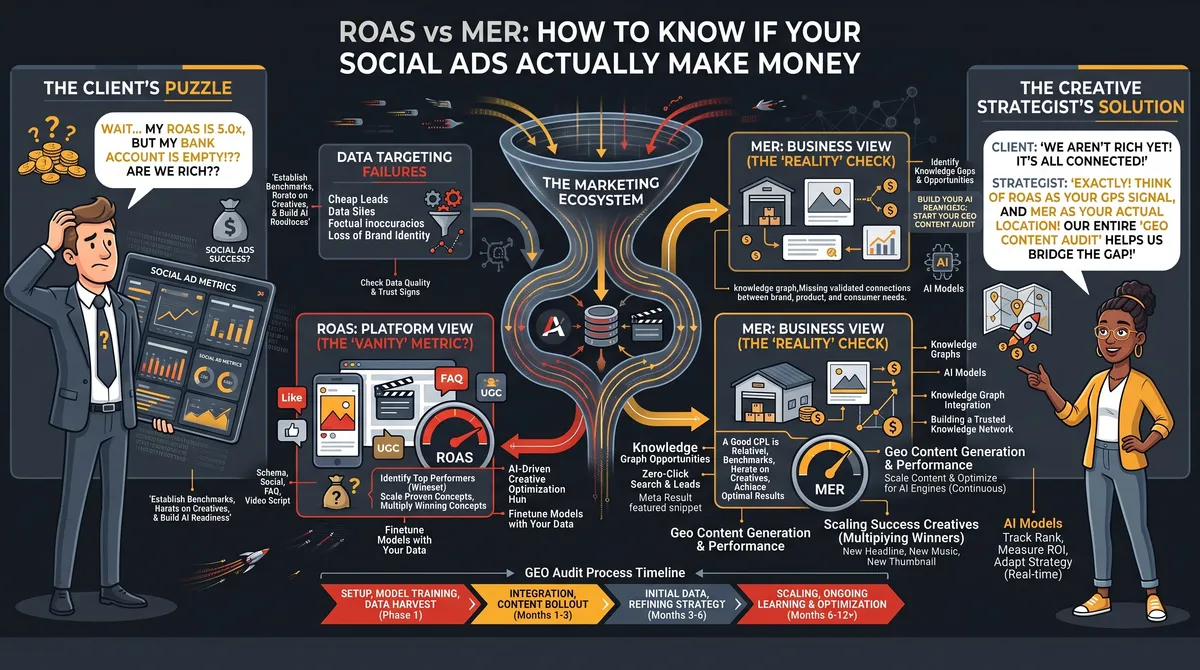
Pick one primary number, usually cost per acquisition or blended marketing efficiency ratio, and use everything else to explain it. Platform reported return is measured by the party selling you the ads and independent tests routinely find it optimistic.
| What you are asking | The metric that answers it |
|---|---|
| Did the platform give this ad a chance? | Spend and impressions |
| Can we capture attention? | Thumbstop rate, 3 second views divided by impressions |
| Can we keep it? | Hold rate, through plays divided by 3 second views |
| Can we convert attention to interest? | Outbound click through rate |
| Is this profitable and scalable? | Cost per acquisition and blended efficiency |
A weak hold rate next to a strong hook rate usually means the ad body does not deliver on the promise the first frame made.
Yes, running alongside the pixel rather than instead of it, and treat event match quality as a health metric you check rather than a setting you configure once. Browser side tracking alone degrades further with each operating system privacy release.
The reason this matters more than it used to is direct. The system that now picks your audience learns from the conversion signal you send back. Weak signal, weaker targeting, higher costs. The fix is infrastructure and it is a one time build with a permanent return.
It ends when the ad set accumulates enough conversion events for the system to predict reliably, which for most accounts means concentrating budget rather than spreading it. Fragmenting into many small ad sets is the most common reason accounts never exit.
Consolidate to one campaign per objective, keep budgets meaningful per ad set, avoid editing live ad sets mid learning, and make sure your conversion event fires often enough to teach the system something. If your true conversion is rare, optimize toward a reliable upstream event and measure the rare one separately.
Three usual causes. The offer is too easy to say yes to, the creative promised something the product does not deliver, or you are optimizing toward a form fill the system can find cheaply among people who fill out forms.
Fixes in order of impact: add qualifying friction to the form, name the price or the commitment in the ad so unqualified people self select out, optimize toward a deeper event such as a booked call, and feed qualified lead status back to the platform so the system learns what a good lead looks like. Lead quality is a signal problem far more often than it is a targeting problem.
Use the automated tools for production, and hire for judgment. Symphony and Advantage+ handle resizing, localization, variant generation, and enhancement well, and paying a human hourly rate for that work in 2026 is paying for the part that got commoditized.
What is worth paying for is the work that decides what gets produced: customer research that yields real language, a concept portfolio built to a volume target, signal infrastructure that keeps the system learning, and independent measurement that tells you the truth rather than the platform’s version of it.
Ask any prospective partner to show you their creative level reporting. If they can only show you campaign totals, they are not doing this job.
Plain text, no formatting to strip, built to paste into ChatGPT or Claude. Take them.
The gap closes with infrastructure, not more content alone.
That sentence is the whole basis of how CCG works. Before any ad gets made, you need clarity on what you stand for and the exact language your customers use, a concept portfolio built to your spend tier’s volume requirement, a conversion signal clean enough for the system to learn from, and measurement at the level where you actually make decisions. Those four things are the Loop: Express, Tailor, Amplify, Evolve.
Paid social sits inside that engine rather than beside it. The same customer language that builds your ad angles builds the content that gets you cited when someone asks an AI engine for a recommendation in your category. Same research, two channels, one system.
Advertising & Paid Social5 min read
Motion's 2026 benchmarks show how many new ads winning Meta accounts test each week at every spend level. Here is your number.
Advertising & Paid Social4 min read
Meta's Andromeda system reads your ad to decide who sees it. What changed, what you still control, and how to build ads for it.
Advertising & Paid Social5 min read
Platform ROAS often looks better than reality. The difference between ROAS and MER, and how to report social ads in business language.
Start with a free GEO Snapshot: your score across six dimensions, three AI engines and three named competitors, emailed within 1 business day.
Nobody can honestly promise an AI placement or a timeline.
What we do promise: your Day 90 GEO Score is measured against your Day 1 baseline, and reported in leads and revenue.