Why Demographic Personas Don’t Work for AI Search
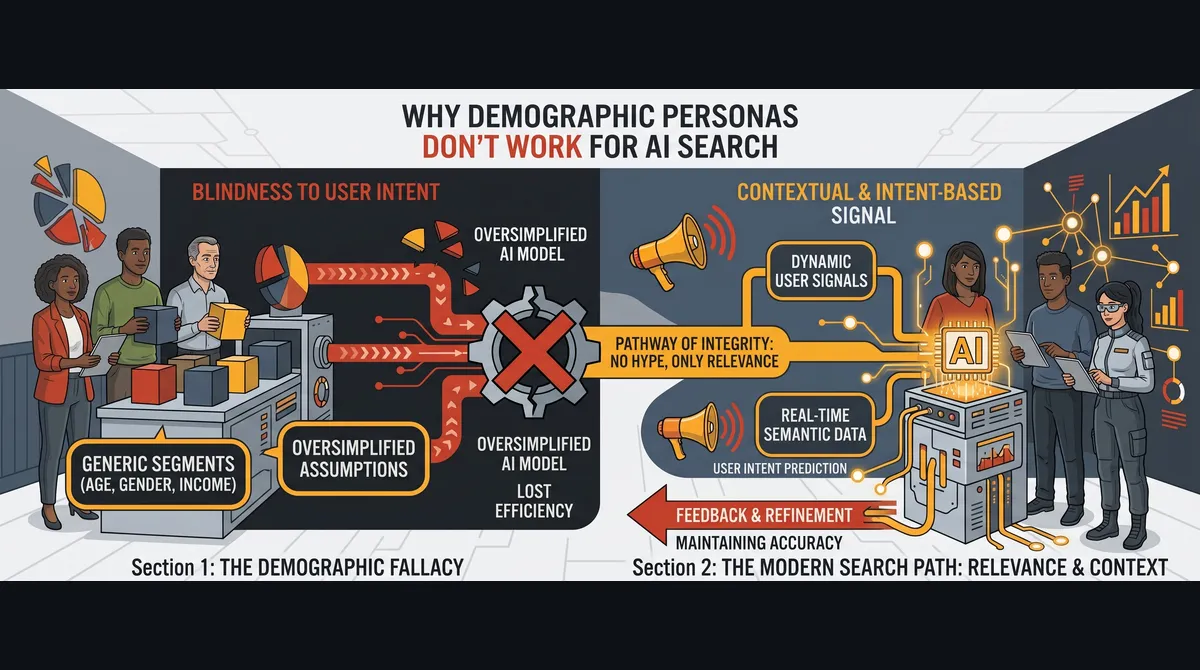
Age range. Income bracket. Zip code. That profile describes a market. It does not describe a community, and community is the unit AI engines actually understand.

6 min read
In short
A model does not reach for a demographic table
Ask a generative engine a question and it reaches for conversation. Forum threads. Community discussions. Publications your people actually trust. The specific phrasing real members of your community use when nobody is selling to them yet.
If your brand is not embedded in those conversations, and they are conversations these systems have already absorbed, you will not be cited. The precision of your demographic research makes no difference to that outcome.
Demographics describe who someone is. Citation depends on what they are saying, in the actual language they use to say it.
The same audience, described two ways
Only one of these tells you what to write. Read the right-hand column and notice that every entry is something you could turn into a page this week.
| The demographic profile | The community picture | |
|---|---|---|
| What it captures | Age, income, location, job title, household composition. | Shared conviction, shared concern, and the vocabulary that marks somebody as an insider. |
| Where it comes from | Surveys, census data, industry reports. Studied from the outside. | Threads, groups, and forums where people talk to each other rather than to a researcher. |
| What it yields | A profile card. Accurate, and largely unusable by a writer on a Tuesday. | Actual sentences people type, which map directly onto pages you can build. |
| Relationship to AI | Almost none. A model was not trained on your survey. | Direct. These are precisely the conversations the models learned from. |
Neither column is wrong. The left one is useful for media buying and budget allocation. It is simply not the input that determines whether an AI names you, and most research budgets are spent entirely on the left.
The tighter the community, the wider the gap
Consider a Sabbath-keeping, feast-keeping congregation. They do not search the way the broader Christian market searches. Their questions, their terminology, and their pre-visit concerns come from a distinct doctrinal identity, and that identity carries its own vocabulary.
A standard keyword tool will show most of that vocabulary with almost no volume, because the community is small enough that conventional search data cannot resolve it. Low volume and high intent look identical to a keyword tool. They are opposites in practice.
The same holds whatever your niche actually is. A specialty B2B category. A regional professional community. A values-driven customer base. The keyword report treats them as a subset of a larger market, which is exactly what they are not.
AI treats them as their own conversation with their own language, which is a considerably more accurate model of how those communities behave. That is a genuine advantage for anyone serving a specific group, and it is invisible to the tools most teams rely on.
Outside-in research skips the thing the models were trained on
Most research studies the market from the outside. Surveys, census data, industry reports. All useful, and none of it capturing how your specific community actually talks about their problem before they ever talk to you.
That gap matters far more now than it did five years ago, for one specific reason. These models were trained on exactly the conversations that outside-in research skips. The forum thread. The group discussion. The post asking a question nobody had answered well yet.
So the research method that produces a clean, defensible profile is the one least likely to tell you what a model will do with a question about your category.
Five things to map that demographics never touch
This is what real niche audience intelligence produces. Note that every row has a place you can actually go to find it.
| What to map | What you are looking for | Where to find it |
|---|---|---|
| Belief and trigger | The shared conviction and shared concern that define the community's real boundaries. Not age or income. | Where the community argues with itself. Disagreements reveal boundaries faster than agreement does. |
| Vocabulary and question format | The exact words and sentence shapes used when typing into an engine, which often differ sharply from generic category terms. | Question threads and titles. Copy the phrasing verbatim rather than paraphrasing it. |
| Trusted sources | The forums, publications, and communities they trust before they ever consider a vendor. | Whatever gets linked to inside those discussions without anyone explaining what it is. |
| Pre-contact questions | What they are already asking AI before contacting anyone. These are happening whether or not you are part of the answer. | Your own sales calls. The first three questions on every discovery call are this list. |
| Format by stage | What earns trust at first discovery, which is usually different from what closes a decision. | Ask your best five clients what they read before they contacted you. The answers rarely match assumptions. |
Notice that three of the five sources are free and two of them are already inside your business. This is not an expensive research programme. It is a different place to look.
Understand how they talk when they are not talking to you
You do not need to understand your audience in general. You need to understand how your community talks about its problem when you are not in the room, because that is the exact language these engines were trained on, and it is the language that earns you a citation instead of a competitor.
Demographics tell you who is out there. Community language tells you what they will actually ask, and whether you will be the answer.
One question worth sitting with before you go further. What is one phrase your community uses about their situation that you would never see in a standard keyword report? If you can name it immediately, you already know where to start. If you cannot, that is the finding.