Why Does AI Recommend Your Competitor Instead of You?
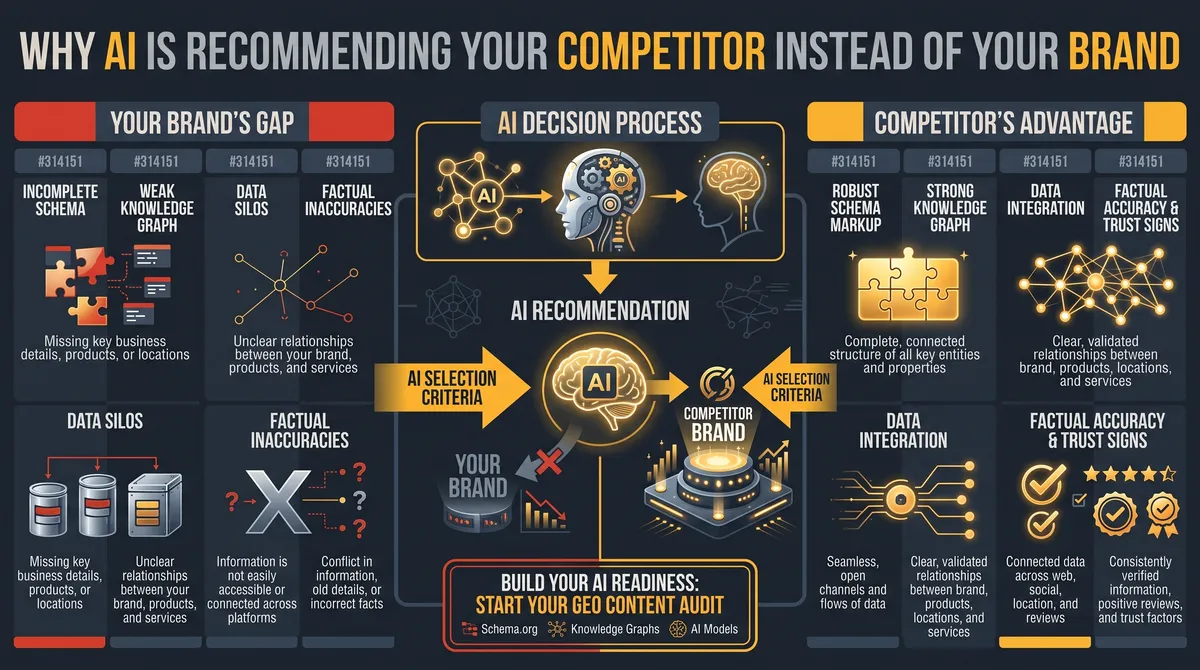
The decision runs on six infrastructure signals, and an engine gates on your weakest one rather than averaging your strengths.

8 min read
In short
The exchange that left no trace
A buyer in your category opened ChatGPT last week and asked which company they should hire. The engine returned three names. One was a competitor you do not consider a serious threat, and none of them was you.
No impression, no click, no bounce. The buyer got an answer, acted on it, and you never learned the conversation happened.
This is the quiet failure mode of generative search, and it is worth understanding precisely, because the standard response to it makes things worse.
Why engines skip brands that rank well
Google and a generative engine are answering two different questions.
Google answers which pages are most relevant to a query. It returns a ranked list and lets the human decide. Being on that list is enough to earn a chance.
A generative engine answers what is true, and who it should say it about. It is not ranking pages. It is assembling a claim and then deciding whether it is willing to attach a brand name to that claim. That is a higher bar and a different one.
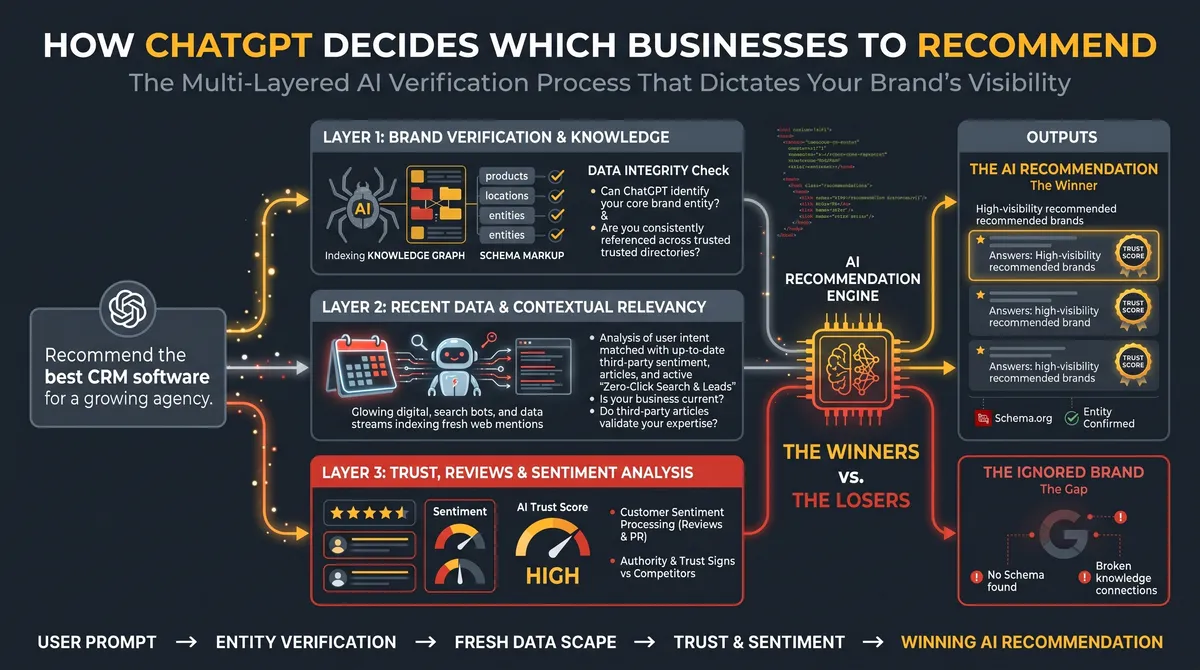
A page can be relevant without being usable. If your homepage says you serve growing brands, your services page says small business, and your Google Business Profile lists a category matching neither, a ranking algorithm sorts you anyway. An engine that has to commit to a sentence like this company specializes in that has nothing stable to commit to. So it moves to a brand whose signals agree with each other.
The data supports the split. BrightEdge found in February 2026 that only around 17 percent of AI Overview citations come from pages ranking in Google's organic top ten. In the Semrush study run by Kevin Indig across 1,094 US categories, Authority Score predicted category ownership 52.5 percent of the time. Indig's own conclusion: "traditional SEO metrics aren't enough to explain who owns a topic."
This is why brands routinely hold position one in organic search and appear in zero AI answers. The two systems are not measuring the same thing.
What an engine checks before it names a brand
| Dimension | The question it answers | What failing looks like |
|---|---|---|
| Entity Clarity | Does the engine have a coherent understanding of what your company is, once it reconciles your site, your listings, and every third-party description? | Sources disagree, so the engine has no confident answer and will not risk one |
| Content Authority | Does anything you publish contain a claim specific enough to be worth quoting? | Generic category education. A number, a method, or a documented result is quotable. Helping brands grow is not |
| Structured Data | Can a machine resolve which entity you are without inferring it? | Missing Organization schema, author markup pointing nowhere, stale modified dates |
| Citation Worthiness | Would an engine stake the accuracy of its answer on you? | All claims self-sourced. An engine that cites you and is wrong carries a real cost, and it weights accordingly |
| GEO Visibility Test | Do you actually appear when buyers ask? | Absent from the prompt set, or present in definitional prompts only |
| Technical Foundation | Can the crawler reach and read you at all? | Blocked paths, render-dependent content, broken URLs. A cited URL that 404s is worse than no citation |
One note on structured data, because the common claim overstates it. Ahrefs tracked 1,885 pages adding JSON-LD in 2026 against roughly 4,000 controls and found no statistically significant citation uplift. Schema is not a citation lever. It is a disambiguation lever, which is precisely what dimension one requires, and that is why it sits here rather than higher.
An engine gates on your weakest dimension
It does not average your strengths. That distinction decides where your budget should go, and almost every content plan gets it backwards.
90 Content Authority
25 Entity Clarity
Not 57 the result lands near the 25
A brand scoring 90 on Content Authority and 25 on Entity Clarity does not land at 57. It lands roughly where the 25 puts it, because the engine cannot use excellent content it cannot attribute to a company it cannot identify.
Which means the highest-return work is never your strongest dimension. It is your lowest one, and most brands have never measured which that is.
Why publishing more does not fix it
The instinct is understandable. Content is the lever most marketing teams know how to pull, and for fifteen years pulling it harder produced results. The mechanism changed underneath the tactic.
Generative engines were never short of things to read. The constraint is not supply, it is usability: how much of what they read can be parsed, verified, and safely attributed. Adding a fifty-first blog post to a domain with no entity clarity adds another unusable document to a pile of unusable documents.
Peer-reviewed research presented at KDD 2024 measured citation lift across roughly 10,000 queries and nine tactics. Adding statistics produced the largest single lift at about 41 percent and citing external sources produced gains up to 115 percent for lower-ranked content. Publishing frequency and word count did not appear among the effective tactics at all.
There is a version of this that is painful to watch. A brand invests in a content program, publishes consistently for a year, produces real quality, and moves its AI visibility not at all. The work was not bad. The work was built on infrastructure that could not carry it.
The gap closes with infrastructure, not more content alone.
That ordering matters. Content built on a sound foundation compounds, because every new piece reinforces an entity the engine already understands. Content built on no foundation just accumulates.
What the fix order looks like
Three phases, and the order is the part most brands get wrong.
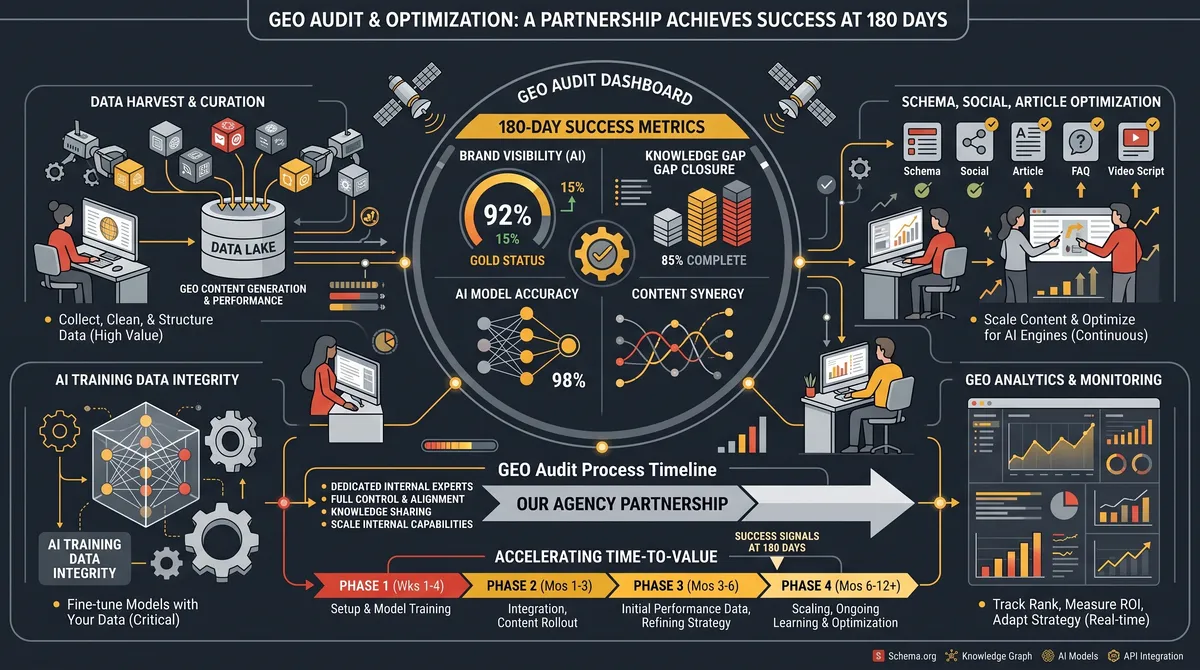
Days 1 to 45: Foundation
Baseline prompt test recorded as Day 0. Entity definition. Schema implementation. Technical cleanup including a full 404 audit and redirect map. Consistency reconciliation across every place your brand is described. Nothing new gets published in this window. This phase is unglamorous and it is the only phase that makes the next two work.
Days 46 to 120: Authority
Now content, and specifically citation-worthy content. Question-based headings matching real buyer prompts, direct answers in the first paragraph under each heading, original data or named methodology, and FAQ blocks that give engines clean extractable pairs. Built on the foundation, each piece strengthens the entity rather than diluting it.
Days 121 to 180: Amplify and measure
Distribution, third-party citation building, and re-testing. Run the GEO Visibility Test again at Day 45, Day 90, and Day 180 against the baseline. A before-and-after score is the only honest proof that anything worked.
The length comes from the constraint rather than the contract. Roughly 82 percent of AI citations come from earned media per Muck Rack's December 2025 analysis, which means the largest lever runs on other organizations' publishing schedules. Those do not compress.
The two wrong self-assessments
Guessing is expensive here, because the two most common conclusions are both wrong.
- We rank well, so we are fine. Different system, different criteria. BrightEdge found around 17 percent of AI Overview citations come from the organic top ten, and in the Semrush study Authority Score predicts category ownership about as reliably as a coin.
- We are invisible, so we need more content. That is the response that produces a year of work and a flat number.
The honest move is to measure the six dimensions directly and find out which one is gating you. Most brands are surprised by which comes back lowest. It is rarely the one they have been worrying about.
A low result is also more common than it feels. The Semrush study of 1,094 US categories found 53.7 percent had no consistent brand leader at all. Most categories are unsettled, which means the position is usually still available.
One question worth sitting with. Of the six dimensions above, name the one you would score lowest on right now.
If the honest answer is that nobody at your company could say, then whatever budget gets approved next quarter is being aimed at a guess.