45% of Customers Now Ask AI Who to Call. AI Names Only 1.2% of Local Businesses.
Demand moved. Supply did not follow. The gap between those two numbers is an opening with a closing date.

7 min read
In short
What the two studies actually measured
BrightLocal surveyed 1,002 US adults for its 2026 Local Consumer Review Survey and found 45 percent now use AI tools to find local businesses. The prior year the same measure sat at six percent. That is a seven-fold move in twelve months, and consumer behavior rarely moves that fast in any category. AI is now the third most-used tool for local recommendations, behind Google and Facebook and ahead of Yelp.
SOCi measured the other side of the exchange. Its 2026 Local Visibility Index covered more than 350,000 business locations across 2,751 brands and asked a simpler question: when someone asks, who actually gets named?
| Surface | How often a local business gets surfaced |
|---|---|
| Google three-pack | 35.9% |
| Gemini | 11% |
| Perplexity | 7.4% |
| ChatGPT | 1.2% |
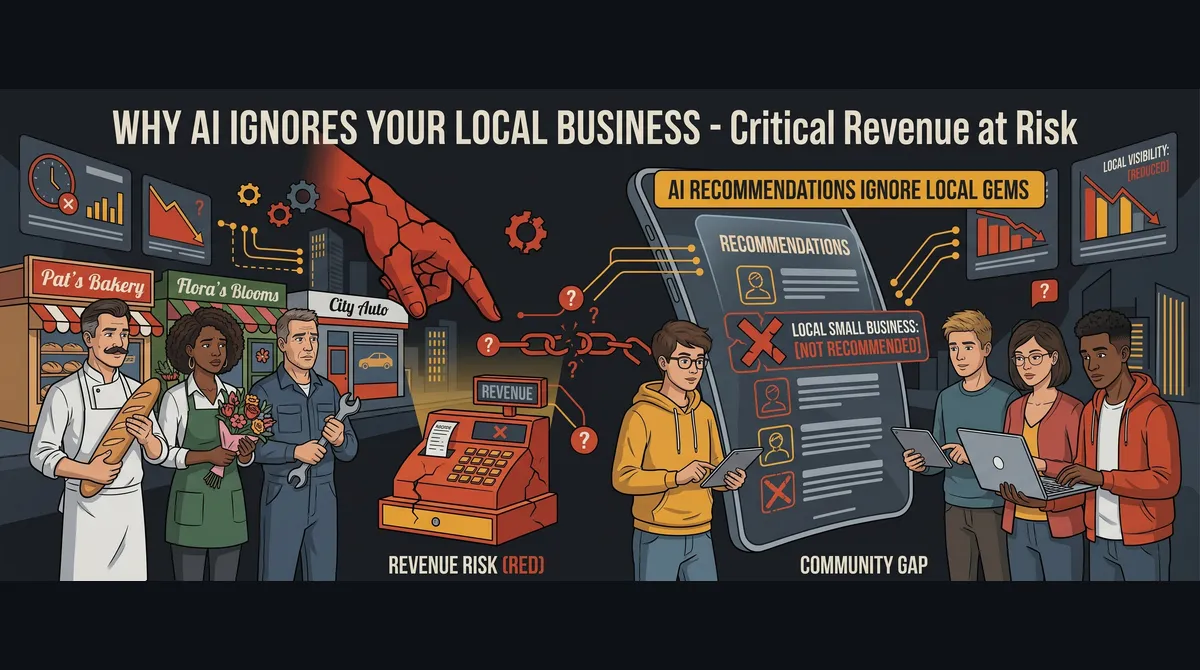
Read those two studies together and the picture is uncomfortable in a useful way. Customer demand for AI-assisted local discovery grew seven-fold. The engines answering that demand name almost nobody.
That gap is not a market failure. It is an opening with a closing date.
The shortlist collapsed from ten to three
The map pack was a list. You appeared alongside nine competitors and the customer compared you. Proximity, reviews, photos, hours, and the customer made a judgment.
An AI answer is not a list. It is a recommendation, usually naming one to three businesses, delivered as a sentence rather than a grid.
Look at what disappeared. The comparison step is gone. The customer is not weighing you against nine others, because they never see nine others. They see the ones the assistant decided were defensible picks, and everyone else is not in second place. They are absent.
The collapse has been measured directly. Joy Hawkins at Sterling Sky tracked AI local packs surfacing 5,943 unique businesses across a query set where the legacy three-pack surfaced 18,330.
Roughly 32 percent of the previous coverage. Two out of three businesses that used to appear somewhere no longer appear anywhere.
Which of your queries are actually affected
AI Overviews appear on roughly 68 percent of local queries against 39 percent for the traditional local pack, per Whitespark's 2026 study of 540 manual queries across six local industries. That average hides a split you need to see, because it decides which half of your funnel is disappearing.
| Query type | What it sounds like | AI Overview appears |
|---|---|---|
| Simple transactional | Tacos San Francisco. Plumber near me | 15%, and the local pack still appears on more than 90% |
| Informational | How long does an eye exam take near me | 92% |
| Hybrid | Average cost of dental implants in Phoenix | 97% |
If somebody already knows they want you, the map pack still delivers them. If they are still deciding who to call, the AI answer has almost entirely replaced it. The half you are losing is the half where the shortlist gets made.
Where this shows up in your business specifically
The failure mode differs by what you sell. Find your row.
| If you run a | What a customer is actually asking AI | Where you get filtered out |
|---|---|---|
| Home services company | Who can fix this, how fast, and do they cover my city | Service area and turnaround time are not published anywhere a machine can read. Vagueness reads as risk |
| MedSpa or clinic | Who does this procedure near me, and are they credentialed | Credentials sit in an image or a PDF instead of text. Outcome claims with no substantiation get dropped |
| Mortgage or real estate office | Who works with my situation, and are they licensed here | License and jurisdiction not stated in text. Inconsistent business name across listings splits the entity |
| Restaurant | Who is open now, what is the food actually like, can I get a table | Hours conflict across listings. Menu locked inside a photo or a script the crawler cannot read |
| Church or nonprofit | Which congregation near me teaches what I believe | Beliefs, service times, and who you serve are implied through design rather than stated in words |
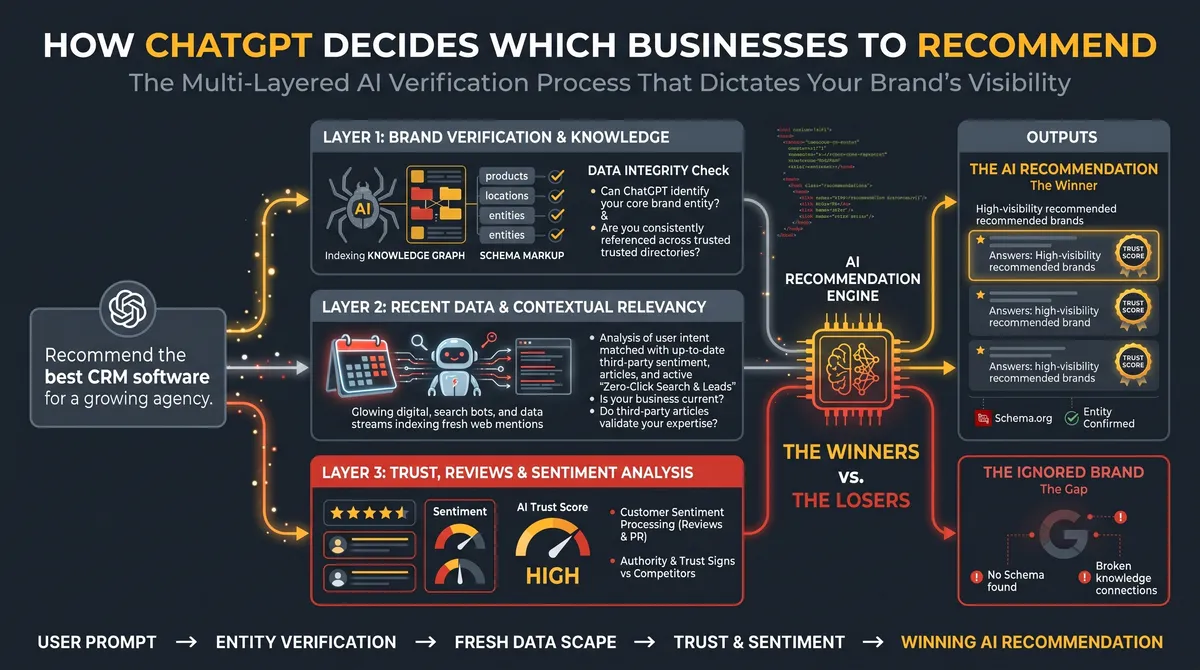
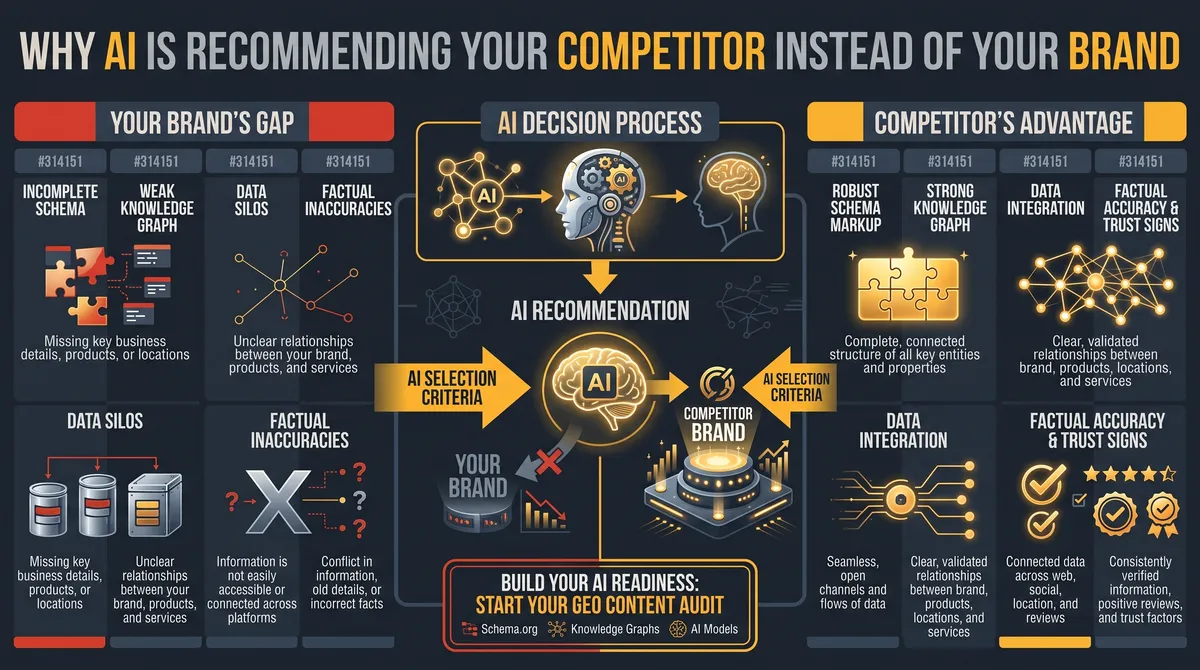
The pattern is the same in every row. The information exists. It is just not in a form a machine can lift.
The local shortlist test
Five checks. Score each honestly out of five, then fix the lowest first. This costs nothing but an hour.
- Named. Ask ChatGPT, Gemini, and Perplexity best [your service] in [your city] and write down every business named. Are you in any of the three answers? Then ask the research version, how much does [your service] cost in [your city], since that is where the AI answer has almost fully replaced the map.
- Consistent. Is your business name, address, and phone identical across your website, Google Business Profile, Yelp, and every directory that carries you? Not similar. Identical.
- Stated. Are your service area, hours, pricing range, and turnaround written in plain text on your site, not implied and not trapped in an image?
- Corroborated. Does anyone other than you say you are good at this, on a page a crawler can reach? Reviews, coverage, roundups, listings.
- Readable. Open yourdomain.com/robots.txt. Are GPTBot, OAI-SearchBot, Google-Extended, PerplexityBot, ClaudeBot, and Bingbot allowed?
Item five is the one that produces the most surprise. A robots.txt copied from a template can remove a business from AI answers entirely, and nothing in any dashboard reports it.
Why almost nobody is named yet
Because being named requires evidence, and most local businesses have built for humans who were willing to do the evaluating themselves.
A human visitor will squint at a photo of your menu. A human will infer your service area from the towns in your gallery. A human will assume you are licensed because your truck looks professional. A retrieval system does none of that. It reads what is written and it declines to guess, which is the correct behavior when the answer is going to be delivered as a recommendation.
The businesses getting named are not the biggest ones. They are the legible ones.
One question worth sitting with. If a neighbor two miles away asked an assistant who to call for what you do, and it named three businesses, would yours be one of them? And if it named one of your competitors instead, how would you currently find out?