82% of What AI Says About You Comes From Other Sites
Your website is the corroborating source in AI answers, not the primary one. That reorders most content budgets.

6 min read
In short
Two studies, one finding
| Study | Sample | Finding |
|---|---|---|
| Muck Rack, What Is AI Reading, December 2025 | Not disclosed | 82% of AI citations come from earned media |
| Omniscient Digital | More than 23,000 citations | Roughly 77% of sources cited about a brand are off-page |
Five percentage points apart, arrived at separately, measuring slightly different things. That convergence is what makes the finding worth acting on. A single study is a data point. Two studies from different organizations landing in the same range is a pattern.
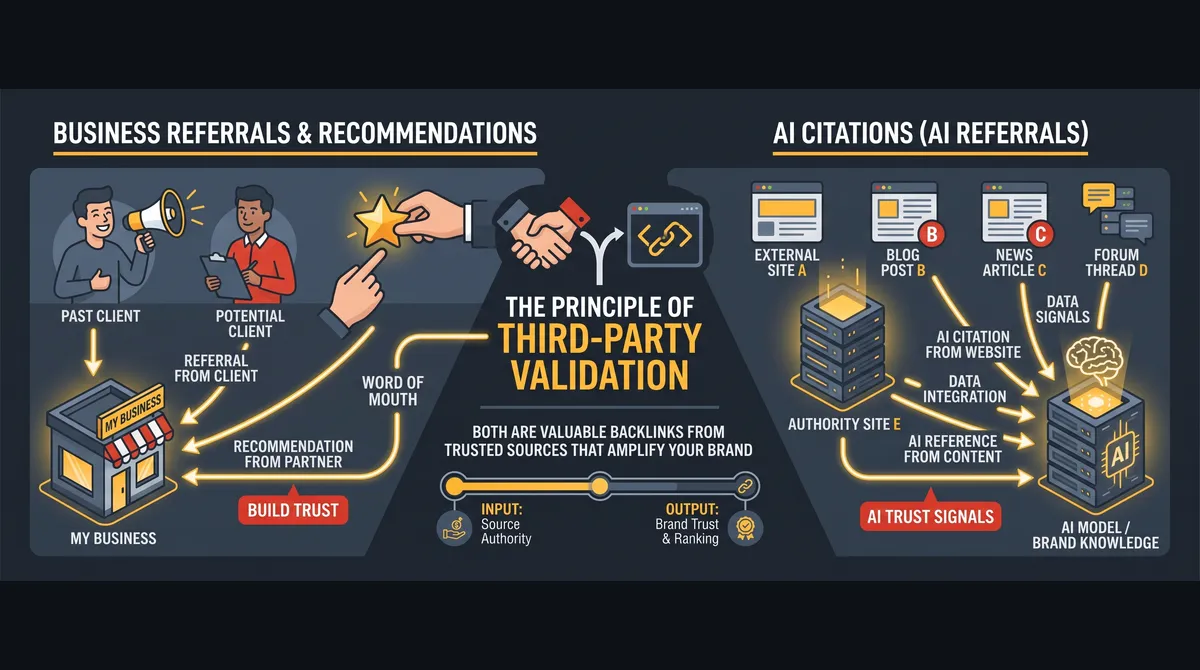
Your website is not where the answer gets built. It is where the answer gets checked.
Why models weight outside sources
Because a retrieval system is a corroboration machine, and that is the correct design.
When a model assembles an answer to whether your company is any good, your homepage is a source with an obvious interest in the outcome. A review platform, a trade publication, a comparison roundup, and a directory listing are four sources with no such interest. Four independent sources agreeing carries more weight than one interested source asserting.
This is not a penalty on your content. It is the same instinct a careful buyer has when they read your case study and then go looking for someone who is not you to confirm it.
The practical consequence: your site's job changed. It is no longer the argument. It is the reference document the argument gets checked against, which means it needs to be accurate, complete, structured, and current far more than it needs to be persuasive.
Where your citation supply actually lives
| If you are a | The off-page sources models are reading | What is usually missing |
|---|---|---|
| Consumer brand | Retailer listings, review sites, roundups, editorial gift guides | Product attributes inconsistent between your site and retail listings |
| Professional services firm | Directories, association listings, trade press, podcast show notes | No third party has ever described what you do in their own words |
| Local service business | Google Business Profile, Yelp, Nextdoor, chamber and permit listings | Business information differs across nine listings, so nothing corroborates |
| Software company | G2, Capterra, comparison articles, forum threads | Comparison pages written by competitors go unanswered |
| Nonprofit or ministry | Charity databases, denominational directories, local press | Impact described in adjectives, so nothing quotable exists |
In every row the failure is the same shape. Nobody outside the building has been given something specific enough to repeat.
The citation supply ladder
Four rungs, ordered by yield per dollar. Climb from the bottom.
Accurate listings
Cheap, fast, unglamorous. Directories, association memberships, review platforms, local registries. Every one is a corroborating source, and consistency across them is what lets a model resolve you as one entity instead of three similar ones.
Answered comparisons
Appear in roundups and alternatives pages. Buyers run comparison and alternatives prompts constantly, and those answers are assembled almost entirely from third-party lists you are either on or absent from.
Earned coverage
Trade press, local business press, podcasts. Slower, more expensive, and it carries the most weight per placement.
Original data
The highest rung and the only one that compounds. A number nobody else has is the single most reliable way to make other people cite you by name.
Look at rung four for a second. Every statistic in this article exists because an organization published research specifically so that others would reference it.
Muck Rack and Omniscient Digital are being cited right now, in this sentence, by a company they have never spoken to. That is the mechanism working exactly as designed.
And it runs in both directions, which is the part almost nobody uses. The peer-reviewed GEO research presented at KDD 2024 found that citing external sources lifted a page's own visibility by up to 115 percent, with the largest gains going to lower-ranked content.
Citing other people makes you more citable, it costs nothing, and it helps most when you are not the incumbent. That is available to you before you spend a dollar on any rung above.
The shortcuts that carry penalty risk
Manufactured mentions, mass guest posting, paid link networks, and generated citations fall under scaled content abuse policy. They carry ranking penalty risk, and they tend to produce exactly the pattern a corroboration system is built to discount: many low-quality sources saying the same thing in the same way.
There is a simpler test. If a source would not have written about you without being paid or automated into it, a model weighing independence has less reason to trust it.
What this reorders
Most content budgets are close to fully allocated to owned media. Blog posts, landing pages, occasionally video. If four out of five citations come from outside that, the allocation is inverted relative to where the citations are.
The honest reallocation is not dramatic. It is roughly this.
- Keep the technical and structural work funded. Your site still has to be readable and extractable to serve as the reference document.
- Stop funding volume. A twelfth blog post at the same depth adds nothing to citation supply.
- Move that money to rungs one and two first, because they are cheap and immediate.
- Fund rung four once, and let it work for years.
One question worth sitting with. Name the last time a source outside your company described what you do, in their own words, on a page a crawler can reach.
If the answer is a press release you wrote, or nothing at all, then four out of five of the citations that decide your AI visibility are being assembled without you.