A Client Told Me Something Last Week. It Changed How I Think About Marketing.
I have written about the call where a client mentioned being found through ChatGPT. What I have not written about is what I did the moment we hung up, and what it told me that no quarterly report ever had.

Updated 6 min read
In short
I opened a new tab and started typing
The call had been routine. Results were good, the relationship was solid, and we were winding down. Then, almost as an aside, the client mentioned that someone on their team had used ChatGPT to find a recommendation. They said it like a compliment, and I am sure they meant it as one. I said something like that is great, and we moved on to scheduling.
Then I hung up and opened a browser.
I typed the kind of question a prospect in that client's category would actually ask. Who should I hire for this in Southern California. Their name was there. Good. So I tried a variation. Different phrasing, slightly different angle on the same question.
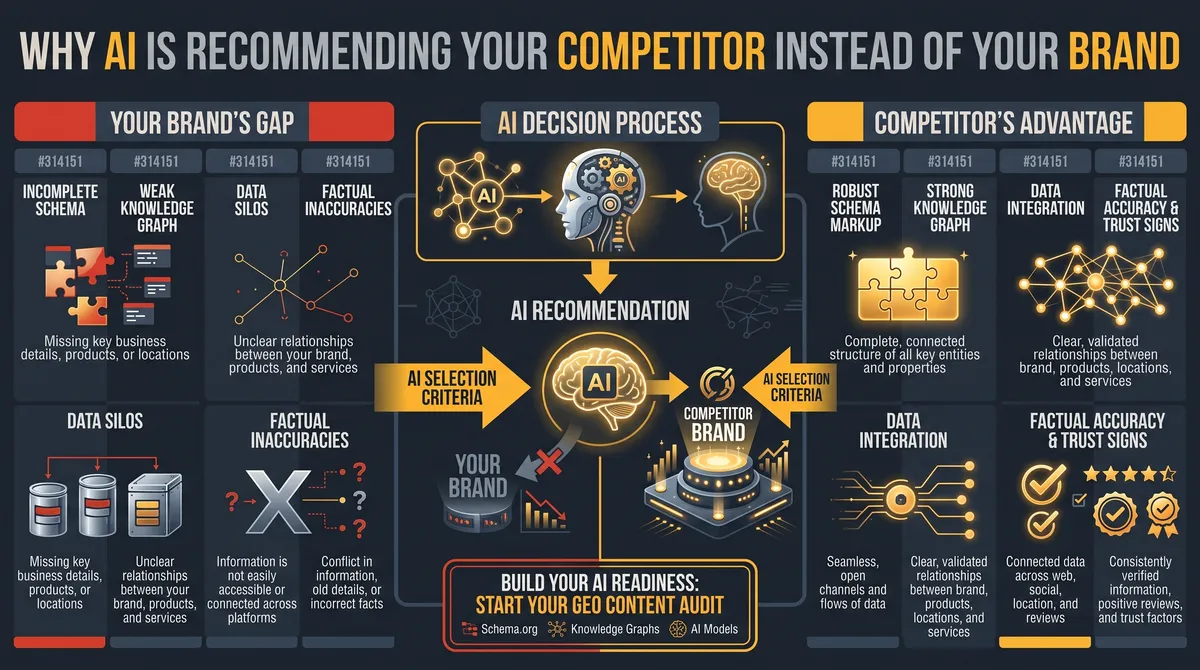
Sometimes the name appeared. Sometimes it did not. Sometimes a competitor appeared instead, one this client outranks on Google by a meaningful margin.
I tried Perplexity. Different results. I tried Gemini. Different again.
Here is what matters about that twenty minutes. It was not planned, it was not part of any audit, and it changed how I think about what visibility means. Not because the result was catastrophic. Because it was inconsistent, and inconsistency is invisible to every report I had ever sent that client.
There is a second visibility layer, running on different rules
If you have been in marketing or business leadership for more than a few years, you have a mental model of what showing up means. It centers on Google. Rankings, impressions, organic traffic. Those are the metrics you have reported for years, and the ones your leadership team understands.
When Google evaluates you, it is looking at technical signals on a site you own. Structure, links, speed, relevance. It is evaluating your website.
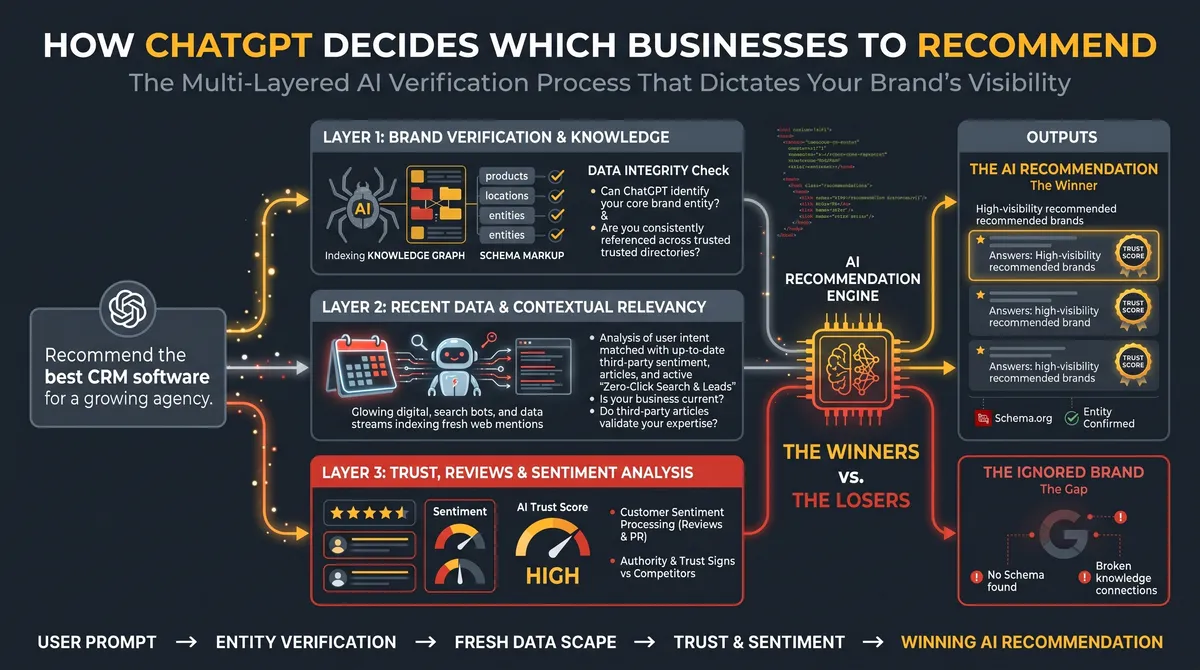
When an assistant answers a question about your category, it is not crawling your site in that moment. It is drawing on an entity layer, which is everything it has absorbed about your brand from across the internet. Mentions in articles. Citations in forums. The way your brand gets described by sources that are not you.
You can be excellent at the first and absent from the second. Until recently there was no practical way to know, because nobody was measuring it and no report had a column for it.
Where buyers actually are in the journey
One afternoon with one client is an anecdote. This is the measured version, and the stage-by-stage breakdown is the part that should change how you plan.
| Stage of the journey | Use AI tools | Use search engines | What it means |
|---|---|---|---|
| Discovery | 35% | 13.6% | The shortlist gets formed here, before anyone opens a search bar. |
| Evaluation and comparison | 32.9% | 15% | The advantage holds while people narrow their options. |
| Final purchase | 24.3% | 22.1% | Nearly even. Search still closes, which is why it has not felt like anything changed. |
Similarweb 2026 Generative AI Brand Visibility Index, published March 2026, drawing on a US market research panel from January 2026
Read the table top to bottom and the pattern is unmistakable. AI has taken the top of the funnel. Search still closes the sale. Which explains why so many businesses feel fine right now: the conversions still arrive through familiar channels, so nothing looks broken. What changed is who made the shortlist, and that decision happened somewhere nobody is watching.
One number worth stating carefully, since it circulates in an exaggerated form. McKinsey found that roughly half of US consumers surveyed intentionally use AI-powered search, and among those users, 44 percent call it their primary and preferred source of insight, ahead of traditional search at 31 percent. It is frequently quoted as 44 percent of all consumers, which roughly doubles it. The real figure is still large. It does not need help.
Run the same twenty minutes on yourself
Before you read anything else, open a tab. Type the question your ideal customer would ask. Who is the best option in your category, in your market. Then try it three more ways, and try it in two other tools.
- If your name appears consistently across multiple phrasings and multiple tools, that is a genuinely good sign, and it is rarer than you would expect.
- If it is missing, or inconsistent, or a competitor is there instead, you have found something your current reporting almost certainly does not capture. Not because anyone did anything wrong. Because this is a new layer, and most reporting frameworks have not caught up to it.
Inconsistency is the most common result and the most useful one, because it means you are close. A brand that never appears has a presence problem. A brand that appears half the time has a clarity problem, and clarity problems are far cheaper to fix.
I am not telling you your SEO is broken
It probably is not. The client in that story ranks well and deserves to. The work behind that ranking was real and it still matters.
I am writing this because a test I ran on a Tuesday afternoon, almost by accident, told me something quarterly reports never had. Not a failure. A blind spot, and one that is easy to close once you can see it.
I would rather you hear about this from someone who found it by accident than discover it the way I did, which is to say months after the shortlist had already been formed without you on it.