Building a Business on a Rock: A 5-Step Guide to Faithful Branding
Branding gets confused with vanity. The coolest logo. The trendiest feed. For a faith-led business it is something else entirely: stewardship and clarity. If people cannot understand who you are, they cannot trust you to help them.

Updated 7 min read
In short
Clarity is not decoration. It is how people find you.
Trust is now a primary buying consideration, not a nice-to-have. If a person cannot tell in a few seconds who you serve and what you stand for, they do not investigate further. They leave.
71% consumers who say brand trust matters more now than in the past
Among Gen Z adults, that figure rises to 79%
Edelman Trust Barometer Special Report: Brand Trust, 2023
“Write the vision and make it plain on tablets, so he may run who reads it.”
Habakkuk 2:2
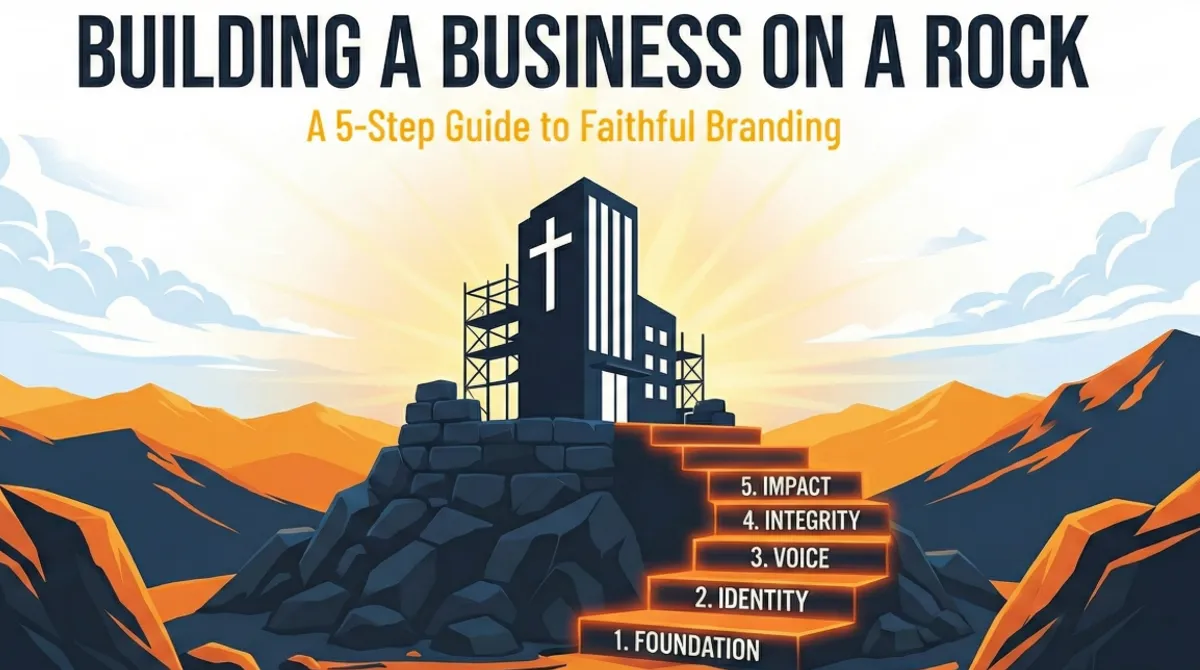
A brand strategy is simply that. Making the vision plain, so the people you are called to serve can find you and run with it. What follows is the five-phase build, adapted from the HubSpot Branding Masterclass and the way Conspicuouz Creative Group (CCG) runs it in practice.
Phase 1: Build your foundation
Before a logo exists, the heart of the business has to be settled. You need a north star that makes every later decision easier.
Define your mission
Your mission is not about the money. It is about the impact. Airbnb does not describe itself as renting rooms. It describes a world where anyone can belong anywhere. That is a mission of hospitality. Yours should be equally clear about the good you bring.
“Where there is no vision, the people perish.”
Proverbs 29:18
Identify core values
Values define culture. They cannot only look good on a page, they have to be true to how you actually act. Coca-Cola builds around optimism and connection. A faith-led business might land on integrity, compassion, or excellence. Pick words you are willing to be held to.
Know your audience
You are not called to serve everyone. Ministry in scripture is specific: specific people, specific needs, specific moments. To serve well you have to know who you are speaking to, what they are struggling with, and what they are hoping for.
“Let each of you look not only to his own interests, but also to the interests of others.”
Philippians 2:4
Write the brand story
Stories build connection in a way a service list never will. Do not recite what you sell. Share the testimony of why you started. Use this frame: I started [brand] because I noticed [problem]. I wanted to create [solution] to help [audience] feel [outcome].
Phase 2: Shape your messaging
Words carry weight. This phase makes your communication clear, kind, and consistent, no matter which room you are speaking into.
Define voice and tone
If your brand were a person, how would they speak? You can be professional without being cold. Encouraging without being salesy. Voice is fixed. Tone adapts. Serious on a contract, warm on Instagram, steady in a hard email.
“Let your speech always be gracious, seasoned with salt, so that you may know how you ought to answer each person.”
Colossians 4:6
Write the tagline, which is really a promise
A short, memorable line that carries your promise. Think of it as a proverb people can repeat without effort. Gatorade asks whether it is in you. Apple told a generation to think different. Short enough to remember, specific enough to mean something.
Phase 3: Build the visual identity
Think of your visuals as a storefront, or a living room. Is it chaotic, or is it welcoming? Excellence here signals that you care about details, and people read that as a signal about how you will handle their money and their time.
Logo and color
A logo has one job before anything else: be legible at small sizes. Simple survives. Color carries feeling, and blue tends to read as trust while red reads as energy. You do not need a design degree to get this right. Canva, Adobe Express, and similar tools will get a clean, professional result.
Type
Choose fonts that serve the reader first and express personality second. One for headlines that carries weight. One for body copy that gets out of the way. Two is enough. Three is usually a mistake.
“But all things should be done decently and in order.”
1 Corinthians 14:40
Phase 4: Launch without being loud
Marketing is not volume. It is reaching the people who need what you carry.
Set a specific goal
Stewarding resources well means naming the target. Ten new clients this month is a goal. Getting known is a wish. One you can measure and adjust. The other just spends money.
Repurpose everything
Respect your own time. One video becomes an email, three social posts, and a blog section. This is how a small team produces like a large one, and it is the difference between a cadence you can keep and one that burns you out in six weeks.
Phase 5: Maintain consistency
Brands do not usually fall apart from one bad decision. They drift. Consistency is just faithfulness applied to a business: showing up when you said you would, being who you said you were.
Write the brand bible
One document holding your values, colors, type, and voice rules. Everyone who touches your brand, employee, contractor, or agency, works from it. Without it, every new person quietly reinvents your brand from memory.
Set a cadence you can actually keep
Do not over-promise. If once a week is what you have, do once a week faithfully. That builds far more trust than a burst of daily posts followed by two months of silence.
“Moreover, it is required of stewards that they be found faithful.”
1 Corinthians 4:2
Small numbers are not a reason to be sloppy
Faithfulness in the details is how a small mission earns the trust to serve the many.
“One who is faithful in a very little is also faithful in much.”
Luke 16:10
In branding, being faithful in a very little means holding to your style guide and your posting schedule when you have forty followers and nobody is watching. That discipline is exactly what prepares the business to handle the much when it arrives.