Gucci, AI, and the Real Marketing Lesson: Craft Still Wins
Gucci labeled the images as AI-generated. People were angry anyway. That single detail turns this from a story about technology into a story about what your audience believes they are paying for.

Updated 7 min read
In short
The detail most takes left out
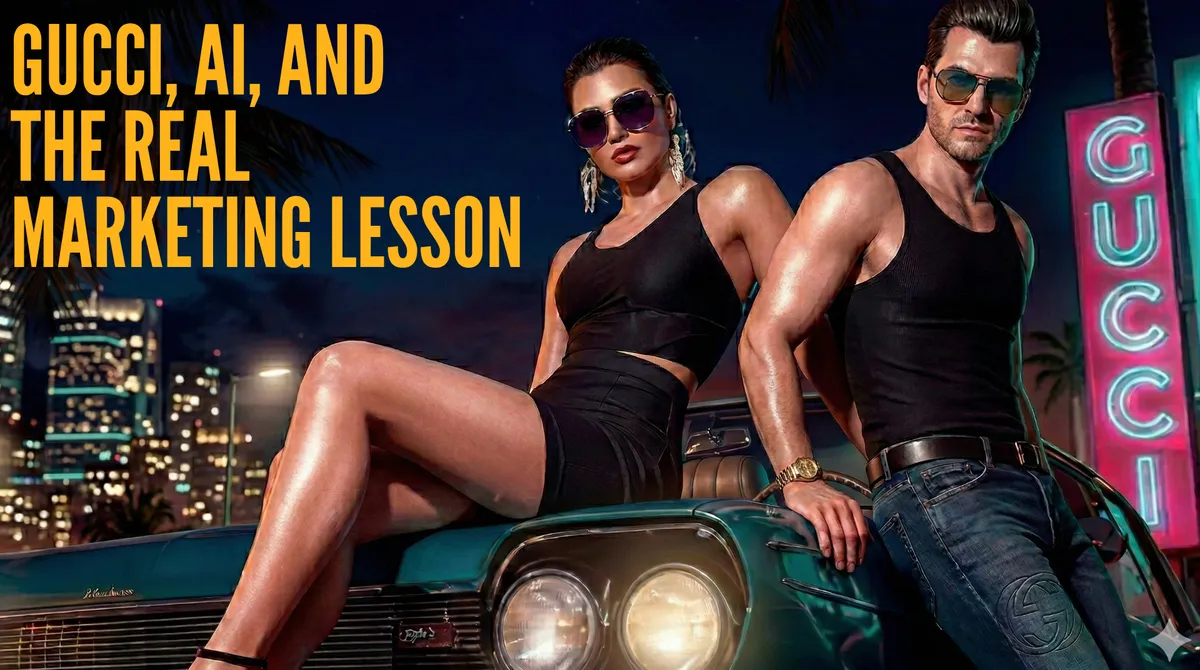
Ahead of the Milan show marking Demna Gvasalia's debut as creative director, Gucci posted a set of AI-generated visuals for the Primavera campaign. The response was fast and hostile. Critics questioned how synthetic imagery squares with a house that sells Italian craftsmanship, and the term used across social platforms was AI slop.
Here is what most commentary skipped. The images were clearly labeled as created with AI, and they ran alongside traditional photography in the same rollout. This was not a brand caught cutting corners. This was a brand that disclosed, and got hit regardless.
Worth knowing: Valentino saw the same reaction to a clearly labeled AI video in December 2025. Audiences were not confused about what they were looking at. They objected to the choice itself. Two brands, same disclosure, same outcome. That is a pattern, not an accident.
Context sharpens it further. Gucci was mid-reset under a new creative director who joined in 2025 after a significant sales decline. A brand actively rebuilding trust reached for the one production method that reads as cost-cutting, at the highest-visibility moment on its calendar.
Sources: BBC News technology coverage and industry reporting, February 2026
The expectation gap, explained simply
Gucci's promise is craft, taste, heritage, and obsessive attention to detail. What AI signals to most people right now is speed, scale, sameness, and cost-cutting. When the process signal contradicts the price signal, trust drops.
That is not a luxury problem. It is an every-industry problem. Your audience is quietly asking one question at every touchpoint: does this feel like the level of care you are charging me for?
| If you are a | What you are actually selling | Where a shortcut shows first |
|---|---|---|
| Contractor | Workmanship and reliability on a job you cannot inspect until it is finished. | Stock or generated project photos instead of your own completed work. Buyers can tell, and it raises the question of whether the work exists. |
| Coach or consultant | Your specific judgment, applied to a specific person. | Generic thought-leadership posts that could have been written about anyone by anyone. If the content is interchangeable, the advice looks interchangeable. |
| Church or nonprofit | Sincerity, and the trust to steward someone's giving. | Synthetic images of people who do not attend, or testimonies that read as generated. Nothing costs more here, because sincerity is the entire offer. |
| Restaurant | An experience someone will walk into and compare directly to your marketing. | Food imagery that does not match the plate. This one gets checked within an hour of arrival, every time. |
| SaaS company | Precision, and confidence that the team sweats the details. | Product screenshots that are not the real product, or docs that read as filler. If the marketing is careless, buyers assume the code is too. |
Perception is the product
AI now generates work faster than most teams can approve it. Which means volume stopped being a competitive advantage roughly the moment everyone got the same tools. What is left is the quality of your decisions: better taste, better judgment, better standards, and above all better restraint.
AI can accelerate production. It cannot take accountability. Accountability is what builds a brand people trust.
People are more visually literate than they have ever been. They can identify a shortcut in about a second and a half, and they are no longer only buying products. They are buying signals about who you are and how much care you put into what you make.
The 3-layer creative stack
This is how to use AI in advertising without diluting the brand. The layers are ordered on purpose. AI involvement drops as visibility rises.
Strategy, AI-friendly
Use AI to speed up thinking, not to replace it. Nothing here reaches the public, so the risk is near zero and the leverage is high.
- Angle generation and positioning drafts
- Audience objection and FAQ mining
- Headline and subject line variants
- Offer clarity, meaning what you are actually selling and to whom
Production, AI-assisted
Use AI to increase iteration speed. Human review before anything leaves the building.
- Rough concepts and pre-visualization
- Format versions: square, vertical, banner sizes
- Captions, translations, and repurposing
- Internal drafts you would not publish as-is. The Gucci lesson lives in this line.
Brand proof, human-led
This is where brands win or lose. If you charge a premium, this layer has to look like a premium every single time.
- Final hero assets and flagship campaigns
- Art direction and taste-level decisions
- Ethics and compliance review
- The test that settles it: would your best client be proud to share this?
Green, yellow, red
If you want one page to hand a contractor or a junior marketer, this is it. Sort every AI use into one of three buckets before the work starts, not after.
| Level | Where it applies | Review required |
|---|---|---|
| Green, safe | Internal ideation, outlines, first drafts, testing variants, research summaries. | None beyond normal work review. Nothing here is public. |
| Yellow, guardrails | Social creative, thumbnails, background elements, supporting B-roll, format resizing. | Named human signs off before publish. Not a group chat. One accountable person. |
| Red, high risk | Brand identity assets, flagship campaigns, anything featuring people, sensitive or faith-adjacent topics. | Human-led from the start. AI may assist the process, never author the final asset. |
Five things worth remembering
We are in a culture that rewards speed and punishes anything that feels inauthentic. People want real stories, real standards, and real accountability. The best use of AI is not replacing the creative team. It is raising the floor on execution while keeping the ceiling on craft and human leadership.
- Your audience buys the signal, not the software. Nobody has ever chosen a brand because of the tool it used.
- AI should increase iteration speed, not lower the taste bar. More options is the win. Publishing more of them is not.
- If you charge a premium, your process must show premium care. The price sets the expectation. The output either meets it or contradicts it.
- Put a named human brand editor in the workflow. Not a committee. One person whose name is on it.
- Test privately before you publish publicly. Disclosure did not save Gucci. Judgment would have.
One question worth sitting with: where do you draw the line between AI efficiency and brand craftsmanship? If you cannot answer it in a sentence, your team cannot either, and they are making that call for you every day.