How Long Does GEO Take to Show Results?
Four kinds of work are happening at four different speeds. Quoting one number hides which one a provider is actually doing.

Updated 7 min read
In short
What the market says, with the confidence labels attached
These figures come from vendor and practitioner guidance rather than independent research, and that distinction matters enough to state before the table rather than after it.
| Milestone | Range | Source type |
|---|---|---|
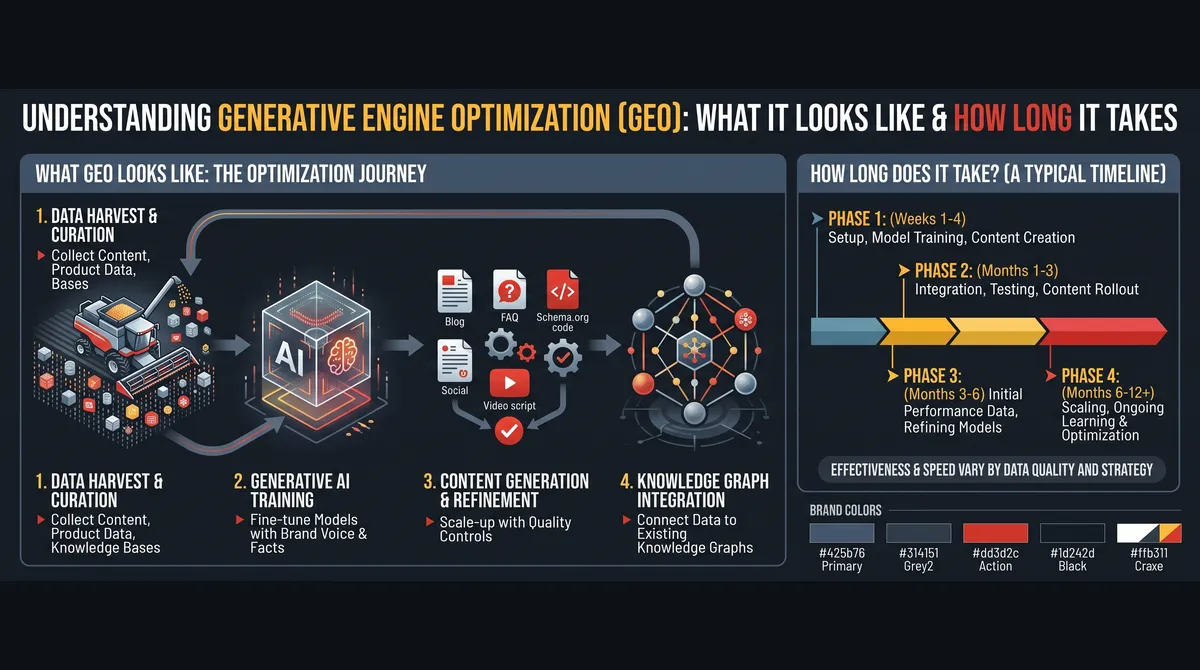
| First meaningful movement in AI answers | 14 to 45 days | Vendor guidance. Estimated |
| Measurable gains | 3 to 6 months | Vendor guidance. Estimated |
| Payback period | 6 to 12 months | Vendor guidance. Estimated |
| Contracts under 30 days | Described as unable to produce measurable results | Vendor guidance |
Every row is an estimate published by someone selling the service. As of August 2026, no independent longitudinal study of GEO time-to-result had been published. Treat these as the market's working consensus, not as findings.
That framing is not a hedge. It is the actual state of the evidence, and a provider who presents these numbers as research is either careless or hoping you will not check.
One thing in the second row does have a mechanism behind it. Amsive's 2026 analysis found half of all AI-cited content is less than 13 weeks old, which means the pool of cited sources turns over roughly quarterly. A quarter is therefore the shortest window in which a change to your own inputs can be observed against a materially different citation pool. That is why three months keeps appearing, and it is a better reason than consensus.
Four speeds, not one
The reason a single number misleads is that the work is not one thing.
| The work | Speed | Why |
|---|---|---|
| Crawler access | Days | One crawl cycle. Binary. It either resolved or it did not |
| Indexation | Days to weeks | Depends on submission and crawl budget, mostly out of your hands |
| Structural editing | Effective at next crawl, compounding after | The page changed. Whether it gets lifted depends on the next retrieval |
| Citation supply | Months | Requires third parties to publish. You influence the timeline, you do not control it |
Look at the spread. Days to months, inside the same engagement.
So when a provider quotes results in 60 days, the useful follow-up is which of those four they mean. A 60-day promise built on crawler access and structural editing is honest and modest. A 60-day promise implying citation supply movement is not.
Why citation supply is slow
Roughly 82 percent of AI citations come from earned media, per Muck Rack's December 2025 analysis. Roughly 77 percent of sources cited about a brand are off-page, per Omniscient Digital's review of more than 23,000 citations.
That means the largest lever in the discipline runs on other organizations' publishing schedules. A trade publication takes weeks to commission and weeks to publish. A review accumulates over quarters. A roundup gets refreshed when its author decides to refresh it.
You can accelerate this by giving people something specific enough to cite, which is why original data is the highest-yield asset in the category. You cannot skip the interval.
The only honest compression is starting earlier.
What the interval actually buys you
Everything above answers how long it takes. Almost nobody asks the follow-up question, which is how long the result lasts once you get there.
90.4% how often a category owner holds position month over month
Ownership is rare, and it is sticky
Semrush and Kevin Indig, 1,094 US categories, January to June 2026. More than 50,000 brands and 600,000 citations.
This is the only figure on this page that comes from independent research rather than vendor guidance, and it changes the shape of the decision.
A six-month interval that produces a position lost the following quarter is a bad investment. A six-month interval that produces a position held nine times out of ten, month after month, is a different calculation entirely. The same study found 53.7 percent of categories currently have no consistent leader, which means the seat is empty and it stays occupied once somebody sits in it.
The interval is the price. Durability is what you are buying, and it is also why arriving second costs more than arriving first.
What each month should actually look like
| Month | What should be happening | What you should be able to see |
|---|---|---|
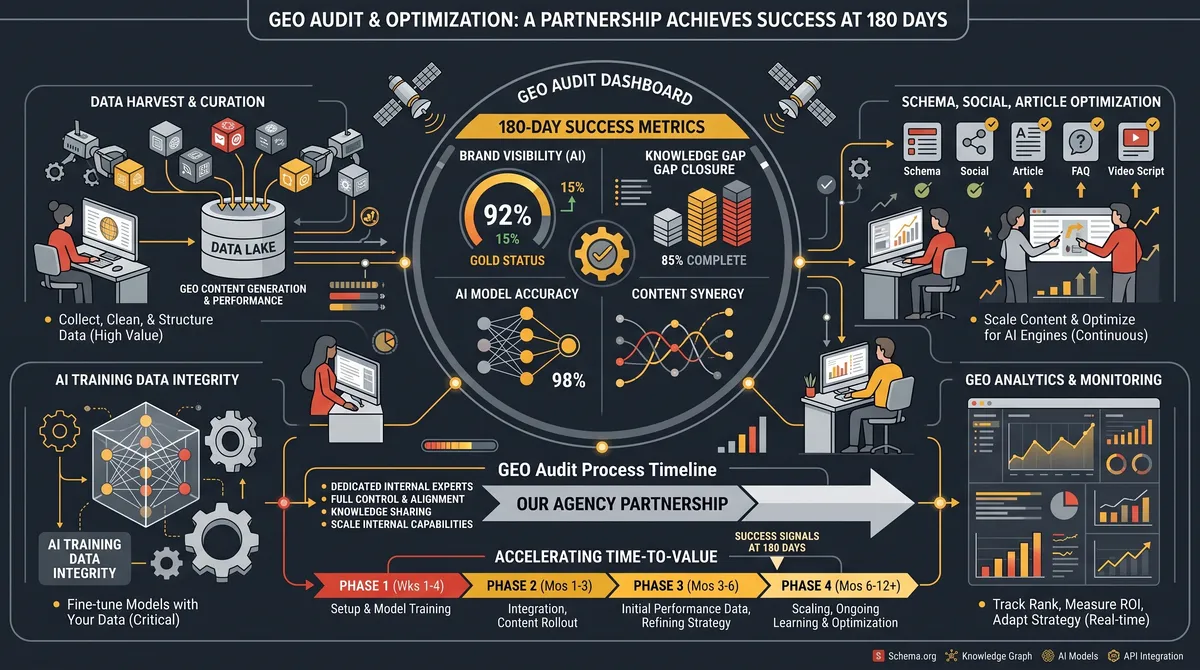
| Month 1 | Baseline prompt test, crawler access fixed, indexation verified, entity and listing consistency corrected | A documented Day 0 score and a fix list. If you cannot see a baseline, nothing that follows is measurable |
| Month 2 | Structural editing on the twenty highest-value existing pages, schema implemented | Early citation-rate movement on refreshed pages, possibly nothing yet in share of model |
| Month 3 | Cluster gaps filled, first earned-media placements in motion, first re-test | Measurable movement against the Day 0 baseline on the frozen prompt set |
| Months 4 to 6 | Citation supply compounding, refresh cycle running, second re-test | Share of model trend, competitive citation gap narrowing against named rivals |
| Months 6 to 12 | Original data published, category position defended | Payback, if the program was scoped against commercial prompts rather than definitional ones |
Month one is the row that gets skipped and it is the one that makes the other five measurable. Without a documented Day 0 number on a frozen prompt set, month six produces an argument rather than a report.
What a 30-day promise actually means
Vendor guidance in this category describes contracts under 30 days as unable to produce measurable results. Some providers offer refund guarantees tied to appearing in named queries within 45 days or nine weeks.
There are two ways to read a short guarantee. Either the provider is confident about the fast half of the work, crawler access and structure, in which case the promise is honest and narrow. Or the guarantee is measured on prompts specific enough that appearing in them is close to inevitable, in which case it is a marketing instrument.
The way to tell them apart is one question: which prompts is the guarantee measured against, and who chose them?
If the provider chose the prompts, the guarantee measures their prompt selection rather than your visibility.
One question worth sitting with. If a provider told you results in 90 days, and you asked what number they would compare against on day 90, would they be able to name the metric, the prompt set, and the Day 0 figure?
If not, then in 90 days there will be a conversation about whether it worked, and no way to settle it.