How to Get Your Business to Show Up in ChatGPT
Most businesses attempt the third step first and the first step never. The sequence is what makes it work.

8 min read
In short
Step 1: Open the doors
Nothing else in this article matters if the system cannot read your site.
Open yourdomain.com/robots.txt in a browser. OpenAI runs three separately identified crawlers with different jobs, and they can be controlled independently. Treating them as one entity is the most common technical error in this whole discipline.
| Crawler | What it does | If you block it |
|---|---|---|
| GPTBot | Collects content that may train future models | You withhold training data. Citation eligibility survives |
| OAI-SearchBot | Builds the index behind ChatGPT search results and the citations attached to them | You lose citation eligibility. This is the one that matters |
| ChatGPT-User | Fetches a specific page live during a conversation | Real-time reads stop mid-conversation |
| Bingbot | Builds the Bing index, one of several inputs to ChatGPT retrieval | You remove one retrieval input |
| CCBot | Common Crawl, feeds multiple training corpora | You leave several models' training sets |
That table gives you a legitimate middle position. If your legal team objects to training data, block GPTBot and allow OAI-SearchBot. You withhold the training material and keep your eligibility to be cited.
Blocking all of them at once removes you from the retrieval pipeline entirely and silently. Several bot management vendors did exactly that by default for a period, which means it may have happened to you without anyone deciding it.
A single Disallow line removes you with no penalty notice, no dashboard warning, and no appeal. A template robots.txt is the most common cause of total invisibility, and it is free to fix.
Step 2: Submit your sitemap to Bing
Most businesses have Google Search Console configured and have never opened Bing Webmaster Tools. Bing's index is one of several inputs ChatGPT retrieval draws on, which means Google indexation alone leaves a gap.
ChatGPT Search initially relied heavily on third-party search infrastructure including Bing, but OpenAI now also operates OAI-SearchBot and incorporates content supplied directly by publisher partners. The more accurate model is a blended retrieval stack, not a single upstream index.
Research on Bing's influence is mixed and highly methodology-dependent. Seer Interactive found that more than 87 percent of SearchGPT citations overlapped with Bing's top organic results for equivalent queries, mostly inside the top ten. Other analyses report far weaker overlap, and we are not citing those figures here because the ones circulating do not disclose their sample, date range, ChatGPT mode, or overlap method.
The practical takeaway: Bing inclusion and crawlability are table stakes, not a complete ChatGPT visibility strategy. Allow OAI-SearchBot, maintain Bing indexation, publish highly citable first-party material, use clear entity and topical signals, earn independent mentions, and track actual ChatGPT citation patterns rather than treating Bing rank as the sole indicator.
Go to Bing Webmaster Tools, add your site, verify ownership, and submit your XML sitemap. Bing allows import directly from Google Search Console, so this takes about ten minutes rather than an afternoon.
Then confirm coverage. Search site:yourdomain.com in Bing. If the page count is materially lower than the same search in Google, you have an indexation gap that no content work will overcome.
Step 3: Make your pages liftable
A model does not cite pages. It cites passages. If your page contains no passage that survives being removed from its surroundings, there is nothing to cite.
One prerequisite before the editing. OpenAI's crawlers parse HTML and do not execute JavaScript. If your headings, pricing, or product descriptions assemble in the browser after load, the crawler receives an empty shell and no amount of structural editing helps. View your page with JavaScript disabled. If the content vanishes, that is the actual problem.
Assuming the content is there, open your five most important pages and apply three edits to each.
- Move the answer to the top. Directly under the H1, before any introduction, write 40 to 60 words that answer the page's question completely. Name your business explicitly inside it. Test it by reading only that block aloud to somebody who has not seen the page. If they ask a clarifying question, it is not self-contained yet.
- Make every section stand alone. Remove backward references. No as mentioned above, no pronouns pointing at a subject named two sections earlier, no sentences that require the paragraph before them. A retrieval system pulls from the middle of documents, not only the beginning.
- Turn headings into questions. Our Services is a label and matches nothing. What does a commercial roof inspection actually include is a question and matches how people prompt.
None of this requires a redesign. It is editing, and it is the highest-return hour available on most sites.
What gets lifted, by business type
The extractable unit differs by what you sell. Find your row and write that thing in plain text.
| If you are a | The passage most likely to get lifted | What usually blocks it |
|---|---|---|
| Consumer brand | Product attributes: ingredients, sizes, certifications, use cases | Attributes live in images or in a script the crawler cannot read |
| Professional services firm | A plain definition of the service and who it is for | The page sells before it defines. There is no definition to lift |
| Home services company | Service area, turnaround, and what a job includes | Stated in a hero graphic instead of in text |
| Healthcare or medspa practice | Procedure explanation and stated credentials | Credentials in a PDF or an image. Outcome claims without substantiation get dropped |
| Faith-based organization | What you believe, who you serve, and when you gather | Implied through photography and design rather than written down |
The pattern repeats in every row. The information exists. It is not in a form a machine can lift.
Step 4: Build citation supply outside your site
This is the step that takes real budget and produces the largest effect, which is an uncomfortable combination.
Muck Rack's December 2025 analysis, What Is AI Reading, found 82 percent of AI citations come from earned media. Omniscient Digital, reviewing more than 23,000 citations, found roughly 77 percent of the sources cited about a brand are off-page.
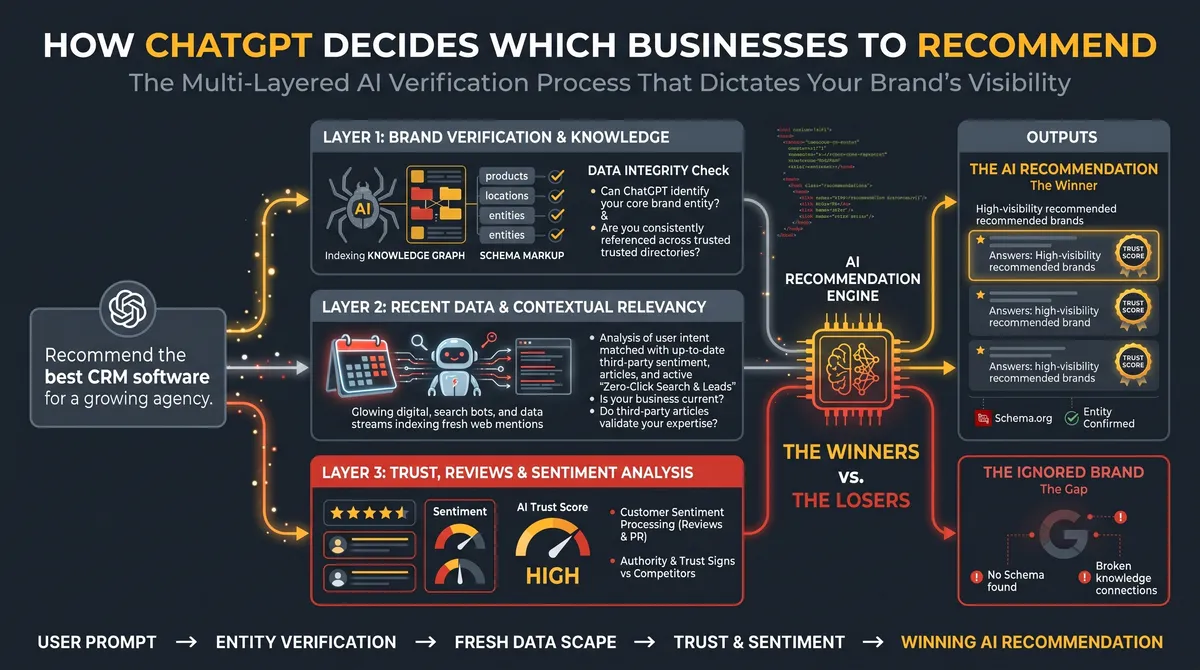
So when a model is asked whether your company is any good, it is mostly reading pages you did not write. Reviews. Roundups. Comparison articles. Trade coverage. Podcast show notes. Directory listings.
Four things move that supply, in rough order of yield.
- Publish original data. A number nobody else has is the only asset that reliably makes other people cite you by name. Every widely quoted statistic in this field exists because an organization published research specifically to be cited.
- Get listed accurately. Directories, association memberships, review platforms, local chambers. Unglamorous, cheap, and it is corroboration.
- Earn coverage. Trade press, local business press, podcasts. Slower and more expensive, and it carries the most weight.
- Be comparable. Appear in roundups and best-of pages. Buyers ask alternatives-and-comparison prompts constantly, and those answers are assembled almost entirely from third-party lists.
What does not work: manufactured mentions, mass guest posting, and generated citations. Those fall under scaled content abuse policy and carry penalty risk.
Step 5: Test whether it worked
Run five prompts in ChatGPT and log three columns each: were you mentioned, were you cited with a link, and who was named instead.
- What is [your category]?
- [Your brand] versus [competitor]
- Alternatives to [competitor]
- Best [category] for [your customer's specific situation]
- Which [category] should I buy?
Run it in a logged-out session so personalization does not flatter you. Record the date. Re-run monthly.
The third column is the one that changes internal conversations. A competitor's name in the slot where yours should be is not a marketing metric, it is a board slide.
How long this takes
The steps do not move at the same speed, and the honest answer depends on which one you are doing.
| Step | Realistic timeline |
|---|---|
| Crawler access | One crawl cycle. Days |
| Bing indexation | Days to a few weeks |
| Structural editing | Effective at next crawl, compounding after |
| Citation supply | Months, because it depends on other people publishing |
Anyone promising ChatGPT visibility in under 30 days is describing a dashboard, not a result. Nothing has finished crawling by then.
One question worth sitting with. If you did steps one through three this month and nothing else, you would be more legible than most of your competitors by the end of the quarter. So what is the actual reason those three have not happened yet?