Ministry Metrics That Matter: From Traffic to Next Steps
Most ministry teams are drowning in data and starving for direction. Your team does not need another dashboard to monitor. It needs the handful of numbers that separate doing enough from doing what matters.

Updated 6 min read

In short
More numbers is not more clarity
Every church staff has sat in the meeting. Charts on the screen, everyone nodding, nobody able to say what any of it means for Sunday. It is easy to count things simply because the tool will count them, and easy to mistake a flood of information for a sign of health.
Meanwhile the questions that actually keep a pastor up on a Tuesday night go unanswered by every dashboard in the building.
- Is this outreach reaching people who are actually searching, or is it just keeping us busy?
- Are we pouring energy into a program whose season has already ended?
- If we have one more dollar or one more hour, where does it change the most lives?
Worth knowing: none of those questions get easier with a better analytics tool. They get easier when the team agrees, in advance, on which five numbers they are willing to be held to. The tool has never been the constraint.
Five vital signs of a digital ministry
A doctor does not run every test at every visit. They check the vital signs, and the vital signs tell them where to look next. Same principle. These five track whether people are moving from casual observer to part of the family.
| Vital sign | What it means in plain terms | What a drop is telling you |
|---|---|---|
| New visitors | The digital first handshake. Someone in your community found you who had not found you before. | Your visibility problem is upstream. Fewer people are discovering the church at all, so nothing downstream can improve. |
| Engaged sessions | People leaning in rather than glancing at the sign and walking on. Real attention, not a bounce. | You are attracting the wrong people, or the page is not delivering what the search promised. Usually the second. |
| Next steps taken | Someone raising a hand. Prayer request, plan your visit, baptism inquiry, small group signup. | The ask is unclear, buried, or too big for where the person is. This is the most fixable number on the list. |
| Generosity | A tangible commitment to the mission, and one of the clearest trust signals a person can send. | Often friction rather than conviction. Check the giving flow on a phone before you conclude anything about the congregation. |
| Returning visitors | Evidence that the community is becoming a spiritual home rather than a search result somebody clicked once. | The slowest number to move and the most important one. A decline here usually shows up months before attendance does. |
Five numbers. One page. If a metric is not on this list, it does not go in the board report, no matter how good it looks.
Rock Valley Christian Church, Murrieta. A working example of this approach applied to a local congregation: which vital signs were tracked, what the reporting looked like month to month, and which decisions came out of it. Worth reading before you rebuild your own scorecard.
Four steps to lead the data instead of following it
Do not let the technology set the agenda. These four steps take one afternoon to set up and change every meeting after that.
Define what counts as a win
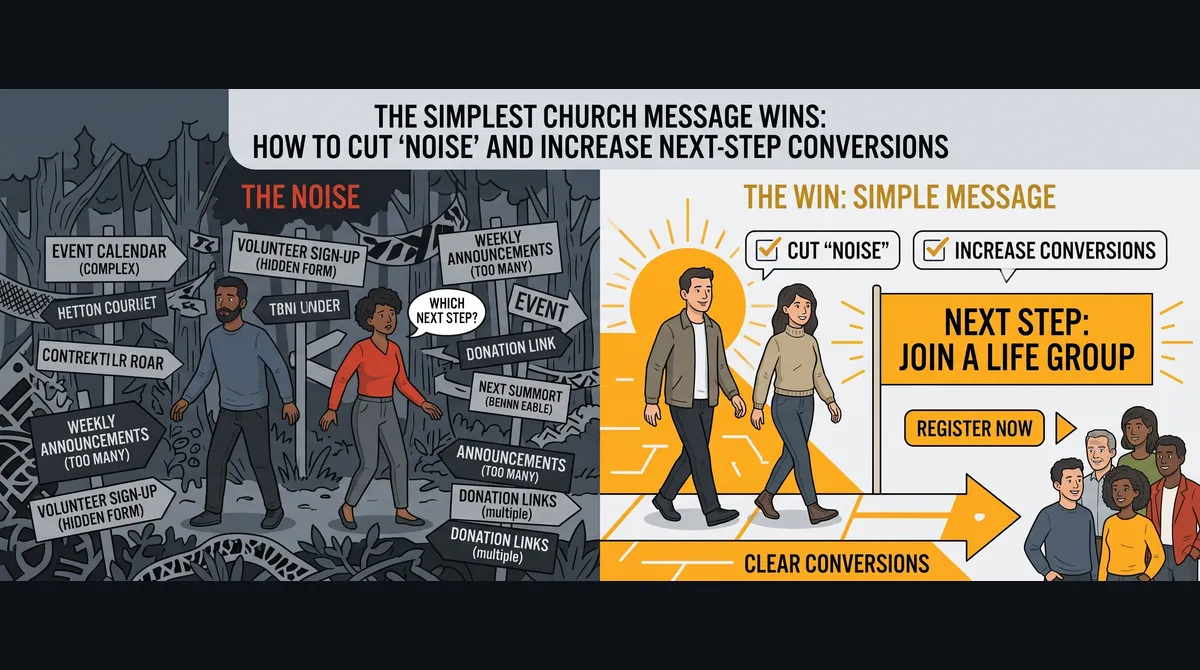
Decide what a win looks like for this season specifically. A plan your visit form. A prayer request. A new members class signup. Pick three or four and configure them as conversions. If everything is a priority, nothing is, and a report with fourteen tracked actions tells a board less than one with three.
Annotate the story behind the spikes
Data without context is just numbers. When you run a Christmas service, host a guest speaker, or launch a campaign, mark it in the report that week. A year from now the board will not see a mysterious spike. They will see the fruit of a specific decision your team made, which is how ministry work gets remembered instead of forgotten.
Hold a one-question monthly review
End the long, aimless data meeting. Once a month, sit down with the team and ask exactly one question.
Where did we see movement?
End every insight with a next step
Information is only useful if something changes because of it. Every observation gets an owner and an action, or it did not happen.
The observation: the marriage ministry page is getting significant traffic.
The next step: add a clear way to ask for help on that page, put a real person's name on it, and tell the counseling team to expect calls. Then check the number again next month.
Every report should produce one of three decisions
Analytics are not the point. Discernment is. If a month of data does not lead to one of these three, the report was a status update rather than a tool.
Invest
Something is genuinely resonating and deserves more of your limited hours. Double down on what is feeding people, and be honest about what is not.
Repair
There is a broken rung on the ladder. A page frustrating seekers, a form nobody can find, a giving flow that fails on a phone. Fix it before you add anything new.
Expand
Something is bearing fruit and is ready to reach further. This is the decision that requires the most confidence, which is exactly why it requires the clearest numbers.
You were not called to be a data scientist
Track the signs of life, not the volume of activity.
Five numbers, three or four defined wins, one monthly question, and an owner attached to every insight. That is the whole system. It fits on an index card, and it will tell you more than a dashboard with forty tiles on it.
Your mission is too significant to be left to the mystery of a spreadsheet. Move from counting clicks to noticing where people are actually moving, and let that shape where the church puts its next hour.