The 20-Minute Fix That Improves Your AI Citation Odds (And You Already Have the Content)
Most advice about AI visibility sounds like a multi-month overhaul. This one takes an afternoon, requires no new content, and you almost certainly already have everything it needs.

Updated 7 min read
In short
Why the question-and-answer shape matters so much
Think about how somebody uses one of these tools. They ask a question. The engine needs to find content that answers it clearly enough to extract and present.
Content written in flowing paragraphs, even excellent and well-researched paragraphs, requires the model to interpret and synthesize before it can use anything. Content structured as a question followed by its answer requires no interpretation at all. It already arrives in the shape the engine needs.
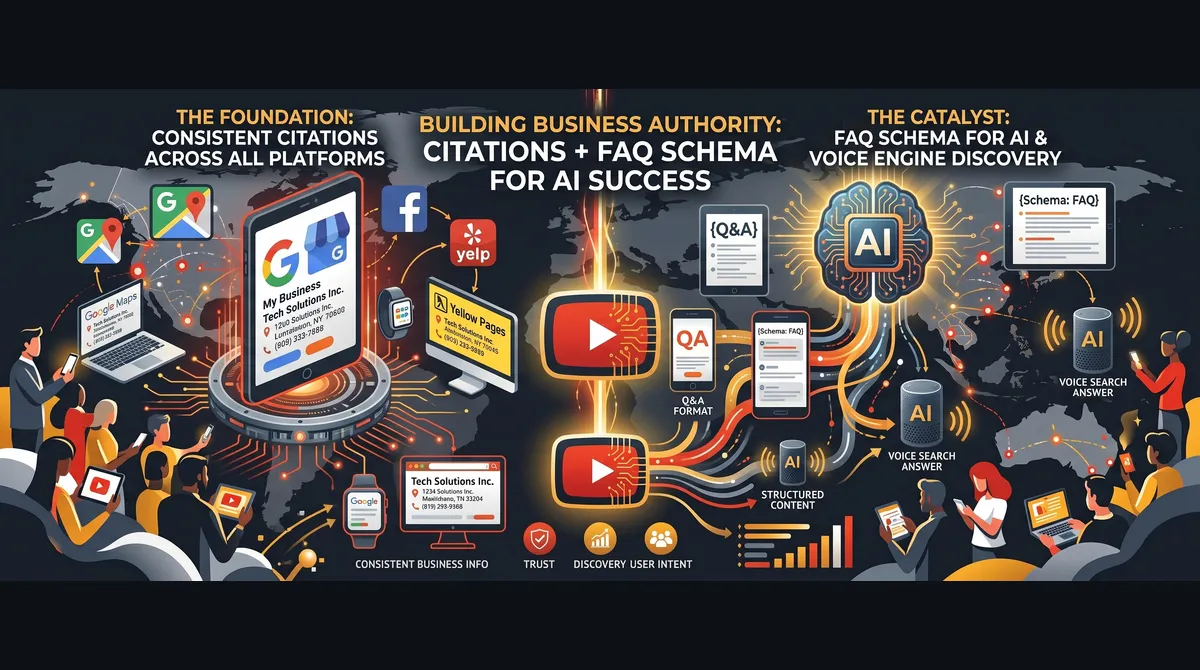
FAQ schema goes one step further. It tells the underlying code, explicitly, this block is a question and this block is its answer.
That is about as close as you can get to handing a generative engine a pre-packaged citation. No guessing where the answer starts or stops.
One expectation to set correctly: the visible expandable dropdowns this markup used to produce in Google results are now limited to a narrow set of authoritative sites. Do not implement this expecting that visual. Implement it for how AI engines read the page, which is where the value now sits.
You already wrote the content. It is just in the wrong shape.
This is what makes it an afternoon rather than a content project. Look at your service pages, your about page, anything explaining what you do or how you do it. Somewhere in there are implicit questions and answers.
We work with businesses in this industry is an answer to who do you work with. Our process starts with an audit answers what is your process. The questions are already being answered. They are simply not labeled as answers.
The task is to find three to five of these pairs on your most important page and restructure them explicitly, as a visible section marked up in the code. Here is what that looks like.
The prose you have now
We work with mid-sized businesses across Southern California, typically companies between five and fifty million in revenue, who need senior-level marketing strategy without the cost of a full in-house team.
The same information, restructured
What size companies do you work with?
Mid-sized businesses in Southern California, typically between five and fifty million in annual revenue.
What do you offer that hiring in-house does not?
Senior-level marketing strategy and execution without the overhead of building a full internal team.
Same information. Completely different shape. One is prose a person reads. The other is a block an engine can lift directly into an answer without deciding where it begins or ends.
The format is the container. This is what to put in it.
Being precise here matters, because it changes what you actually write. Researchers from Princeton and Georgia Tech published the founding academic study on this at KDD 2024, testing nine content tactics across ten thousand queries.
The study did not test FAQ markup. It tested what content contains. So the honest reading is this: the FAQ structure gives an engine a clean block to lift, and the research tells you what to load into that block. Five tactics worked.
| What worked | Measured lift | What that means in an FAQ answer |
|---|---|---|
| Adding statistics | +41% | Replace vague claims with numbers. Between five and fifty million beats mid-sized. The specific figure is the citable part. |
| Adding quotations | ~28% | A line from a named client or a recognized source, inside the answer rather than off in a testimonial section. |
| Citing sources | Large | Counterintuitive but consistent: citing others makes you more citable. The effect was strongest for lower-ranked pages, which is most pages. |
| Fluency | Meaningful | Clear sentences beat dense ones, with no new information added. Convoluted writing works against you even when the substance is strong. |
| Authoritative voice | Meaningful | Answer with confidence rather than hedging. An answer full of qualifiers is harder to lift cleanly. |
Aggarwal et al., GEO: Generative Engine Optimization, KDD 2024. Nine tactics tested across roughly ten thousand queries. Reported lifts vary by metric and domain.
Four of the nine tactics did nothing, or actively hurt. Keyword stuffing. Simplifying language for its own sake. Padding content out to length. Purely persuasive language with no substance behind it.
That list is worth as much as the first one, because it describes what a great many service pages currently do. If your FAQ answers are long, enthusiastic, and light on specifics, you have built the right container and filled it with the wrong thing.
Four steps, one page
Do not attempt this across the whole site. One page, done properly, will teach you more than twelve done hastily.
Pick the page that answers who should I hire
Usually your homepage or your primary services page. Not your blog. You want the page that would need to be right if somebody asked an assistant for a recommendation in your category today.
Pull out three to five implicit questions
Read the page and note every place it answers something without being asked. Who you serve, what you cost, how long it takes, what happens first, what makes you different. Write each as a real question a stranger would type.
Write answers that stand alone, with specifics in them
Each answer must make complete sense to somebody who has read nothing else on the page, because that is exactly the condition it will be read in. Then apply the research: put a real number in it, cite a source where you have one, and drop the hedging.
Publish the visible section, then add the markup
The questions and answers go on the page as readable text, not hidden behind a script. On most content systems this is a custom HTML block plus a small script in the page head, and a developer can usually do it the same day once the pairs are written.
Sequence matters: publish the visible content first, let it get crawled, then add the markup. Schema describes what is on a page. Labeling content nothing has seen yet is describing a room nobody has entered.
Best effort-to-impact ratio available. Not the whole picture.
This is one of six dimensions that determine whether AI engines find and recommend you, and it is the one with the best return for the time invested. That is why it is worth doing first, this week, before anything larger.
It is not sufficient on its own. Entity clarity, content authority, citation worthiness, external presence, and technical foundation all matter, and a perfectly marked-up page that nobody else on the internet references still struggles to get recommended.
Start with the afternoon fix. Then find out what else is on the list.