The Digital Front Porch: Make It Easy to Find Your Church
Nobody clicks through five pages to find a volunteer link anymore. If the path to participation is not obvious, the opportunity is gone, and you will never know it existed.

Updated 7 min read
In short
Search is collapsing the middle steps
The old path had four stops. Search the church, click the link, hunt for the events page, look for a signup button. Every stop was a chance to give up, and plenty of people did.
That path is compressing. AI answers surface a direct response instead of a list of links, and people increasingly expect to act from wherever they are rather than navigate to where you want them. The practical implication does not depend on any particular feature launch: the number of steps a person is willing to take has dropped, and it is not going back up.
A note on expectations: booking directly from a search result is available in some industries through specific integrations, and it is not something a church gets automatically by publishing an event page. Do not wait for that. Shorten your own path instead, which you control completely.
In ministry there are no customers. There are people trying to take a courageous step, usually on a hard day. Five of those steps account for nearly everything that happens on a church website.
- Cross the threshold. Plan a first visit so they do not have to walk in cold and alone.
- Find their purpose. Sign up to serve and put their gifts somewhere useful.
- Reach for help. Request the counseling or assistance they have been praying about for weeks.
- Enter community. Register for a retreat or a group where life change actually happens.
- Find a shepherd. Start a conversation with a pastor who will walk beside them.
They are not uninterested. They are tired.
It is comfortable to assume people do not engage because they do not care. The harder answer is that we made it too much work.
Consider who is actually on the other end. Someone at a hospital bedside. A parent in a parking lot who has just decided this is the week. A person three months into something they have told nobody about. When life is heavy, every extra click is a reason to quit.
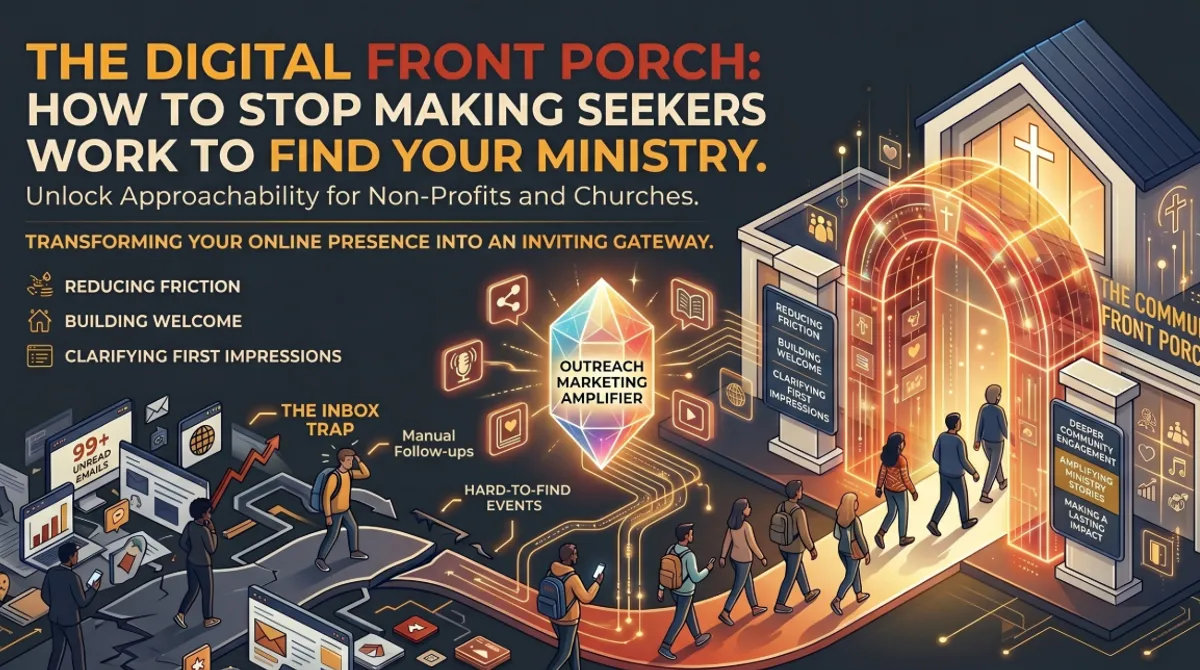
They do not abandon a fourteen-field form because they stopped caring about God. They abandon it because they are exhausted by everything else, and your form asked them for one more thing at the wrong moment. Removing friction is not a marketing tactic here. It is hospitality applied to a website.
The Big Four gateway pages
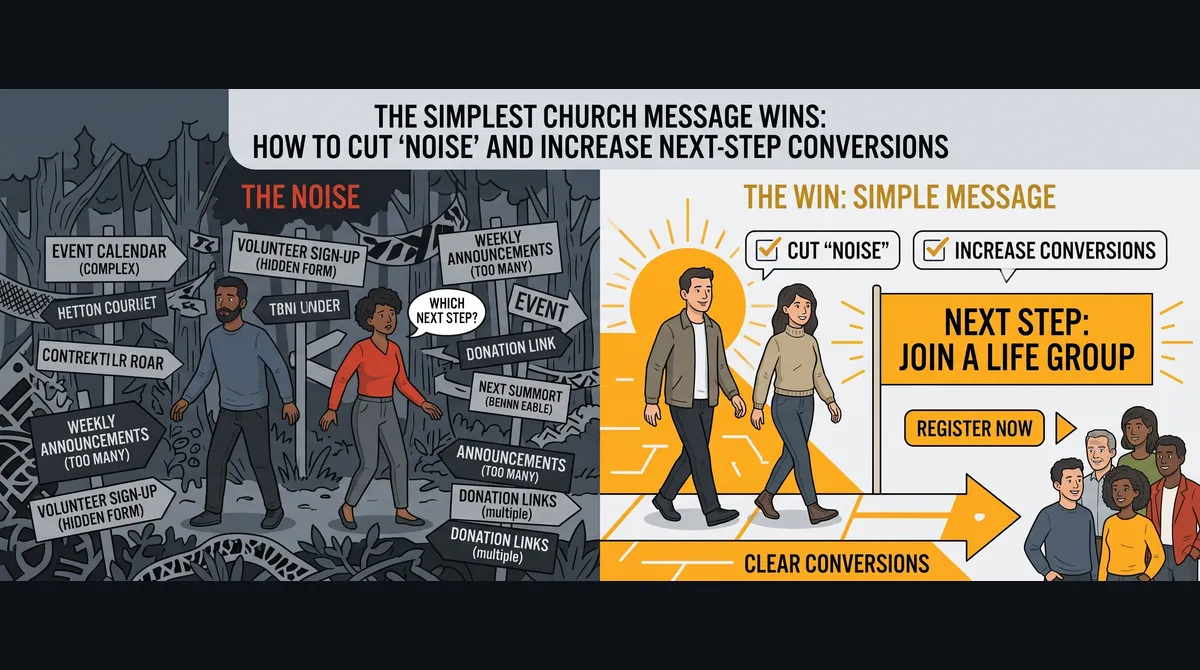
A great church website is not a hundred pages of information. It is the removal of every obstacle between a person's need and the help you offer. Replace the maze with four straight paths.
Each one does exactly one job. One page, one action, no competing asks. That last part is where most churches break the pattern, usually by adding a giving prompt to the counseling page.
The welcome mat
Everything a guest needs to walk through the doors this Sunday. Service times, where to park, what people wear, what happens to their kids, and what the first ten minutes will feel like.
One action: plan your visit.
The offering plate
Secure, fast, and free of distraction. Say plainly where the money goes. Test the whole flow on a phone, because that is where most giving now starts and stops.
One action: give.
The workers' entrance
A simple way to say I am in, how can I help. List the roles that are genuinely open right now, and say how much time each one actually takes.
One action: volunteer.
The lifeline
Prayer, counseling, and practical assistance. Put a real name and a real response time on this page. Someone arriving here is having the hardest day of anyone on your site.
One action: ask for help.
Four design decisions that remove friction
Stop thinking of the website as a brochure. Think of it as a conversation with someone who is nervous. These four make that conversation feel natural.
Issue the invitation twice
Repetition is not pushy, it is helpful. You would not give an altar call only at the start of a service and then hide the aisle. Put the same next-step button near the top of the page and again at the bottom, so it is there when someone is ready rather than when you decided they should be. Same words both times.
Shorten every form
You would not ask for someone's life story before shaking their hand. Treat the form the same way. Name, email, phone. That is the handshake. Everything else can come in the follow-up conversation, where it belongs anyway.
Test it yourself: open your own prayer request form on a phone and count the fields. If you would hesitate to fill it out on a bad day, so will they.
Treat speed as the front door
Most of your community finds you standing in a grocery line or sitting in a waiting room. A slow site on a phone reads as a closed sign, and nobody waits to find out otherwise. Speed is the digital version of answering the door promptly, and it is usually the cheapest improvement on this list.
Let people book real time
For high-trust moments, we will get back to you is a gap where doubt grows. A live calendar closes it. Four places it earns its keep.
- Counseling intake. A named time on a calendar is peace of mind for someone in crisis tonight.
- Next step meetings. A clear path for a new visitor who is ready for more than a Sunday.
- Volunteer interviews. Honoring the time of people who already offered it.
- Partnership conversations. A straight path for donors and sponsors who want to talk before they commit.
Rock Valley Christian Church, Murrieta. A working example of gateway pages, shortened forms, and mobile-first design applied to a local congregation. Useful to look at before you decide what to rebuild first on your own site.
The churches that grow will be the easiest to say yes to
Remove the steps between someone's curiosity and their first real move.
None of this requires a redesign or a budget. Four pages that each do one thing. A button in two places instead of one. Three form fields instead of twelve. A site that loads before someone gives up. A calendar where a real conversation can be scheduled.
In a world this loud and this tired, the path to your church should be the easiest part of somebody's week. That is worth an afternoon of work.