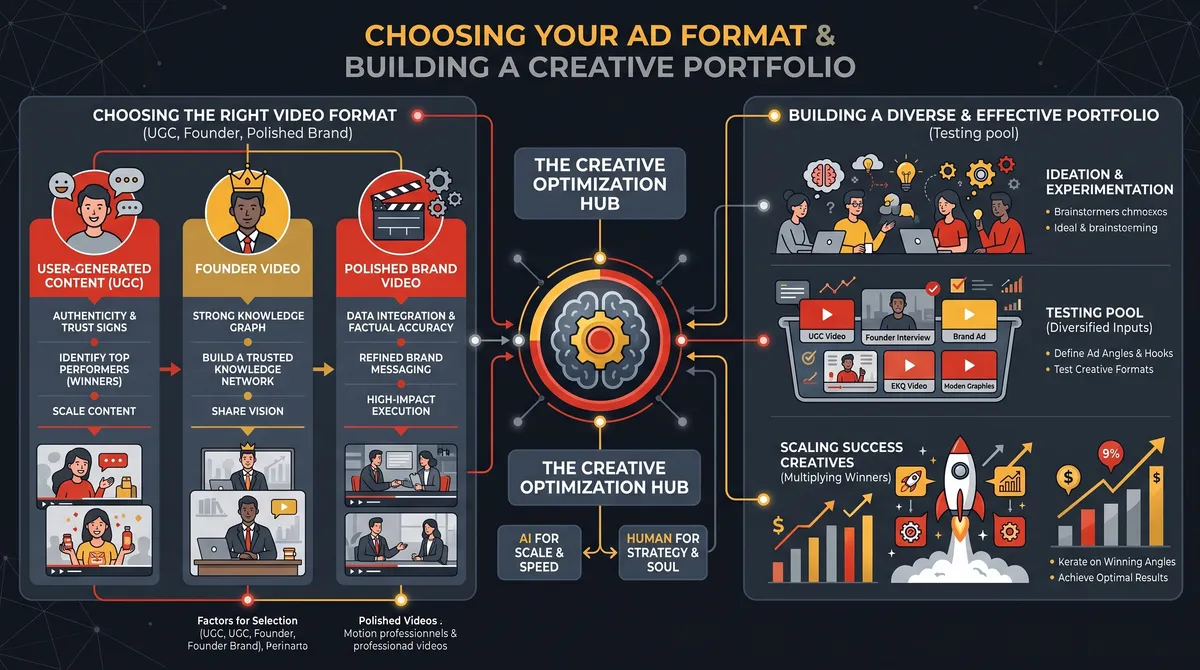
UGC, Founder Video, or Polished Brand Video?
You don't have to choose one. The strongest accounts use fast formats to find ideas and polished production to scale the ones that already proved themselves.

5 min read
In short
Creative outweighs targeting, by a lot
NCSolutions analyzed nearly 450 consumer brand campaigns across digital and television and measured what actually drove incremental sales. This is the 2023 update of their study, so treat it as a durable finding rather than a current measurement.
| Driver | Share of sales lift |
|---|---|
| Creative | 49% |
| Reach | 22% |
| Brand | 21% |
| Targeting | 11% |
| Recency | 5% |
NCSolutions, Five Keys to Advertising Effectiveness, 2023 update. Nearly 450 consumer brand campaigns across digital and television.
When Advertiser Perceptions surveyed marketers about the same question, they believed targeting was the biggest driver. The measurement put it fourth.
One caveat worth holding onto. This study covers consumer packaged goods rather than social ads specifically. It is the most rigorous public measurement available on the question, and it matches what Meta's system now rewards, since the ad itself helps choose its audience.
Creative and targeting are not separate levers anymore. On Meta, the creative is a targeting input, which means the 49 percent and the 11 percent are converging.
What ranks, by hit rate
Motion's 2026 Creative Benchmarks ranked asset types by hit rate, meaning the share of ads that became winners.
- Leaders: text-only ads, product images with text, lifestyle-product images, and customer-style video.
- Middle of the pack: high-production video.
- Bottom: animation and carousels.
Text-forward and customer-style ads win because they are fast to make and fast to change. High production earns its place as a scaling layer, not a discovery layer.
If you are not an ecommerce brand
Motion's dataset is heavy on ecommerce and includes the holiday shopping season. The principle carries over. The formats need translating, and most businesses reading this are not selling a product from a photo.
| Ecommerce format | Home services or contractor | Clinic or practice | Church or nonprofit |
|---|---|---|---|
| Text-only ad | A specific symptom named on a clean card. Leak after the first rain? | A question a patient actually asks, stated plainly | Service times and location, stated without decoration |
| Customer-style video | A technician explaining a warning sign on a phone | A staff member answering the question people call about | A member describing what a first visit was like |
| Product image with text | Before and after of finished work | The space itself, with what to expect on arrival | A photo of the actual room, not a stock congregation |
| Demo | A walk-through of your process, start to finish | What the first appointment actually involves | What happens in the first fifteen minutes |
Every column is the same idea: name a specific thing a real person worries about, and show it without polish. The production value was never the variable.
Three layers, three jobs
| Layer | Job | Formats | Production |
|---|---|---|---|
| Discover | Find ideas that land | Text cards, phone video, founder talking head, customer quotes | Fast and simple |
| Sustain | Keep proven ideas fresh | Lifestyle images, hybrid edits, GIFs | Medium |
| Scale | Put weight behind winners | Polished video, professional shoots | High |
The rule that holds it together: only produce high-end versions of ideas that already won.
A $10,000 shoot for an untested idea is a gamble. The same shoot for a proven idea is an investment.
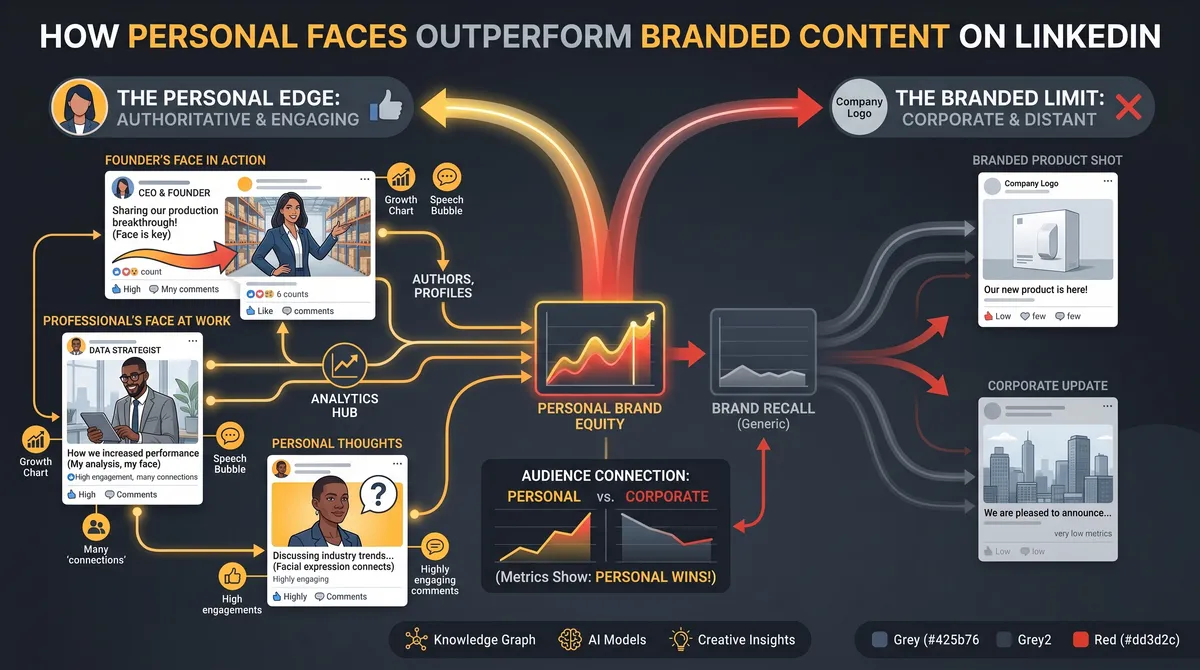
Founder video belongs in the discovery layer. It is fast to make, it carries trust, and it appears as a tracked format in Motion's Meta benchmarks. On LinkedIn, the platform's own materials put employee posts at roughly twice the click-through rate of company page posts.
Match the hook to the moment
Motion found hooks fall into two groups, and they do different jobs.
- Promotional hooks like newness, price anchors, urgency, and announcements give people a reason to act now. They fit people who already know you.
- Pattern-interrupt hooks like confessions, contrarian takes, warnings, and myth busting stop strangers mid-scroll. Riskier, and they reach new audiences.
Do not test only the top five hooks. Motion recommends keeping a standing slot for riskier ideas.
That slot is where new winners come from. An account that only tests proven hooks converges on a shrinking set of ideas.
Your first portfolio, in seven steps
- List 5 to 8 customer problems in your customers' own words.
- Pick 8 distinct ideas. Each should change the problem, the proof, or the format.
- Make discovery versions fast. Text cards, phone video, and a founder take.
- Post organically first. Watch saves, shares, comments, and watch time.
- Promote the proven ideas with paid budget.
- Produce polished versions of the ideas that win in paid.
- Record what won and why in a living document, so each round starts smarter than the last.
Step seven is the one everybody skips, and it is the only step that makes the next round cheaper than this one.
Sources
NCSolutions, Five Keys to Advertising Effectiveness, 2023 update, covering nearly 450 consumer brand campaigns across digital and television in the consumer packaged goods category. Advertiser Perceptions marketer survey on perceived performance drivers. Motion, Creative Benchmarks 2026, for asset type hit rates and hook tactics. Motion's dataset is weighted toward ecommerce and includes the holiday shopping season. LinkedIn Business, Thought Leader Ads product page, for the employee post click-through comparison. Format translations for non-ecommerce categories are CCG operating guidance rather than published research.