Why Founder-Led Content Beats Your Company Page
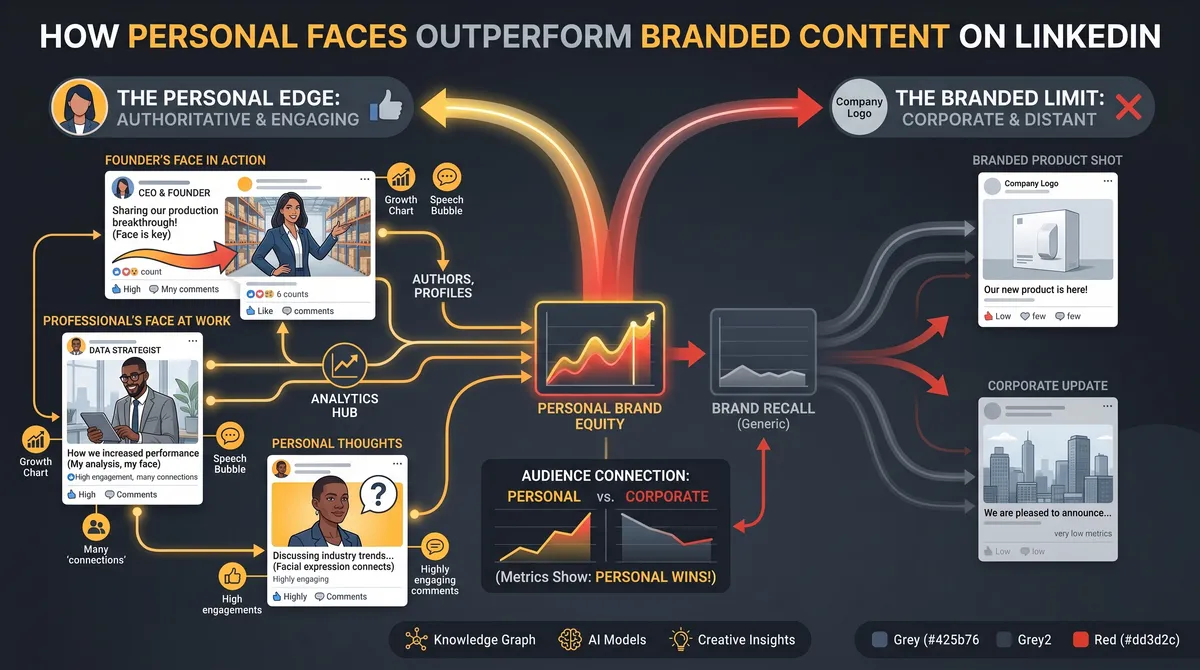
People trust people. LinkedIn's own data says posts from employees earn roughly twice the click-through rate of the same content from a company page.

4 min read
In short
The platform says so itself
Most claims about personal branding come from agencies selling personal branding. This one comes from LinkedIn, describing its own product.
About 2× click-through rate, employee posts against company page posts
Same content. Different sender. Double the clicks
LinkedIn Business, Thought Leader Ads product page
That figure reframes the question. Founder-led content is not a branding exercise layered on top of distribution. It is better distribution.
The pattern holds outside LinkedIn too. A Nielsen study from 2021, still widely cited, found 88 percent of consumers trust recommendations from people they know above all other forms of advertising. That study is five years old and reaches most readers through secondary coverage, so treat it as a durable directional finding rather than a current measurement.
A logo cannot have an opinion. A person can, and that is the entire advantage.
What Thought Leader Ads actually do
They let a company promote a personal post as an ad. Four details worth knowing before you plan around them.
- Anyone can be the voice. LinkedIn expanded these beyond employees, so a founder, a subject-matter expert, a customer, or a partner can be the named author.
- Permission is required. The person grants access before you can promote their post.
- The post stays theirs. It runs under their name and profile, not the company page's.
- Engagement accrues to the person. Comments and follows land on their profile, which compounds over time.
That last point cuts both ways and deserves an honest conversation before you start. The audience you build attaches to a person rather than to the company, which is an asset while they are with you and a question worth asking in advance if they might not be.
What to post, and what to skip
The trust advantage disappears the moment the post sounds like a press release.
| Post this | Not this |
|---|---|
| A specific lesson from real work | Generic industry commentary anyone could have written |
| A clear opinion you would defend | Safe positions nobody disagrees with |
| A story about a customer problem you solved | A company announcement in first person |
| Something you learned the hard way | A rewritten blog post intro |
If the post could run just as well from the company page, it will not earn the trust advantage that made you choose a person in the first place.
Five steps
- Pick the right voice. The person who actually talks to customers, not whoever has the biggest title.
- Post organically first. Find out what resonates before you spend anything.
- Promote what earned attention. Use Thought Leader Ads on posts that already drew real saves, shares, and comments.
- Keep the person involved. Someone has to reply to the comments, and it should be the author.
- Judge it on conversations started, not impressions.
Step two is the one that gets skipped, and it is the one that tells you whether there is anything worth funding.
If you work in a regulated industry
Personal-voice content is not exempt from review. Financial services, healthcare, legal, insurance, and several other sectors carry content approval requirements that apply to what a named individual publishes on behalf of a firm, just as they apply to a company page.
The informal register that makes founder-led content work is exactly what makes it easy to publish without thinking about review. A personal post promoted as a paid ad is company advertising regardless of whose name sits at the top.
Build the approval step into the workflow before the first post rather than after the first problem. It costs a day. The alternative does not.
Sources
LinkedIn Business, Thought Leader Ads product page, for the employee post click-through comparison and the expansion beyond employees. LinkedIn Marketing Solutions Help, Thought Leader Ads requirements. Nielsen trust in advertising study, 2021, cited here via Sprout Social, 2024, and presented as a durable directional finding rather than a current measurement. Compliance requirements vary by industry and jurisdiction, and nothing here is legal advice.