What ChatGPT Thinks About Your Brand (And How to Check)
Knowing you are invisible in AI answers is the easy half. Knowing why is the half that determines what you do next, and the same score can point at three unrelated problems.

Updated 6 min read
In short
What does AI already believe about you?
Before you commit to a content calendar, a paid media spend, or a rebrand, that question is worth answering. Not what you assume it believes. What it actually says, right now, when a real buyer asks a real question.
You have analytics. You have a rankings dashboard. You very likely do not have an answer to this one, and most brands substitute a hunch. We probably show up. I doubt our competitor is ahead of us there. Hunches are expensive when they are wrong, and this one usually is.
But getting the score is the easy half, and it is where most of this conversation stops. A number tells you that you have a problem. It does not tell you which problem, and there are three of them wearing the same disguise.
Same score, three causes, three unrelated fixes
This is the part that decides whether a measurement was worth running. Two brands can score identically and need nothing in common.
| The cause | What it looks like in the results | What actually fixes it |
|---|---|---|
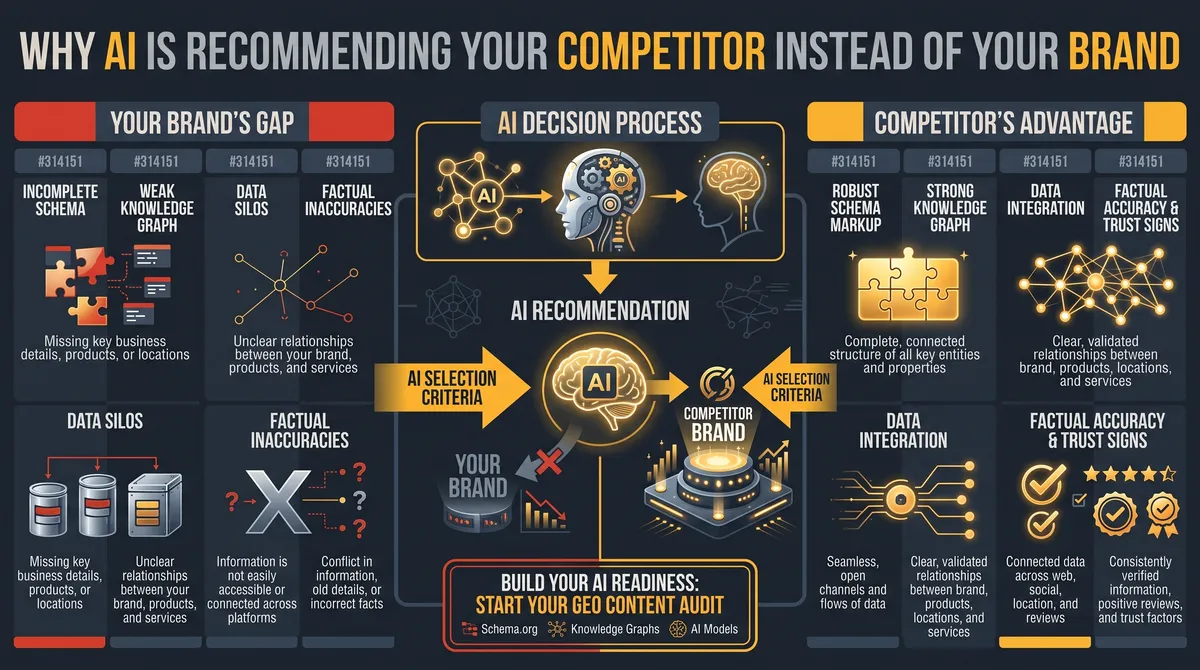
| External absence | You never appear, on any phrasing, in any engine. Competitors with thinner offerings appear consistently. | Third-party presence. Directory listings, industry references, partner mentions, real contributions to real conversations. The slowest fix, and the only one that works here. |
| Structural illegibility | You are clearly referenced elsewhere, and still rarely quoted. Engines summarize around you rather than lifting from you. | Structure. Real tables, clear headers, question-and-answer blocks, schema markup, answers written to stand alone. An afternoon of work, and the cheapest fix on this list. |
| Entity confusion | You appear on some phrasings and vanish on others. Or you appear and get described using a service you dropped two years ago. | Consistency. One name, one description, one category, written identically everywhere it appears. Free, fast, and the most commonly skipped. |
Building third-party presence when your real problem is inconsistent naming means every new mention adds another slightly different version of you to the pile.
That is the expensive mistake, and it is the default one, because external presence is the fix everybody has heard of. Diagnose before you prescribe.
Four readings that separate the three causes
You cannot tell the three apart from a single number. You can tell them apart from four, and each one rules something out.
- Mention frequency. How often you appear on category-level questions, benchmarked against your three closest competitors using identical prompts. Consistent absence across every phrasing points at external presence. Intermittent absence points at entity confusion.
- Accuracy of the description. When you do appear, is the representation correct? A brand can be mentioned and still be misrepresented: outdated pricing, a discontinued service, an old positioning line repeated as current fact. That is a different problem than invisibility and it needs a different fix.
- Structural readability. Whether your content is built so crawlers and knowledge graphs can parse it. Well-written content that is poorly structured gets skipped, not because it is weak, but because it is unreadable to the system trying to extract from it.
- Competitive benchmark. A side-by-side rate comparison against the competitors actually appearing in the same prompts, which are frequently not the ones you named going in. The list of who shows up instead of you is usually the most useful output of the whole exercise.
Run the prompts across all four major engines, not one. Each draws on different training data and different live sources, so strong presence in one guarantees nothing about the others. A brand doing well in Perplexity and absent from ChatGPT has a specific, findable reason for that split.
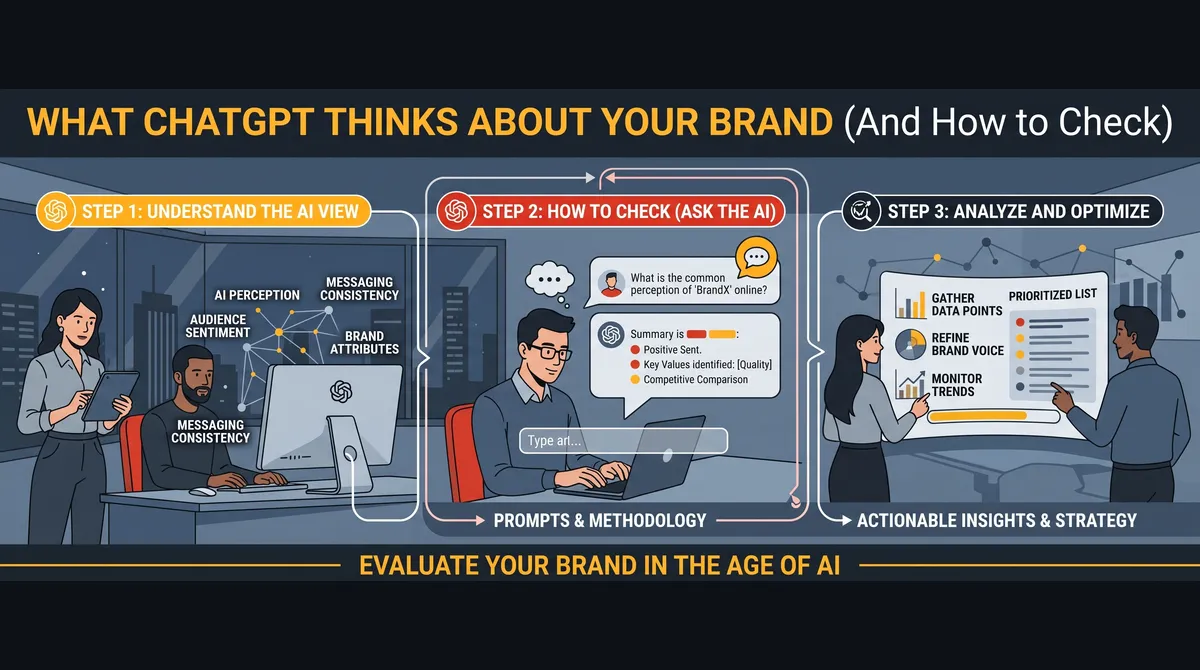
Four steps that produce a usable baseline
Rather than a data dump nobody acts on. The fourth step is where the value is, and it is the one most audits skip.
Select prompts your actual buyers would ask
Not generic industry keywords. The specific question formats a real prospect types before they ever contact a vendor. If you cannot write five of these from memory, that is itself a finding.
Run them across all four engines
ChatGPT, Claude, Gemini, and Perplexity. Different training data, different live sources, different results. The pattern of which engines carry you and which do not is diagnostic in itself.
Score what comes back
Mention frequency, accuracy of description, and how you stack up against the named competitors appearing in the same responses.
Diagnose the structural cause
External absence, structural illegibility, or entity confusion. This step is the product. Everything before it is just evidence gathering, and an audit that hands you a score without a cause has handed you a number you cannot spend.
The baseline is not preparation for the work
You would not greenlight a media buy without knowing your current conversion rate. The same logic applies here, and it is not a metaphor. Content strategy without a diagnosis is a prescription written before an examination.
The baseline is not a nice-to-have before the real work. It is the first real work. Everything after it either closes a measured gap, or it is a guess wearing a strategy's clothes.
One question worth sitting with before you go further. What would you guess your mention frequency is against your closest competitor? Write the number down before you test. The gap between your guess and the result is the more interesting finding.