What Does Generative Engine Optimization Cost in 2026?
Almost nobody in this category publishes a rate card, which is why every discovery call starts with the same guessing game. The arithmetic is not complicated.

8 min read
In short
What the market sells
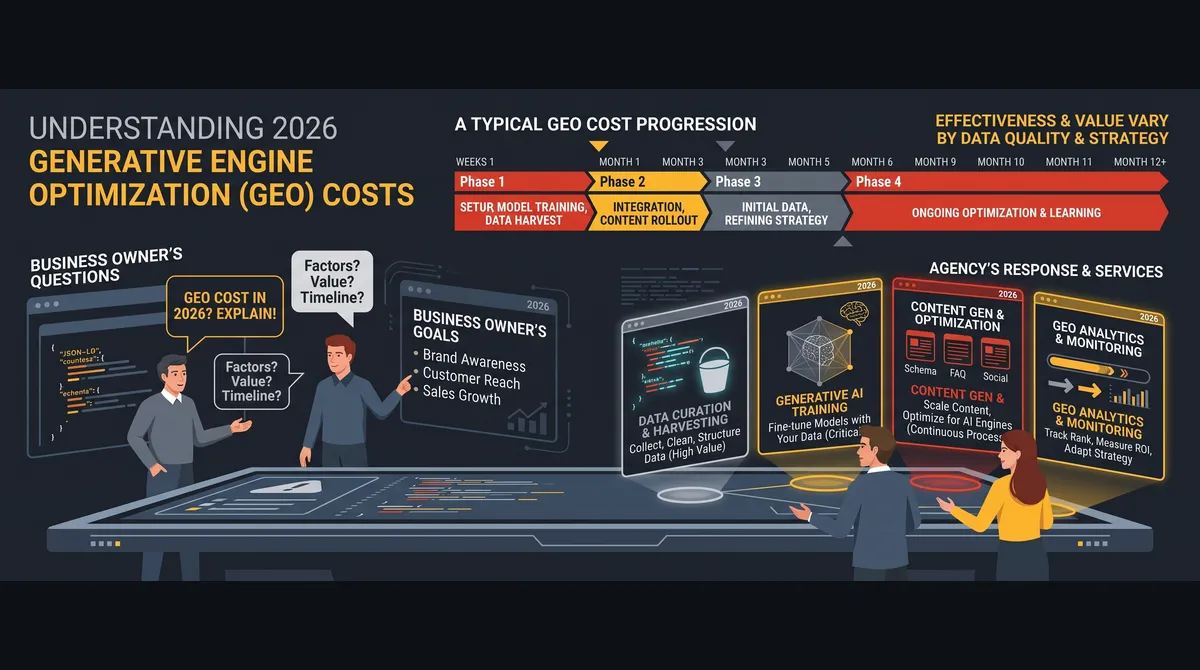
Published GEO pricing comes from market compilations rather than research, so this page compares scope rather than quoting ranges. Scope varies more in this category than in traditional search.
| Engagement | What it usually covers |
|---|---|
| One-time GEO audit | Baseline prompt test, technical access review, entity and structured data assessment, prioritized fix roadmap |
| Small business retainer | Single category, limited engine coverage, on-site structural work |
| Mid-market retainer | Multi-engine testing, structural editing, entity work, some citation supply |
| Boutique specialist | Named methodology, proprietary scoring, deeper off-site work |
| Enterprise program | Multi-category, multi-market, integrated PR and data publishing |
| Local, single location | Listing consistency, local prompt set, profile and directory work |
| Local, multi-location | The same, scaled across locations with consistency enforcement |
| Digital PR, standalone | Earned coverage and citation supply only |
| Monitoring software | Measurement only. No execution |
Note the last row against the ones above it. Monitoring software is doing a completely different job. A tool tells you that you are invisible. It does not make you visible.
Why GEO costs more than SEO
Because it is a superset, and the added work is the expensive part.
Ahrefs surveyed 439 agencies in 2024 and found the most common SEO retainer sat at $500 to $1,000 per month. That figure is two years old and worth treating as a floor rather than a current benchmark, but even against a generous update, a full GEO retainer is a multiple large enough to deserve an itemized explanation rather than a positioning statement.
Four cost drivers account for the difference.
Multi-engine measurement
SEO measures one system. GEO measures four or more, each behaving differently. SOCi's 2026 Local Visibility Index found ChatGPT surfaces a local business 1.2 percent of the time against Gemini at 11 percent, so testing one engine and inferring the rest is not a shortcut, it is a different answer.
Monthly cadence instead of quarterly
Amsive found half of all AI-cited content is less than 13 weeks old, and AirOps found pages unrefreshed for three months are more than three times as likely to lose citations entirely. Three to four times the reporting frequency costs three to four times the analyst hours.
Off-site citation supply
Roughly 82 percent of AI citations come from earned media, per Muck Rack's December 2025 analysis. That work prices closer to PR than to content. A GEO retainer that includes real off-site work is absorbing most of a PR retainer inside it.
Proof density in content
Research presented at KDD 2024 by Aggarwal and colleagues measured citation lift across roughly 10,000 queries. Adding statistics produced the largest single lift at about 41 percent, citing external sources produced gains up to 115 percent for lower-ranked content, and adding quotations lifted visibility around 28 percent. Sourced, quoted, verified content takes materially longer to produce than keyword-optimized content, and the verification is not optional.
None of those four are optional and none of them existed in a 2019 SEO scope.
Bottom-up budget math
Top-down pricing tells you what the market charges. Bottom-up math tells you whether you can afford it, and the two should meet.
Gartner's 2025 CMO Spend Survey put marketing at 7.7 percent of company revenue, with 61.1 percent of that going to digital. Conductor's 2026 survey of more than 250 senior marketing executives put average GEO allocation at about 12 percent of digital marketing budget, with 94 percent planning to increase it.
| Step | Calculation | Result |
|---|---|---|
| Marketing budget | $10,000,000 at 7.7% | $770,000 per year |
| Digital share | $770,000 at 61.1% | $470,470 per year |
| GEO allocation | $470,470 at 12% | $56,456 per year |
| Monthly | Divided by 12 | About $4,700 per month |
Two caveats stated plainly. The Conductor figure is a vendor survey rather than independent research, and it describes enterprise budgets rather than mid-market ones. Use this as a sanity check on a proposal, not as a target.
What each budget size should buy
| If your revenue is | What that buys | What it will not buy |
|---|---|---|
| Under $5M | Audit plus technical fixes plus listing consistency. Largely one-time work | Ongoing citation supply or multi-category coverage |
| $5M to $20M | One category worked properly. Multi-engine testing, structural editing, some earned media | Multi-category or multi-market programs |
| $20M to $100M | Multiple categories, real citation supply, original data once a year | Enterprise-scale international coverage |
| $100M and up | Integrated program across PR, content, technical, and data publishing | Nothing much. At this level scope is the constraint, not budget |
| Local, single location | Listings, local prompt set, profile work, on-site structure | Trade coverage or original research |
The first row is the honest one. Under $5 million, a large share of the value is in one-time work that does not need a permanent retainer, and a provider who insists otherwise is selling continuity rather than outcomes.
What a price below $1,500 actually means
Not a judgment about any specific provider. Arithmetic.
At $1,500 per month, after margin and overhead, a provider has roughly six to ten working hours. Now list what a real GEO scope requires monthly: running a 25-prompt set across four engines, logging and analyzing 100 responses, structural editing on existing pages, entity and listing consistency checks, and any off-site citation work at all.
That does not fit. Something is being dropped, and it is almost always the off-site work, which is the 82 percent.
A price far below what the scope needs is a scope statement, whether or not anyone says so.
When the price is too high for what you need
Symmetry matters here, and most agency pricing pages skip this half. Three situations where a full retainer is the wrong purchase.
- You have not run a baseline. Buy the audit. A diagnosis costs a fraction of a retainer and frequently makes the case for one on its own. Buying a retainer before a diagnosis is buying a treatment plan for an unnamed condition.
- Your problem is technical and finite. If the audit finds blocked crawlers, broken schema, and inconsistent listings, that is a project, not a program. Pay for the project. Re-test in 90 days.
- You have in-house execution capacity. If you have technical, content, and PR functions that can act on findings, buy measurement and strategy rather than delivery hours.
Worth knowing before you pay for a diagnosis: some providers, this one included, run the baseline audit at no cost. The scope above tells you what the work involves. It does not mean you have to pay it to find out where you stand.
Four questions that size any proposal
- How many engines, and does the price scale with them? Four engines is four times the measurement work of one.
- What percentage of hours is off-site? If the answer is near zero, the proposal is aimed at the smaller half of the citation supply.
- Is the baseline included, and delivered before the work starts? A program without a Day 0 number is unmeasurable by construction.
- What is the refresh commitment? Pages unrefreshed for three months are more than three times as likely to lose citations. A proposal with no maintenance line has priced a launch, not a program.
Any proposal that answers those four clearly is comparable to any other proposal that does. That is the entire point of publishing this page.
One question worth sitting with. Take the last GEO proposal you received and divide the monthly fee by an hourly rate you consider reasonable. Then list what the scope says will happen every month.
If the hours do not cover the list, the difference is not efficiency. It is something that will not get done, and you will find out in month four.