Why AI Can’t Find Your Business (And Why More Content Won’t Fix It)
Someone on your team asked ChatGPT about your category last Tuesday and your company never came up. Your competitor, with half your content and a weaker ranking, appeared three times. That is not a content problem.

Updated 8 min read
In short
Search returned a list. AI returns a decision.
For twenty years search worked like a library index. Pages got crawled, keywords got matched to queries, and a ranked list came back. Everything you built, domain authority, link profile, keyword coverage, was built for a retrieval system whose job was to send people to your website.
Generative engines do not do that. When somebody asks a question about your industry, the system is not ranking a list of links. It is assembling an answer from what it has learned and what it can retrieve, weighted by what it treats as authoritative, clear, and corroborated. The output is not a set of options. It is a recommendation.
One honest note before the technical part. Nobody outside these companies knows exactly how their systems weight and select sources. What follows is the best available explanation for a pattern that is consistently observed, drawn from how these architectures are known to work.
Treat it as a working model that predicts what actually happens, rather than as documented fact about proprietary systems. Anyone claiming more certainty than that is selling something.
Reason 1: Your brand gets averaged out during retrieval
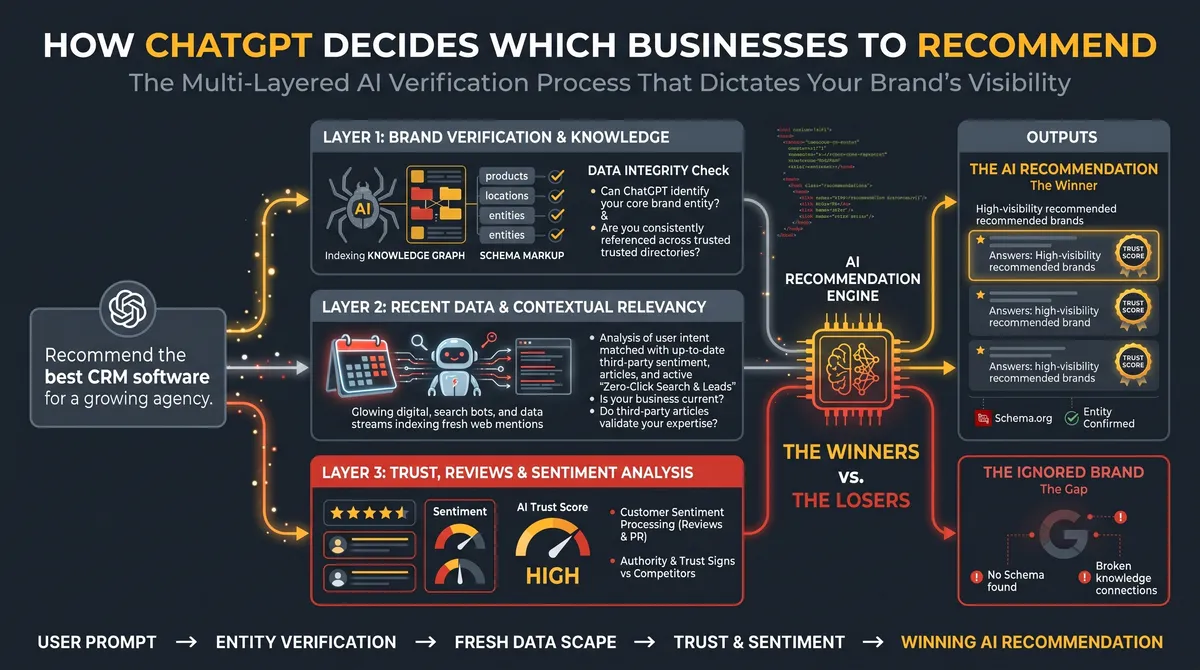
Many AI search tools use an approach called retrieval-augmented generation. Rather than relying only on what a model absorbed during training, the system pulls relevant chunks of external content at the moment of the query and hands them to the model as context.
In principle this should help you. If your content is indexed and your site is clean, you get retrieved when relevant. In practice, something else happens.
When a system retrieves content on a category question, it does not pull only from you. It pulls dozens or hundreds of chunks from across the web: your site, competitor sites, industry publications, community threads, review platforms, analyst write-ups. Then it synthesizes across all of them.
Your brand-specific language is statistically rare next to the generic category language surrounding it. The category comes through clearly. You get averaged out.
Your named methodology, your specific positioning, your service language: all of it appears in a small fraction of the retrieved material. Meanwhile phrases like digital marketing agency or marketing partner appear across thousands of chunks, from every source in the set.
Feeding cleaner data from your own site does not solve this, because retrieval pulls from everywhere rather than only from you. The gap closes when your signal is dense enough across the whole retrieval surface that it survives being averaged with everything else.
Reason 2: The default the model starts from is generic
Every large language model, whatever the brand on it, is built on the transformer architecture. It works by predicting the most probable next fragment of text given everything before it, and that probability was shaped by an enormous body of training material.
Which carries an implication your marketing team has probably never had stated plainly. These systems are structurally biased toward high-frequency, commonly co-occurring language. Brand names are the opposite: low-frequency, highly specific, and rare unless a brand has built enough corroborated presence to become expected in that context.
Using ourselves as the example
The phrase digital marketing agency appears an enormous number of times across the material these systems learned from.
The phrase Conspicuouz Creative Group appears far fewer times, and historically most of those were on properties we own.
So when a model answers a question about agencies in Southern California, it reaches for the generic and the well-corroborated unless something in the evidence makes a specific name expected. That is not a judgment about quality. It is arithmetic.
How this fits with retrieval
These two mechanisms are often described as separate. They are better understood as layered, and the distinction matters for what you actually do about it.
- Training sets the default. What the model reaches for when nothing pushes it elsewhere.
- Retrieval can override the default, which is genuinely good news, because it means recent work can register without waiting for a new training cycle.
- But it only overrides when the retrieved signal is strong enough to outweigh the default. A single page on your own domain rarely is. Corroboration across independent sources frequently is.
Which is why brands with strong rankings can still be absent. Your position on Google is a signal to Google's algorithm. It is not something the model was trained to weight. What it learned from is the language that exists about your brand across the whole internet, and most of that is not on your website.
Reason 3: The signals you optimized are not the signals being read
Traditional crawlers were built to find keywords, heading structure, page authority, and link graphs, because those served a system matching text to text. AI-mediated systems appear to be doing something structurally different: building a representation of what your brand is.
What you do, who you serve, which category you belong to, and how confidently any of that can be stated given the available evidence. A keyword in your main heading is one surface-level input into that picture. It is weighed against everything else that describes you anywhere.
| Where you describe yourself | What usually goes wrong | The effect |
|---|---|---|
| Your website | The current positioning, rewritten last year and not carried anywhere else. | One version of you, contradicted by four others. |
| Business profile | A category chosen at signup and never revisited, plus a shortened business name. | A second entity that may not obviously be the same company. |
| Professional profiles | A description written for recruiting rather than for buyers. | A third version, in a different vocabulary entirely. |
| Directories | Listings created years ago, some by other people, most never updated. | Old addresses and abandoned service descriptions, still being read. |
| Press and third parties | However somebody else chose to describe you, in whatever year they wrote it. | The version you control least, and the one weighted most heavily. |
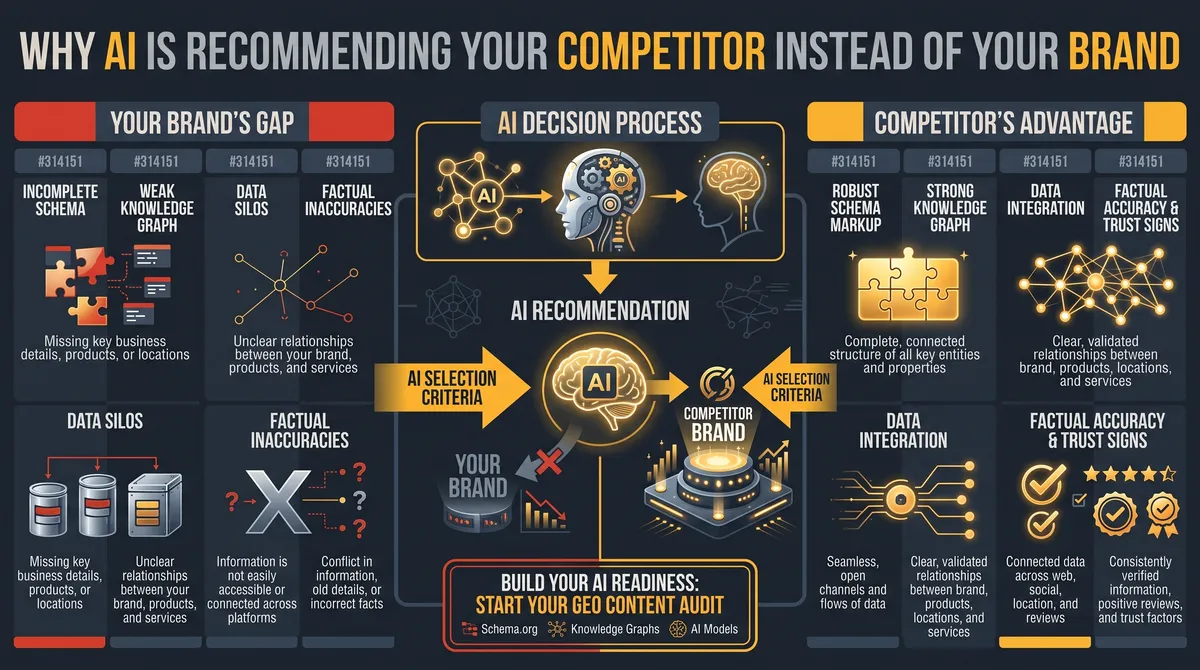
An entity described five different ways is a low-confidence entity. And low-confidence entities do not get named in an answer where the system needs to make a confident recommendation. It reaches instead for a competitor whose description is consistent, even where their keyword work is weaker.
This is the paradox: the signals you spent years optimizing are largely invisible to the systems now mediating your buyers' research.
Three mechanisms, one root cause
Dilution during retrieval. A default that favors the generic. Weighting that rewards consistency over keywords. Three different explanations, and all three point at the same thing.
The visibility infrastructure most businesses built was designed for a retrieval system that no longer exclusively controls the answer.
We found this on ourselves before we found it on anyone else. When we tested our own agency across these platforms, competitors with less content and thinner positioning appeared more consistently than we did.
The pattern was not content quality. It was directory presence, consistent business details across platforms, and references from sources that were not them. Exactly what the three mechanisms above would predict.
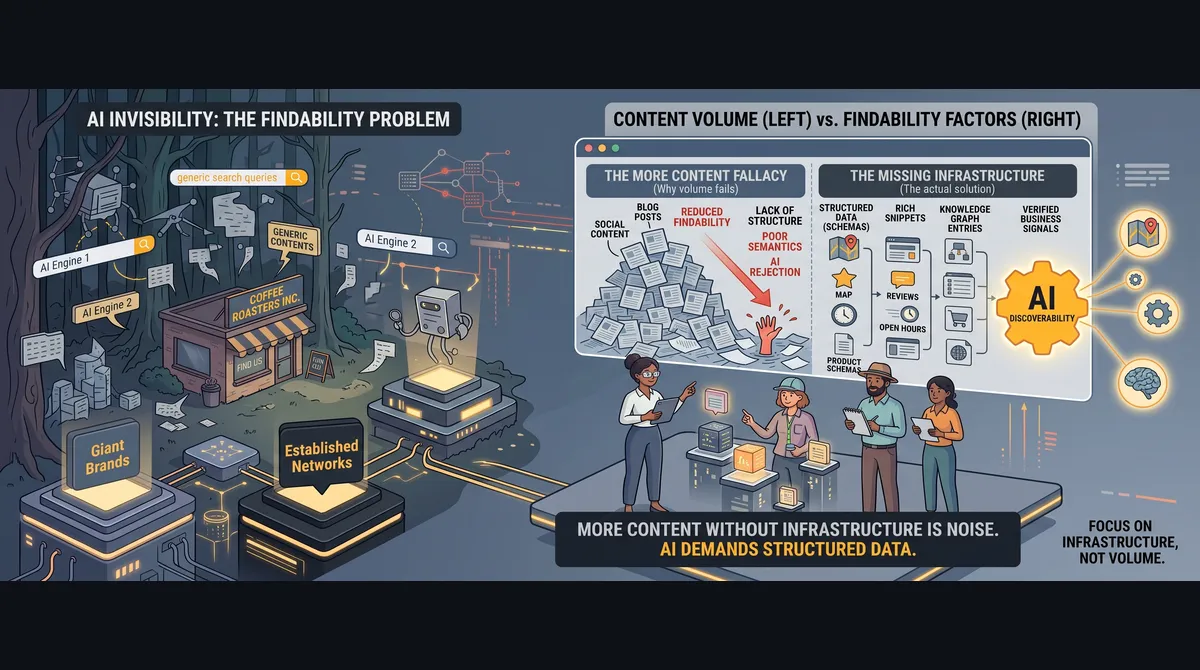
The brands appearing in AI answers did not get there by publishing more. They got there because their signal is dense, consistent, and independently corroborated across the sources these systems draw from. That is a foundation, and foundations are built before content strategies rather than after them.
In order, cheapest first
The order matters, because each stage makes the next one worth doing. Reversing it is why so much effort produces so little movement.
Make the entity consistent
One name, one description, one category, written identically everywhere it appears. Not similar. Identical. This is free, takes an afternoon, and is the single highest-return hour available, because every later signal reinforces one entity instead of splitting across four.
Label what you have
Structured data so a system can parse your business details, services, and answers without interpreting them. It cannot cite what it has to guess at, and guessing is where the confident recommendation goes to somebody else.
Write things worth quoting
Content specific enough to be lifted. Peer-reviewed work on this found that adding concrete statistics produced the largest single improvement in citation likelihood, at around forty percent, with direct quotations next. Padding, keyword stuffing, and persuasive language without substance did nothing or made things worse.
Get corroborated by people who are not you
The slowest stage and the one that actually moves the needle. Legitimate directory listings, industry references, partner mentions, real contributions to real conversations. It cannot be bought convincingly and it cannot be rushed, which is precisely why it works.
On timelines, honestly: entity and structural fixes can register relatively quickly once systems re-read your properties, while corroboration builds over months. Anyone quoting you a precise number of days for when AI answers will change is guessing, because these systems update on schedules nobody outside them publishes.