Is GEO Just Rebranded SEO? Here’s the Honest Answer.
Marketing has a long history of repackaging old ideas with new acronyms and charging for the upgrade. If you are skeptical, that is a healthy instinct and I would keep it. Here is the direct answer, including the part that complicates it.

Updated 5 min read
In short
Where they genuinely overlap
These are not enemies, and good search work is not wasted. The same fundamentals matter to both: a technically sound website, clear content, and a site that crawlers can actually reach and read.
If your foundation is a mess, with broken pages, no clear structure, and thin or outdated content, that damages your standing in AI answers too. In that sense GEO builds on SEO. It is not a replacement that renders the previous decade obsolete.
Google says as much itself. Its published guidance holds that search best practices remain relevant, because its generative features are rooted in the same core ranking and quality systems. On Google's own surfaces, the two are far closer than the louder commentary suggests. Hold onto that, because it matters when we get to the data.
Where they genuinely diverge
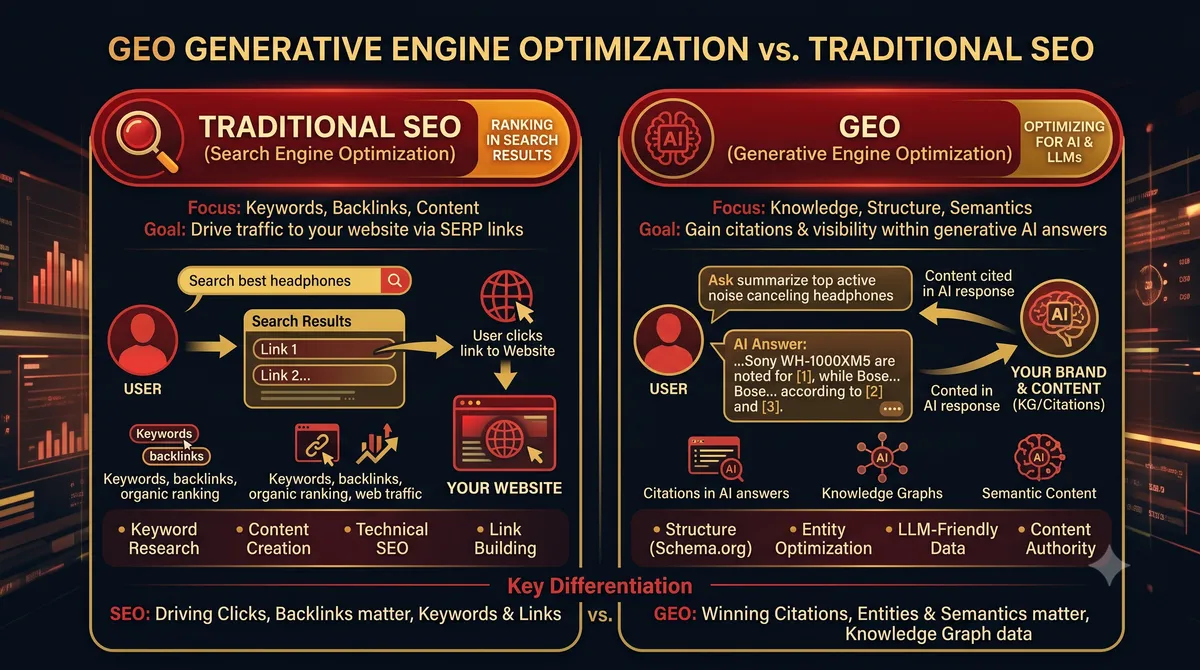
This is the part that is actually new, and the part I think justifies treating it as a distinct discipline rather than a buzzword. Four differences, and the second one is the one that changes how you work.
| Search optimization | Generative engine optimization | |
|---|---|---|
| The core question | How do I get this page to rank well in results? | How do I get my brand recognized as a trusted, citable entity by a model forming an answer? |
| The unit of work | The page. Something you control completely, on a site you own. | The entity. Your brand as it exists across the whole internet, most of which sits on sites you do not own. |
| The audience | A ranking algorithm ordering a list of options. | A model synthesizing many sources into one answer, and deciding who is safe to name. |
| The outcome | A position in a list, which a human then chooses from. | Whether you get mentioned by name inside the answer. Often with no link, no ranking, and no result in the traditional sense. |
Look again at the second row, because it is the whole thing. SEO is work you do on property you own. GEO is largely work you do on property you do not. That single shift is why the same effort does not automatically produce the same result in both systems.
If they were the same thing, the overlap would be near total
Here is the cleanest test available. If GEO were simply SEO renamed, then the pages ranking at the top of Google would also be the pages AI engines cite. By definition, the same work would produce the same outcome. So measure the overlap.
~76% → under 20% overlap between top Google rankings and AI-cited sources
Mid-2025 to early 2026, in roughly one year
Ahrefs, July 2025, for the earlier figure. Brandlight analysis cited by 5WPR, May 2026, for the current one.
That number did not drift. It roughly halved, and in some datasets fell further. The comfortable assumption that good SEO produces good AI visibility has been eroding month by month, and the erosion is measurable rather than anecdotal.
Now the honest complication, because the divergence is not uniform. Google's own AI Overviews still overlap substantially with Google's rankings, which makes sense given they run on the same underlying systems.
The sharp divergence sits with the platforms Google does not operate. Those systems select sources on entirely different logic, and that is precisely where a separate discipline earns its keep.
Which sharpens the answer rather than softening it. Strong search work still serves you well inside Google's ecosystem. It does considerably less for you everywhere else, and everywhere else is growing.
Two businesses, same SEO, different outcome
Picture two companies with near-identical websites. Similar content quality, similar technical setup, similar search performance.
Business A
Has been building relationships in the industry. Mentioned in trade publications. Present in relevant discussions. Referenced by partners and customers in places that exist outside their own website.
Business B
Has been heads-down on their own site. Good content, solid technical work, disciplined publishing. Minimal footprint anywhere else on the internet.
On Google, these two might perform almost identically. Both have good sites. Both may rank well for the terms that matter.
But when a model is asked who the trusted providers in a category are, it draws on everything it knows about both, including all of that external activity. Business A has a richer, better-validated presence in the wider conversation. Business B, with an equally good website, is comparatively invisible to that synthesis.
Same SEO. Different GEO. That is the divergence in practice, and it is not theoretical.
So is it worth a separate focus?
If AI search were a marginal channel, I would tell you not to bother with a separate discipline. Keep doing good search work and let the rest sort itself out. That would be the correct advice for something niche.
It is not niche. Roughly half of US consumers surveyed by McKinsey now intentionally use AI-powered search, and among those users, 44 percent call it their primary and preferred source of insight, ahead of traditional search at 31 percent. In several major consumer categories, between 40 and 55 percent use it for purchasing decisions.
McKinsey AI Discovery Survey, August 2025, representative US consumer panel, n=1,927
That is a real and growing share of how buyers research vendors, and it is judged by a system that does not map cleanly onto search performance. So yes, I think it warrants its own focus, built on top of your search foundation rather than instead of it. Not because the acronym is exciting. Because the measurement says it is tracking something different, and that something is increasingly where buying decisions begin.
One caution on the numbers, since this post is about being straight with you. The 44 percent figure is of AI search users, not of all consumers. It gets misquoted constantly in the direction that flatters the argument. Across the whole population the number is closer to one in five, which is still a great deal of buying research happening where nobody is measuring.