What Changed in AI Search This Quarter
The center of gravity in buyer research has moved, and most mid-market brands are measuring the place it used to be.

8 min read
In short
Shift 1: The assistant became the first stop, not the second
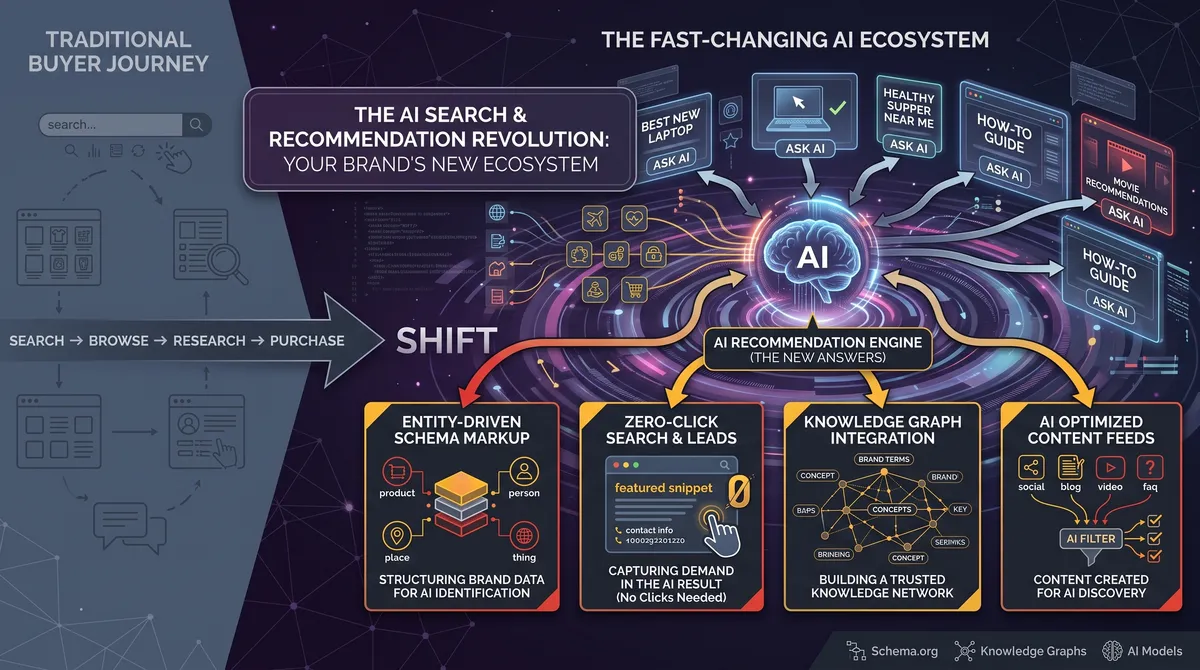
A buyer with a problem used to open a search engine, scan a list, and click three or four results. Increasingly they open an assistant, describe the problem in a full sentence, and receive a short synthesized answer with two or three brand names in it.
G2's Answer Economy survey of 1,076 business-to-business buyers in March 2026 found 51 percent now start research in an AI chatbot rather than a search engine, up from 29 percent eleven months earlier. Sixty-nine percent said they chose a different vendor than planned because of AI guidance.
- What this changes: the funnel lost a stage. There is no browsing step where an also-ran brand gets noticed. A buyer gets a short list and acts on it. Inclusion is binary, and there is no position eleven.
- What it does not change: the criteria for being trusted. Consistency, specificity, and corroboration still decide it. The mechanism is new. The judgment is old.
Shift 2: Zero-click became the majority outcome
SparkToro, using Similarweb clickstream data, found 68.01 percent of US Google searches ended without a click in the first four months of 2026, up from 60.45 percent in 2024.
Your impressions can hold steady while your sessions decline, and the gap is not a tracking error. It is the answer being consumed on the results page. Seer Interactive measured the effect directly across 3,119 informational queries: organic click-through fell 61 percent where an AI Overview appeared, and rose 35 percent for brands cited inside it.
A brand cited inside an AI Overview and never clicked has still influenced the buyer. A brand ranking below the Overview and never cited has not, regardless of position.
The measurement move: add citation presence to your reporting alongside sessions. Run a standardized set of buyer-language prompts monthly across ChatGPT, Claude, Gemini, Perplexity, and Google AI Overviews, and record whether your brand appears, in what position, and how it is characterized.
That characterization line matters more than most teams expect, because engines describe brands as well as list them, and an inaccurate description is its own problem.
Shift 3: Structured data became table stakes, for a narrower reason than usually claimed
Schema spent a decade as a nice-to-have that earned a rich snippet. That framing is obsolete, but the replacement framing usually overstates it, and the evidence is worth knowing before you fund the work.
Ahrefs tracked 1,885 pages that added JSON-LD between August 2025 and March 2026 against roughly 4,000 control pages. No statistically significant citation uplift on ChatGPT or Google AI Mode, and a significant 4.6 percent decline on AI Overviews. A searchVIU experiment cited in the same report found ChatGPT, Claude, Perplexity, Gemini, and Google AI Mode all extracted visible HTML only at retrieval, ignoring JSON-LD entirely.
“If you're already doing the rest of the SEO work well, JSON-LD isn't going to be the unlock.”
Louise Linehan, Ahrefs
So why is it still on the critical path? Because schema is a disambiguation lever rather than a citation lever, and disambiguation is exactly what Shift 4 requires. Organization schema is how you declare which entity you are, including your name variants, so an engine encountering an old form can resolve it rather than treating it as a separate company.
The practical position: Organization, Article, and FAQ schema belong on the critical path as entity hygiene, not as a citation strategy. It is specification-driven, it validates objectively, and it ships in days rather than quarters. Fund it accordingly, and do not expect it to move citations on its own.
Shift 4: Entity consistency became the gate
This is the shift most brands have not internalized, and it is the one that silently caps everything else.
Generative engines resolve entities before they make claims. They build a working profile from every source they can reach: your site, your structured data, directories, press mentions, social profiles, and third-party descriptions. If those disagree about your name, category, location, or what you do, the engine has no confident answer and will not risk asserting one.
The scale of the off-site problem is documented. Roughly 82 percent of AI citations come from earned media per Muck Rack's December 2025 analysis, and Omniscient Digital's review of more than 23,000 citations found around 77 percent of sources cited about a brand are pages the brand does not own. Most of your entity is assembled from places you cannot edit.
An example from our own domain, since it would be strange to describe this problem without disclosing it. A self-audit of czcreativegroup.com found four different name variants in circulation across directories, older bylines, and third-party citations.
A ranking algorithm tolerates that. A generative engine treats it as unresolved and moves on to a brand whose signals agree.
Name, category, and description consistency stopped being a branding nicety and became an infrastructure requirement. Audit every controllable mention, then declare your variants explicitly in Organization schema.
Shift 5: Broken URLs became an active negative signal
Under the old model, a 404 was a small waste. Under the new one it is evidence.
Engines cite URLs. A cited URL that fails is a direct hit to the reliability of the source that provided it. Retired blog posts, an old lead magnet link still circulating, internal links pointing at renamed pages: each one is a dead trail attached to your brand.
Worth checking today, and again a disclosure rather than a hypothetical. On our own domain, 404 hits in a single month roughly matched total traffic to the primary offer page.
That is a meaningful share of site traffic hitting a wall, and it was invisible until someone pulled the report. Nothing in any dashboard raises a flag for it.
Five moves, in order
This is foundation work, and the sequence is the part that matters.
| Move | Effort | Why now |
|---|---|---|
| 1. Pull your 404 report and build a redirect map | Low | Fastest fix on the list. Removes an active negative signal |
| 2. Reconcile name, category, and description everywhere | Medium | Gates every other dimension. Propagates slowly, so start first |
| 3. Implement Organization, Article, and FAQ schema | Low to medium | Entity hygiene that supports move two. Validates objectively |
| 4. Run a baseline visibility test across five engines | Low | You cannot report a change without a before number |
| 5. Restructure your five strongest existing posts | Low | Question headings, direct-answer first paragraphs, FAQ blocks. On content that already performs |
Note what is absent from that list: publishing new content. Research presented at KDD 2024 measured citation lift across nine tactics and roughly 10,000 queries. Adding statistics produced the largest lift at about 41 percent and citing external sources up to 115 percent for lower-ranked content. Publishing frequency and word count did not appear among the effective tactics at all.
Content produced before the foundation exists is content the engines cannot attribute. It accumulates rather than compounds. The gap closes with infrastructure, not more content alone.
What is worth watching next
Three open questions, stated as questions because the answers are not settled.
- Does citation become a reportable metric with real tooling? Measuring citation presence currently requires manual prompt sets or third-party tools of uneven reliability, and as of August 2026 no independent cross-platform accuracy benchmark had been published for any of them. Whoever solves this cleanly changes how budgets get justified.
- Do engines converge or diverge on source selection? Underlying signals currently overlap enough that infrastructure work lifts visibility across engines at once. There is already counter-evidence: SOCi's 2026 index found ChatGPT surfaces a local business 1.2 percent of the time against Gemini at 11 percent. If divergence widens, GEO fragments into per-engine work and gets considerably more expensive.
- How much does owned content matter against third-party corroboration? The 82 percent earned-media figure suggests corroboration carries more weight, but the weighting between the two is not knowable from outside. Directionally this favors brands that earn genuine mentions over brands that publish at volume.