Most Marketing Strategies Were Built for a Search Engine That’s Already Changing. Here’s the Gap Nobody’s Named Yet.
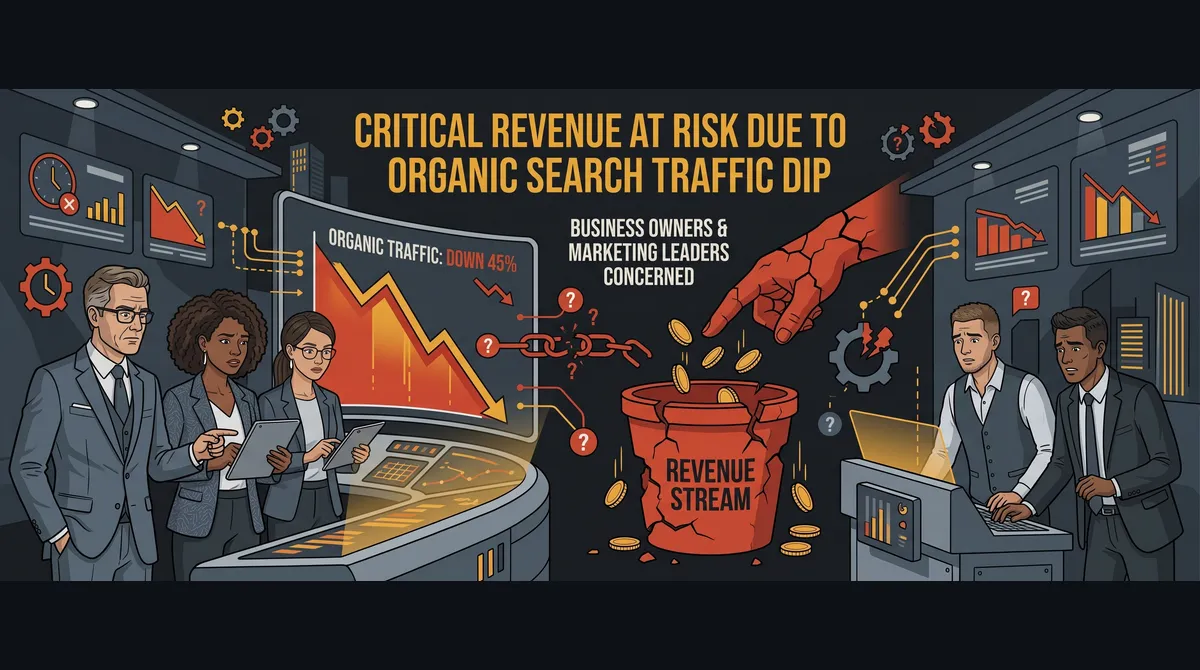
The plan driving your content calendar, your search priorities, and your website roadmap was built for an environment that is measurably changing underneath it. Not someday. Now, with data to prove it.

Updated 7 min read
In short
In one sentence
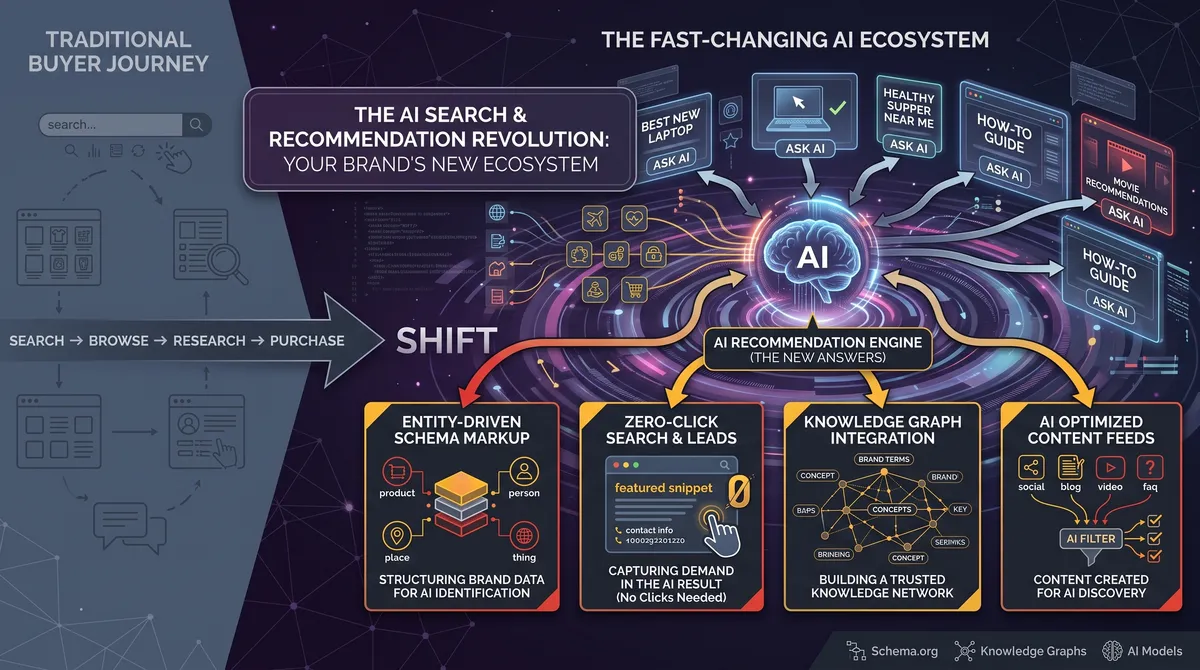
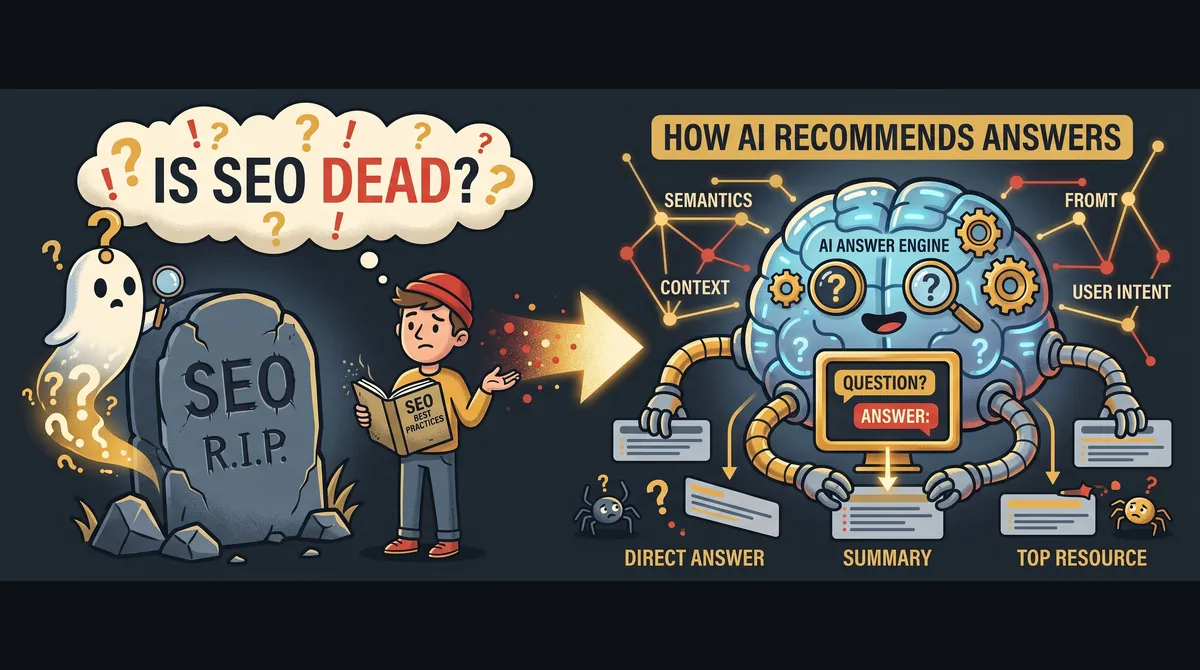
Google ranks pages. AI recommends entities. Two systems, two definitions of visibility, and most strategies address only the first.
For most of two decades that was fine, because the first system was practically the only one that mattered. Optimizing your site to rank well was a reliable proxy for people being able to find you, and the proxy held.
A second visibility system has emerged alongside it, and it runs on fundamentally different inputs. Most marketing teams sense something has moved. Very few have had a clean framework for naming what it is, which is what this is for.
What changed, with the numbers behind it
This is no longer speculative. Each of these comes from a named study with a stated method, which matters, because a great deal of what circulates on this topic does not.
| Figure | What it measures | Source |
|---|---|---|
| -61% | Organic click-through rate on informational queries where an AI Overview appears, falling from 1.76% to 0.61%. | Seer Interactive, September 2025. 3,119 queries, 42 organizations, 25.1 million impressions. |
| -41% | Organic click-through rate on queries where no AI Overview appears at all. Clicks are falling everywhere, not only where AI is visible. | Seer Interactive, same study |
| 93% | of searches in Google's AI Mode end without any click to an external site. AI Mode replaces results rather than sitting above them. | Semrush, September 2025 |
| 35% | of US consumers use AI tools at product discovery, against 13.6% using traditional search at the same stage. | Similarweb, 2026 Generative AI Brand Visibility Index |
| 17 to 38% | Overlap between brands ranking in Google's top ten and brands cited in AI answers, down from roughly three quarters a year earlier. | Multiple studies, early 2026. Range varies by methodology. |
Now the row that argues for doing something rather than despairing. Seer also found that brands cited inside an AI Overview see roughly 35% higher organic click-through than uncited brands on the same results page.
So the picture is not simply that clicks are disappearing. Clicks are consolidating around whoever gets named. The gap between cited and uncited is widening on the same page, for the same query, at the same moment.
This is not a failure of your marketing team
It is that the shift outpaced the tools and reporting frameworks. Search Console does not tell you whether ChatGPT recommended you. Most search platforms have no field for AI visibility. The metrics teams report on, rankings and organic traffic and impressions, were built for the system that is now half the picture.
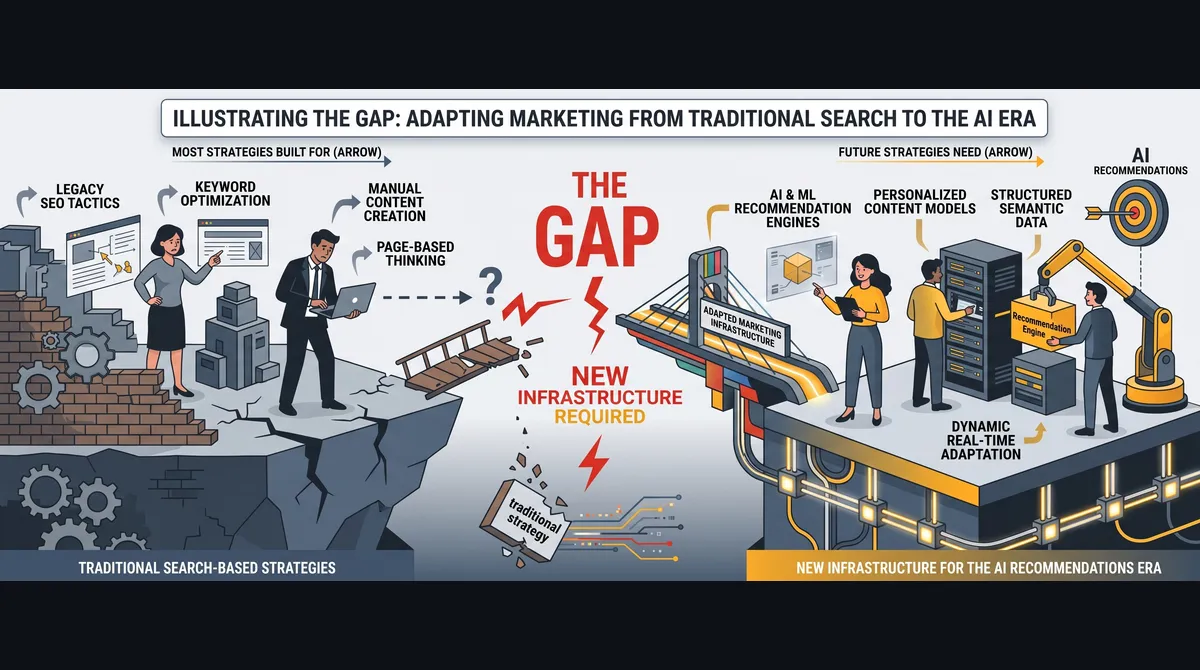
So a strategy built around those metrics is, by definition, optimizing for a shrinking share of how buyers actually find vendors. Not wrong. Incomplete. Those are different diagnoses with different responses, and the distinction is worth holding onto before anyone starts assigning blame internally.
The uncomfortable part: because the reporting has not caught up, the gap is invisible in exactly the documents where you would expect to find it. Your dashboards will look reasonable throughout.
The six things that determine AI visibility
If search visibility is measured by rankings, AI visibility is measured by something else entirely, and it breaks into six dimensions. Most strategies address none of them, not through neglect, but because the category did not exist until recently.
| Dimension | The question it answers | What failure looks like |
|---|---|---|
| Entity clarity | Do you exist as a clearly defined, consistently described entity in the knowledge layer these systems draw from? | Appearing on some phrasings and vanishing on others. The most common finding, and the cheapest to fix. |
| Content authority | Is your content specific enough to be worth quoting, or general enough that nothing would bother? | Pages full of sound advice that could have come from anyone in your category. |
| Structured data | Can an engine parse and extract cleanly, or does it have to interpret? | A beautiful site with no labels on any of it. Nothing breaks, which is why it survives for years. |
| Citation worthiness | Do you answer questions definitively, or do you hedge? | Answers so qualified that no clean sentence can be lifted from them. |
| Measured visibility | Are you actually being cited right now, across multiple platforms, for the queries that matter? | Nobody in the organization can answer this, and nobody has been asked to. |
| Technical foundation | Can AI crawlers reach and trust your site at all? | Everything above is irrelevant if this fails, which is why it gets checked first. |
Peer-reviewed work supports several of these directly. Researchers from Princeton and Georgia Tech, publishing at KDD 2024, tested nine content tactics across roughly ten thousand queries. Adding specific statistics produced the largest single lift at around 41 percent. Adding direct quotations came next at roughly 28 percent. Citing external sources helped substantially, particularly for lower-ranked pages.
Four of the nine tactics did nothing or actively hurt: keyword stuffing, simplifying for its own sake, padding content to length, and purely persuasive language. That list describes a great deal of what currently sits in most content guidelines.
Aggarwal et al., GEO: Generative Engine Optimization, KDD 2024. Reported lifts vary by metric and domain.
This is not a content problem first
Which is the most important thing in this piece, because more content is always the first instinct and it is usually the wrong first move.
It is an infrastructure problem first. Before anything can be cited, the foundation has to exist. Entity signals consistent across your digital properties. Structured data implemented. Your site properly indexed in the places these engines actually retrieve from, which includes indexes you may not have thought about.
- Infrastructure. Consistent entity signals, structured data, crawler access. Unglamorous, cheap, and load-bearing for everything after it.
- Citation-worthy content. And even here it is not volume. It is specificity and depth in a focused area rather than broad coverage of everything.
- Distribution and external presence. The part that takes longest and cannot be shortcut, because it depends on other people.
Reversing that order, which is what just produce more content effectively does, invests real effort into a system that cannot use it yet.
If your strategy has no line item for any of this
No visibility audit. No AI visibility score. No entity clarity assessment. That is not a criticism of the strategy. It is a description of when it was written relative to when this accelerated.
It does mean there is a gap between what the strategy measures and what increasingly determines whether buyers find you. And the overlap between the two systems keeps narrowing, from roughly three quarters a year ago to somewhere between seventeen and thirty-eight percent now, depending on whose methodology you use.
Worth one honest caveat, since this post is about measurement. That divergence is not uniform. Google's own AI answers still overlap substantially with Google's rankings, which makes sense given they run on the same systems. The sharp separation is on the platforms Google does not operate, and those are the ones growing fastest.