Ranking First on Google No Longer Puts You in the Answer
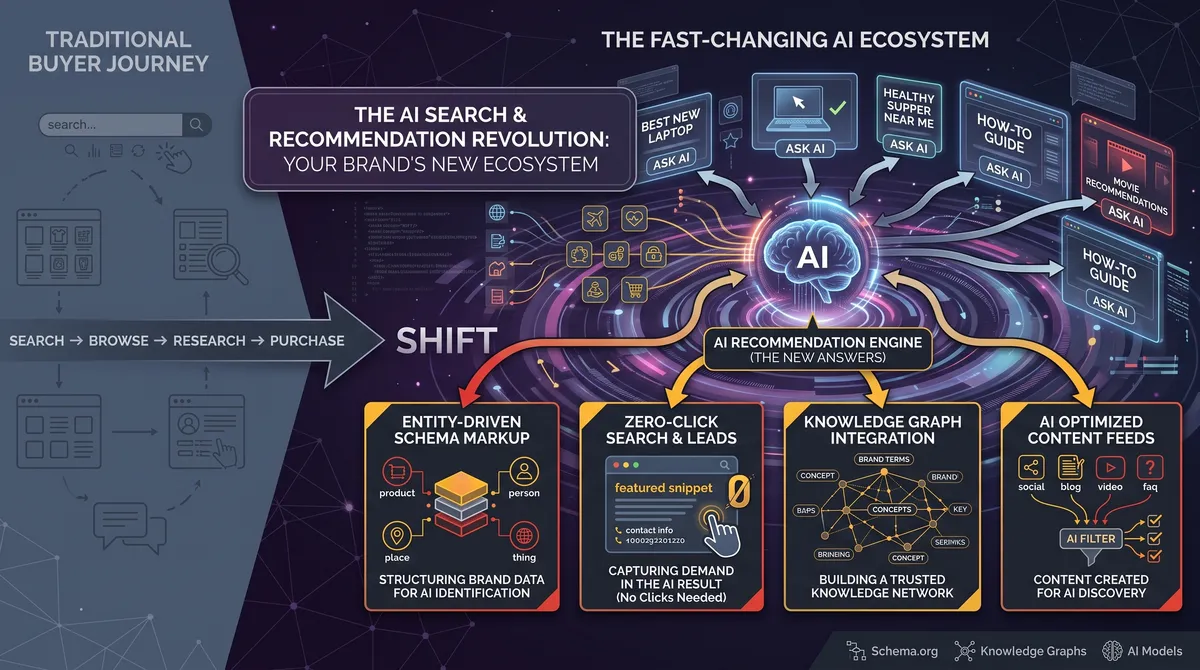
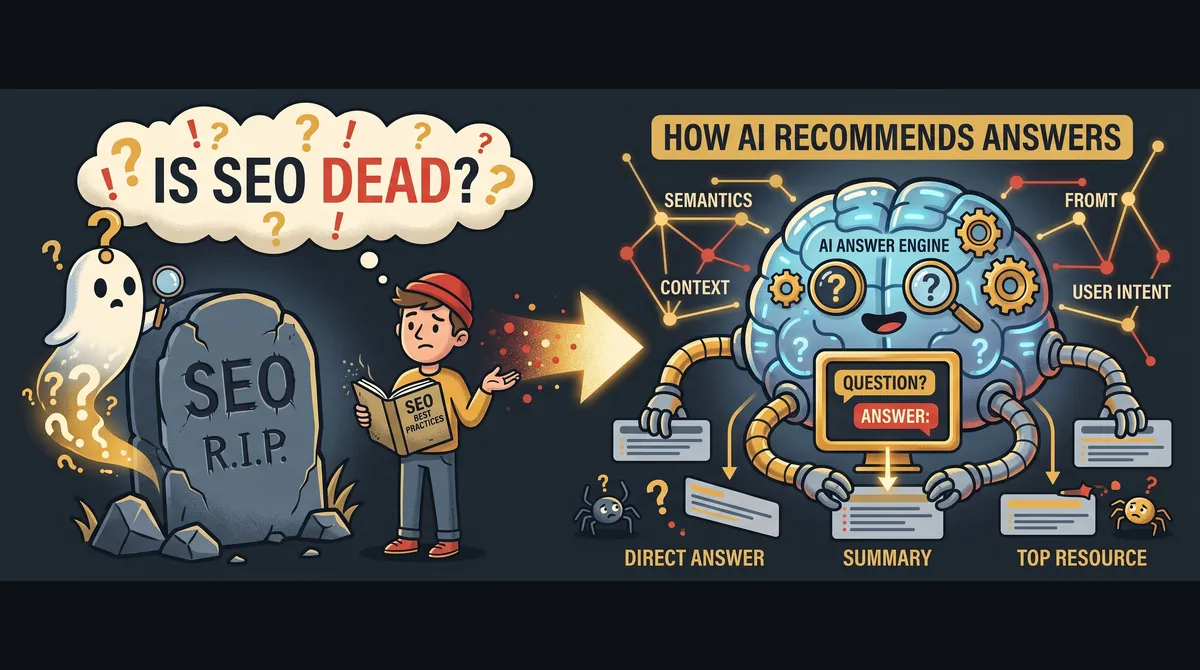
Google ranks pages. AI recommends entities. Those are two systems making two decisions, and a rankings report cannot detect a problem in the second one.

6 min read
In short
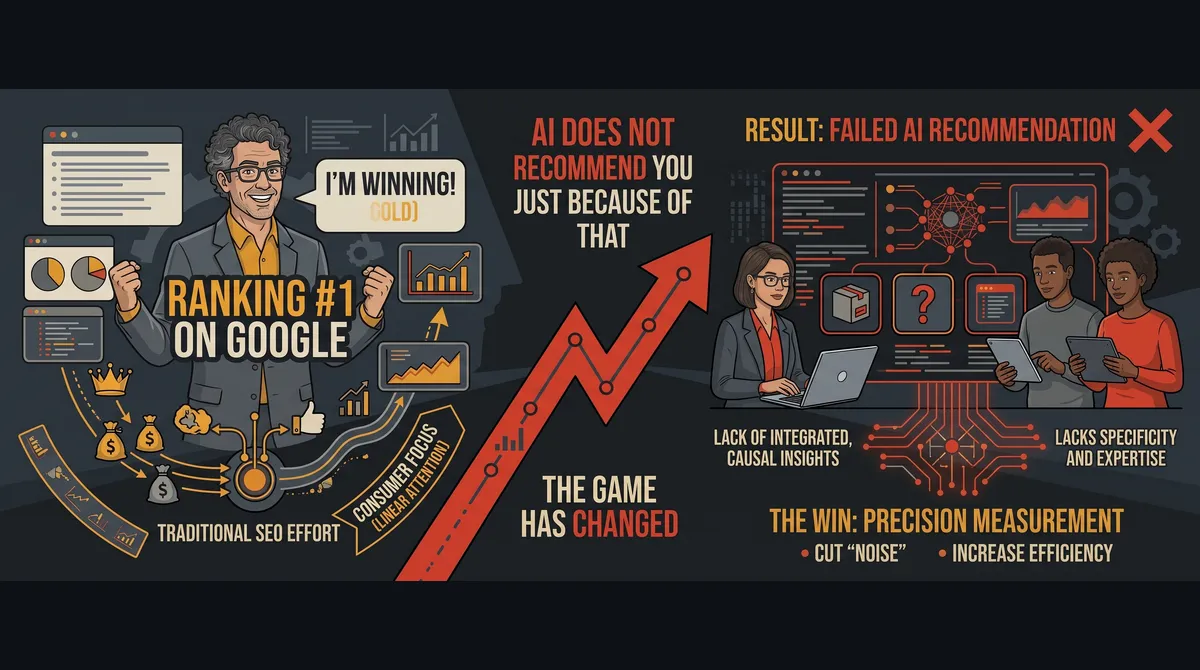
A number one ranking is evidence of a ranking
That sentence sounds obvious written down. It stops sounding obvious the moment you look at how ranking reports get presented internally, where position one is treated as proof of visibility rather than proof of position.
Two different systems are making two different decisions.
- Google ranks pages. It orders documents by relevance and authority for a query, and presents a list. The user does the choosing.
- An answer engine recommends entities. It assembles a response, names a small number of sources, and does much of the choosing on the user's behalf.
Being in the list underneath is not the same as being in the answer above it. That is the gap, and it does not close by ranking harder.
What the overlap data actually shows
About 17% AI Overview citations coming from Google's organic top ten
Five out of six citations come from somewhere else
BrightEdge, February 2026, a figure that has held flat for months. That is down from roughly 76 percent measured by Ahrefs in mid-2025.
Authority metrics do not bridge it either. In the Semrush category study run by Kevin Indig across 1,094 US categories between January and June 2026, covering more than 50,000 brands and 600,000 citations, Authority Score predicted category ownership 52.5 percent of the time and organic traffic predicted it 48.4 percent.
Sit with those two numbers for a second. The two metrics most agencies lead their reporting with predict AI category ownership about as reliably as a coin. Indig's own conclusion in the published analysis was direct: "traditional SEO metrics aren't enough to explain who owns a topic."
What did correlate in that study was consistency. Once a brand owns a category, it holds the position month over month 90.4 percent of the time. Ownership is sticky, and stickiness rewards whoever arrives first with clear, corroborated signals rather than whoever has the strongest domain.
Google AI Overviews favor content that already ranks. So ranking is the path to AI visibility.
That objection is correct, and it is correct about one surface out of five.
AI Overviews do draw heavily on content already performing in Google search. Google's own guidance says so. If your entire AI visibility strategy is aimed at that surface, ranking work genuinely serves it, and this is exactly why cutting an SEO program to fund a GEO program is the wrong trade.
Here is where it stops holding, and it stops holding on the objector's own ground. AI Overviews are the surface most favorable to that argument, and even there only about 17 percent of citations come from the organic top ten.
Ranking first improves your odds on the friendliest surface and still leaves five out of six citations going somewhere else.
Beyond that surface the connection thins further. ChatGPT, Perplexity, and Claude are not built on Google's ranking output. They assemble answers from live retrieval, third-party corroboration, and model priors, and the SOCi 2026 Local Visibility Index showed how far apart those systems land in practice: ChatGPT surfaced a local business 1.2 percent of the time, Gemini 11 percent, Google's three-pack 35.9 percent. Same businesses, four different thresholds.
So the honest version is narrower than either side usually states. Ranking is a strong input to one AI surface and a weak input to the others. Keep it. Stop treating it as the whole measurement.
What this changes in your reporting, by role
| If you are the | What you are currently being shown | What is missing |
|---|---|---|
| CMO presenting to a board | Rank, sessions, conversions | Whether a buyer researching your category in an assistant ever encountered your name |
| Marketing director managing an agency | Position changes and traffic trend | Which competitor is being named in the answers you are ranking beneath |
| Founder still holding marketing | A monthly report with green arrows | Whether the green arrows describe a surface your buyers still use first |
| Ecommerce lead | Category page rankings and revenue per session | Whether product attributes are legible enough to be selected by an assistant |
| Local operator | Map pack position and calls | Whether you appear in a one-to-three name answer that replaced the ten-result list |
Every row has the same shape. The existing report is accurate and incomplete, and incomplete reports produce confident wrong decisions.
Three gauges to add, not to swap
Nobody should throw out rank tracking. Add three numbers next to it.
- Share of model. The percentage of category responses across engines that mention your brand. This is your presence.
- Citation rate. Of those mentions, how many actually link to you. This is your traffic potential.
- Competitive citation gap. Your share of model minus your nearest competitor's. This is the number that gets a budget approved, because it is the only one that names who is winning.
Report monthly. AI content freshness cycles run on roughly a 70-day cadence, which means a quarterly report is describing a position that has already changed twice.
There is no industry-standard formula for any of these yet, and that is worth saying plainly rather than pretending otherwise. Semrush, Profound, and Conductor each weight them differently, and as of mid-2026 no independent cross-platform accuracy benchmark had been published. Consistency of method matters more than the specific number.
One question worth sitting with. Your last marketing review reported a ranking. If somebody in that room had asked which competitor gets named when a buyer asks an assistant to recommend three companies in your category, could anyone have answered? And if not, what exactly was being reviewed?