Siri Promised, Gemini Delivered: AI on Your Phone Is Becoming a Do-Bot
Phone assistants stopped answering questions and started completing tasks. That is not a feature war. It changes who gets chosen, and it changes what your marketing has to prove.

Updated 8 min read
In short
From chatbot to do-bot, in about four months
This moved faster than most people tracked. Here is the sequence, because the pace is part of the point.
| When | What happened | Why it matters to you |
|---|---|---|
| February 2026 | Samsung and Google demonstrated Gemini completing multi-step tasks across apps at Galaxy Unpacked. Beta launched on Pixel 10 and the Galaxy S26 series. | The demo was food and rideshare. The pattern is any transaction with steps. |
| March 2026 | Screen automation rolled out to Galaxy S26 users in the United States and Korea. Gemini opens and controls apps to order food, call a cab, or fill a grocery cart from one command. | This is the moment it stopped being a demo. Real people, real orders, real selections you did not influence. |
| May 2026 | Google announced Gemini Intelligence, a wider agentic suite. Rollout began on Galaxy and Pixel, with expansion planned to watches, cars, glasses, and laptops later in the year. | The surface is not the phone. The phone was first. |
| 2026, ongoing | Apple is reported to have rebuilt Siri on Gemini foundations, delivering the personal context, on-screen awareness, and cross-app action capabilities it previewed in 2024 and delayed. | If accurate, the agentic layer is arriving on both platforms rather than one. There is no waiting it out. |
Google and Samsung product announcements, February through May 2026. Apple and Google arrangement per press reporting, not a joint announcement, and details may change.
One detail worth holding onto: these features are opt-in, and the user is prompted for permission each time a task begins and can stop it mid-run. The assistant assembles the order. A human still approves it. That approval step is where your brand either survives or gets swapped out.
It is not a feature war. It is a trust war.
I have been an Apple user since college in 1998. Macs, iPhones, the whole ecosystem, and it was earned. For years those were the best tools available for creative work and for running a life. Apple was not hardware to me. It was an operating system for how I worked.
I remember Siri launching and thinking my phone was about to help me run everything. Then years went by. I got faster and the assistant did not. Today I rarely use it, and when I do it makes enough mistakes that it breaks the only thing an assistant has to earn.
If I have to check the work, it is not an assistant. It is friction with a nicer voice.
That is the whole lesson, and it applies to your business more directly than it applies to Apple. Reliability compounds into trust. Unreliability compounds into avoidance. Nobody announces that they have stopped trusting you. They just stop opening the thing.
Funnel compression
Nobody wakes up wanting agentic AI. People want three things, and they have wanted them forever: fewer steps, fewer decisions, and more confidence that they are not making the wrong choice.
When an assistant executes the task, the journey collapses.
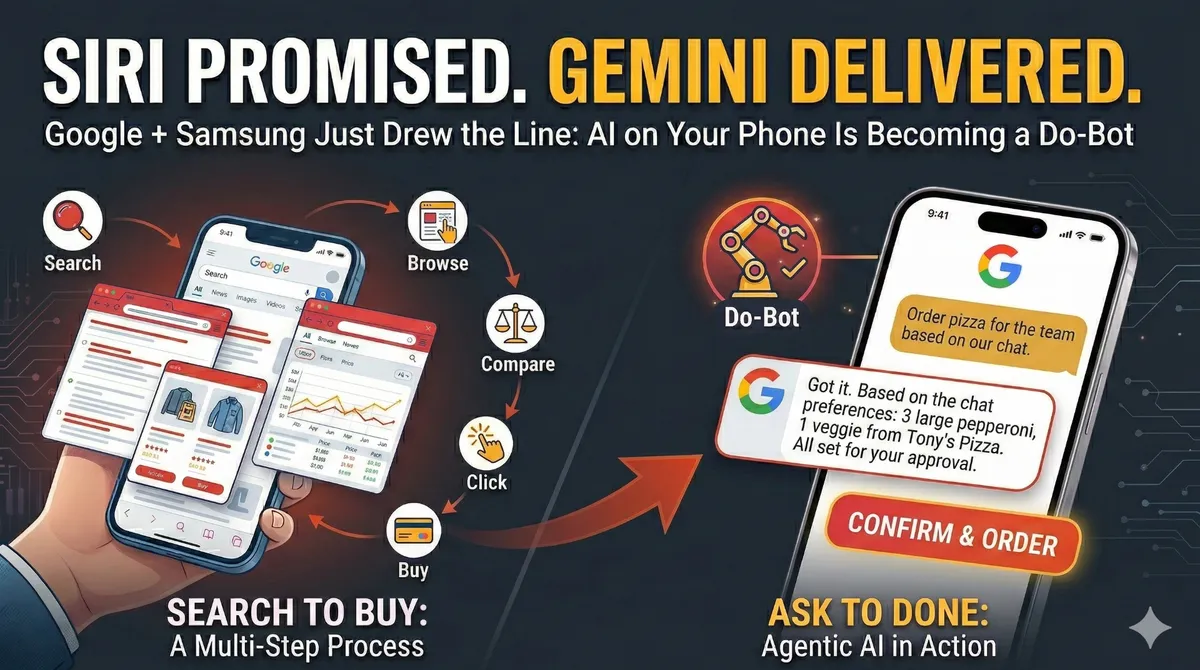
Search → browse → compare → click → buy
Ask → confirm → done
Look at what disappeared. Browse and compare are gone, and those are the two stages where most marketing budgets currently live. Your beautiful comparison page, your carefully built middle-funnel nurture, your retargeting sequence: all of it assumed a human doing the comparing.
When funnels compress, the brands with the clearest signals win, because clarity is the only thing that survives a summarization step.
Will the apps cooperate, and does it change your job?
Nilay Patel at The Verge named this the DoorDash problem: an agent that operates inside other companies' apps only works if those companies allow it, and they have their own reasons not to. Every platform that lets an assistant place orders gives up the customer relationship it spent a decade buying.
Here is the useful part. The outcome does not change what you should do.
- If the ecosystem resists and assistants cannot reliably finish the action, people stop trusting them and keep doing it themselves. You still win by being the easiest option to understand and act on.
- If the ecosystem cooperates, brands compete to be the assistant's default pick. You still win by being the easiest option to understand and act on.
Two futures, one instruction. Reduce friction and increase trust. That is a rare gift in strategy, and it means you can act now without betting on which way this goes.
Worth underlining separately: Apple has historically been elite at product and interface. Google has been elite at distribution and data. When AI becomes the interface itself, distribution decides. Baked into the operating system is not an app, it is a habit. A prerecorded demo is not a product. Shipping is the product.
Three shifts, starting now
If an agent becomes the shopper, the scheduler, or the researcher, marketing has to change what it optimizes for.
Optimize for the agent, not only the answer
AI Engine Optimization already covers being understood and cited by AI when someone asks a question. Agentic assistants add a second requirement on top of it: being easy for software to compare and confidently choose when a task has to be completed. Same discipline, one more job. Being findable is table stakes. Being selectable is the new work.
Proof assets become decision assets
When something is summarizing options, beautiful is not enough. The creative has to be decision-grade, which means four things are stated rather than implied.
- A clear offer. What you sell, in a sentence a machine can lift intact.
- Clear constraints. Service area, turnaround time, pricing bands. Vagueness reads as risk, and risk gets filtered out.
- Clear proof. Outcomes, reviews, guarantees. Ideally with real numbers that reconcile.
- A clear next step. One action, unambiguous enough that software could take it.
Machine-readable trust becomes a growth lever
Inconsistent business information, vague policies, and a clunky checkout do not only cost you humans now. They cost you the assistant's confidence, which is quieter and far more expensive. These stop being hygiene items and become conversion infrastructure.
- Consistent name, address, and phone across every listing
- Structured FAQs in real text, not collapsed behind scripts
- Clean service pages, one service per page
- Transparent pricing ranges, published where a machine can read them
- Accessibility and privacy basics handled properly
A new scoreboard for agencies
The old metrics still count. Three new ones are coming, and they are harder to fake.
| New metric | The question it answers | What moves it |
|---|---|---|
| Selection rate | Did the assistant choose you when it narrowed the options? | Clarity of offer, stated constraints, structured data, and consistency of your information everywhere it appears. |
| Completion rate | Once selected, did the action actually finish? | Working forms, fast pages, no dead ends, no surprise required fields. Ordinary technical hygiene, now revenue-critical. |
| Trust rate | At the approval step, did the human say yes to you specifically? | Brand recognition, reviews, and whether your name reassures a person in the half second before they tap confirm. |
Notice that trust rate is where brand and infrastructure meet. An assistant can put you in front of someone. Only your reputation gets you past the confirm button.
The AI-ready presence scorecard
Five questions. Score each one out of five, honestly, and fix the lowest first. Every improvement here helps human conversion and agent reliability at the same time, which is why this is the cheapest work available right now.
Clarity
Is the offer instantly understandable? Read your homepage headline aloud to someone outside your industry. If they cannot say what you sell and who for, score it low.
Proof
Are there real outcomes on the page, with numbers that reconcile? A published figure you cannot defend is worse than no figure at all.
Friction
How many steps to book or buy? Count them on a phone, from a cold start, without logging in. Then remove one.
Consistency
Is your business information identical everywhere it appears? Name, address, phone, hours, services. Mismatches read as uncertainty to a machine, and uncertainty loses.
Compliance
Are your policies clear, your accessibility handled, your privacy honest? Reducing risk and increasing trust turn out to be the same task.
Demos do not change markets. Shipped experiences do. More features do not win, less friction wins. More content does not win, clearer signals win.
One question to sit with. If an AI assistant had to pick a single option for your customer today, would it pick you? And if it did, would the experience hold up all the way to done?