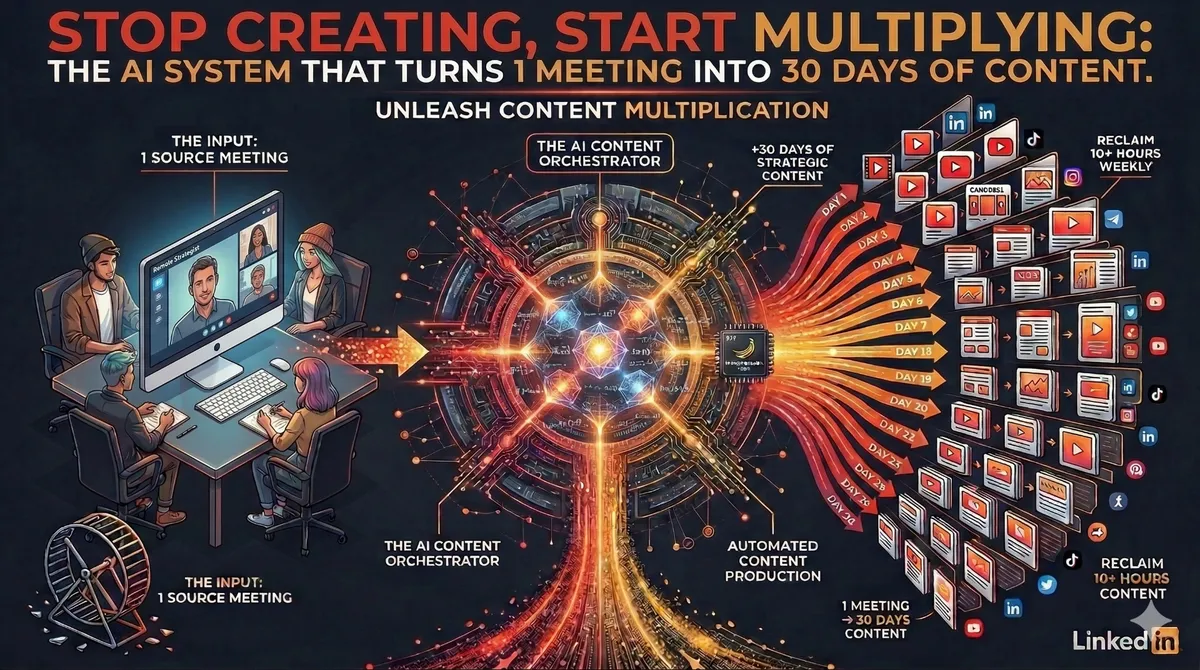
Stop Creating, Start Multiplying: The AI System That Turns 1 Meeting Into 30 Days of Content
Most teams do not have a content problem. They have a source problem. They are trying to invent posts out of nothing while sitting on a week's worth of real conversations they have already had.

Updated 8 min read
In short
It is a source problem, not a content problem
Sitting down to think of something to post is the hardest possible way to produce content, and it is what almost everyone does. You open a blank document with no input and try to manufacture insight on demand, on a Tuesday, between two other things.
Meanwhile, you spent the week having conversations where you explained something well, corrected a wrong assumption, talked someone through a decision, or fixed a problem you have now fixed forty times. All of that was content. None of it got captured.
Stop creating. Start capturing.
The difference matters more than it sounds. Content invented from nothing is generic because it came from nowhere. Content pulled from a real conversation carries specifics, tension, and a reason to exist, and those are exactly the things a model cannot supply for you.
Where the content already is
Seven places, all of which produce material every single week whether or not anyone captures it.
| The source | What it produces, and why it works |
|---|---|
| Sales calls | The exact language buyers use for their own problem. This is worth more than any keyword tool, because it is how they will phrase the question to an AI engine too. |
| Client onboarding | Every question a new client asks is a question a prospect had and never asked out loud. Answer it publicly next time. |
| Proposal recaps | You already made the argument for why this approach beats the alternative. That argument is a post, minus the client's name. |
| Project updates | Process made visible. Most buyers have no idea what the work actually involves, and showing them builds more trust than describing it. |
| Recurring objections | The single highest-converting source in this list. There is a whole section on it below. |
| Mistakes you fixed the hard way | Uncomfortable to write, disproportionately effective. Nobody can copy your specific failure, and admitting one is the fastest credibility you will ever buy. |
| Wins you can explain plainly | Only the ones you can describe without exaggerating, with real numbers and written permission. An unverifiable win reads as a lie even when it is not. |
If you are thinking mine is not polished enough: good. Real beats polished, every time. A messy voice note recorded in a parking lot after a hard call has more usable material in it than an hour spent staring at a content calendar.
One source, ten ideas, thirty days
Three steps, roughly forty-five minutes, and you have a month planned. Run it once and the blank page stops being part of your week.
Pick one real source
Not a topic. A document that already exists. A meeting recap you sent last week. A proposal. A long answer you wrote to a client question. A post-mortem covering what went wrong and what you changed. A voice note.
Strip the client's name and any confidential detail before it goes anywhere. The insight is transferable. The identifying information is not yours to publish.
Pull ten grounded ideas out of it
The final instruction is what keeps this grounded. Without it you will get ten polished ideas, several of which quietly reference things that never happened, and you will not catch all of them.
Expand the best ones into thirty days
You are no longer forcing content. You are building a library, and the four proof posts are the ones that will actually generate conversations, so write those first.
The objection-to-content method
If you want content that actually produces conversations rather than impressions, start here. Write down the objections you hear constantly, then answer each one in public, properly, without defending yourself.
The reason this works: an objection is a fear wearing a business suit. Answer the fear underneath and the reader feels understood rather than sold to. Here are five common ones and what each is really saying.
| What they say | What it usually means | The post that answers it |
|---|---|---|
| We tried marketing before and it did not work | I got burned and I cannot tell whether it was them, me, or the approach. I do not want to be embarrassed twice. | Name the three most common reasons it fails, honestly, including the ones that are the client's fault. Credibility comes from the uncomfortable one. |
| We do not have the budget | I do not yet believe the return is real, so any price feels like a gamble. Budget is almost never the actual constraint. | Show the arithmetic. What a lead is worth, what a close is worth, and what the work has to produce to pay for itself. |
| We need to think about it | There is a question I did not ask, or a person I have to convince who was not on the call. | Write the thing they would forward internally. The post that makes their case for them to someone who was not in the room. |
| We are waiting until things slow down | I do not have the capacity to manage another project, and I suspect this will need me constantly. | Show exactly how much of their time the first ninety days requires, hour by hour. Specificity here removes more friction than any promise. |
| We just need more leads | I have diagnosed my own problem and I want you to execute against it, not question it. | Explain when more leads is genuinely the answer and when it is not, so a reader can diagnose themselves. Do not tell them they are wrong. |
Done properly, this produces content that reads like you are inside your buyer's head. Done lazily, it produces five posts explaining why the objection is stupid, which is the fastest way to lose the person you were trying to reach.
Four rules that keep this from sounding like everyone else
- Never post the model's opinions. Post yours, supported by what you have actually seen. A generated opinion is the average of every opinion, which is why it reads as having no author.
- Add one detail nothing could invent. A specific moment, a mistake, a number, a thing somebody said. One per piece is enough, and it is the only part a competitor cannot reproduce.
- Use your actual language. If you would not say it out loud to a client, delete it. Read the draft aloud once and you will find every sentence that fails this in about ninety seconds.
- Keep it tight. One idea per piece. An essay disguised as a post gets scrolled past by exactly the people who would have agreed with it.
The division of labor: AI handles structure, volume, and the tedious middle. You supply the taste, the experience, and the one detail that proves a person was here. That split does not change no matter how good the tools get, because the second half is made of things that happened to you.