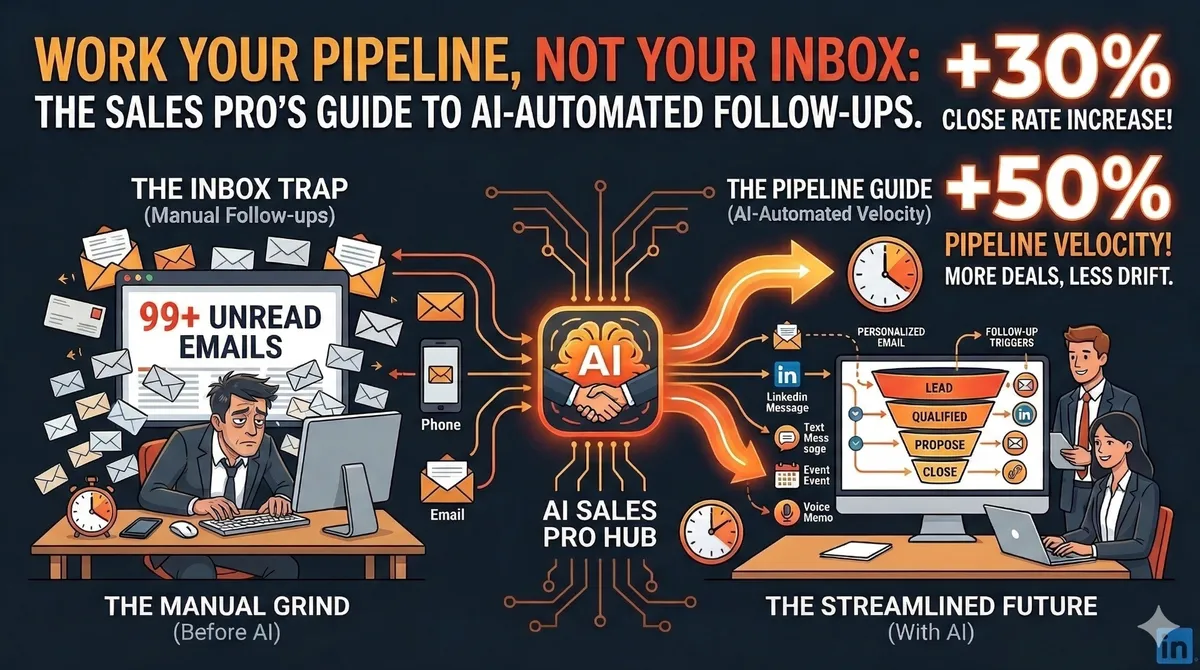
Work Your Pipeline, Not Your Inbox: AI Follow-Ups
Most teams do not lose deals because they are bad at selling. They lose them because follow-up is inconsistent, and it is inconsistent because it lives in somebody's memory instead of a system.

Updated 7 min read
In short
What a follow-up is actually for
It is not a courtesy note. A good follow-up does three specific things, and a deal that stalls has usually failed at one of them.
- Confirm what was discussed, so nobody remembers it differently in six weeks. This is worth doing for the written record alone.
- Surface the real objection, so you can address it while you are still in the conversation rather than guessing at it after the deal goes quiet.
- Give one clear next step, so the deal moves rather than waits. Two next steps is the same as none.
Where AI fits: it makes all three faster. It does not do any of them for you. You still own the truth and the relationship, and both of those are the parts that actually close.
The 5-5-5 follow-up
Fifteen minutes, three steps, same every time. Run it immediately after the call while the room is still in your head. Waiting until end of day costs you the details that make the email land.
Step 1 (5 min): Capture the raw notes
Dump everything you have into one place. Messy handwriting. Half sentences. A voice memo you recorded in the car. The email thread that set up the call.
Do not organize anything yet. Speed is the point, because the value of this step decays by the hour. The next step exists specifically to handle the mess.
Step 2 (5 min): Have AI organize it
Four questions turn chicken scratch into something you can act on. Note that everything you are asking about came from the call itself.
The instruction to say not discussed is the most important line in that prompt. Without it you will get a plausible, confident, invented answer for every gap, and you will not notice.
Step 3 (5 min): Draft the email, then make it yours
Then do the part that decides whether this works. Read every line for accuracy, and add one sentence only you could write. Something they said that stuck with you. A constraint you understood without them spelling it out.
That one line is the entire difference between an email that proves you were listening and an email that proves you have a template. Prospects can tell, and the ones worth having can tell fastest.
What the email should look like every time
Same skeleton on every deal. The repetition is not laziness, it is what makes the email scannable to a busy buyer who is comparing you to two other vendors.
| Section | What goes in it | Why it is there |
|---|---|---|
| Opening, 1 to 2 lines | Thanks, the outcome in one sentence, and your one personal line. | This is the only part that proves a human wrote it. Put the personal line here, not buried at the bottom. |
| Three bullets, priorities | The goals as they described them, in their words where possible. | This is your written record. If you have it wrong, they will correct you now instead of at contract stage. |
| Three bullets, next steps | Each with a named owner and a date. Including the ones that belong to you. | Owners and dates turn intentions into commitments. An action with no name attached does not happen. |
| One call to action | Reply with approval, or book time here. One ask, phrased as an instruction. | Two asks split the response. Most stalled deals have an email like this with three options in it. |
| Attachment, optional | Proposal, one-pager, or the document they asked for. | Only if they requested it. An unrequested attachment turns a recap into a pitch. |
Consistency builds trust. Trust closes deals.
Four ways this goes wrong
Every one of these has cost somebody a deal. The fourth one can cost you an account.
- Letting the model invent details. If you did not discuss it, cut it. A recap containing something the buyer never said destroys the credibility of everything else in the email, and they will not tell you why they went quiet.
- Sending without reading. Ever. A generated email that is ninety-five percent right is more dangerous than one that is obviously wrong, because the error hides.
- Automating too early. Run it manually until the output is consistently good, then systemize. Automating a process you have not validated just produces the same mistake faster and in more inboxes.
- Pasting other people's data into tools without checking first. The one worth a separate conversation, below.
Before you paste anything
You are about to put notes about a named individual, from a private conversation, into a third-party system. Three things to settle first, ideally once, in writing.
- Which tool, and on what terms. Use a business account with training disabled rather than a personal one. Free consumer tiers frequently retain and train on what you submit.
- What your client's agreement actually permits. Plenty of enterprise contracts and data processing agreements restrict exactly this. Find out before, not during an audit.
- How much you actually need to include. The workflow works on what they told you plus role and company context. It does not need their profile scraped in, and a summary built from the call is more accurate anyway.
A useful test: would you be comfortable if this person could see exactly what you pasted and why? If the answer is no, that is research about someone rather than preparation for them, and buyers notice the difference in the email that comes out the other end.
What tight follow-up actually buys you
When follow-up is fast, specific, and honest, five things change, and none of them are about the email itself.
- Fewer just checking in emails, because a next step with a date does not need chasing.
- Fewer ghosted deals, because the objection surfaced while you were still in the conversation.
- Faster decisions, because the buyer has a written summary they can forward to whoever actually signs.
- Cleaner handoffs, because delivery inherits a documented record instead of a story told from memory.
- A better client experience before they have paid you anything, which is the most reliable predictor of what they will expect afterward.
That is not AI magic. That is operational discipline, with AI handling the tedious parts.