Your Video Isn’t Bad. Your First 3 Seconds Are (60-Second Script)
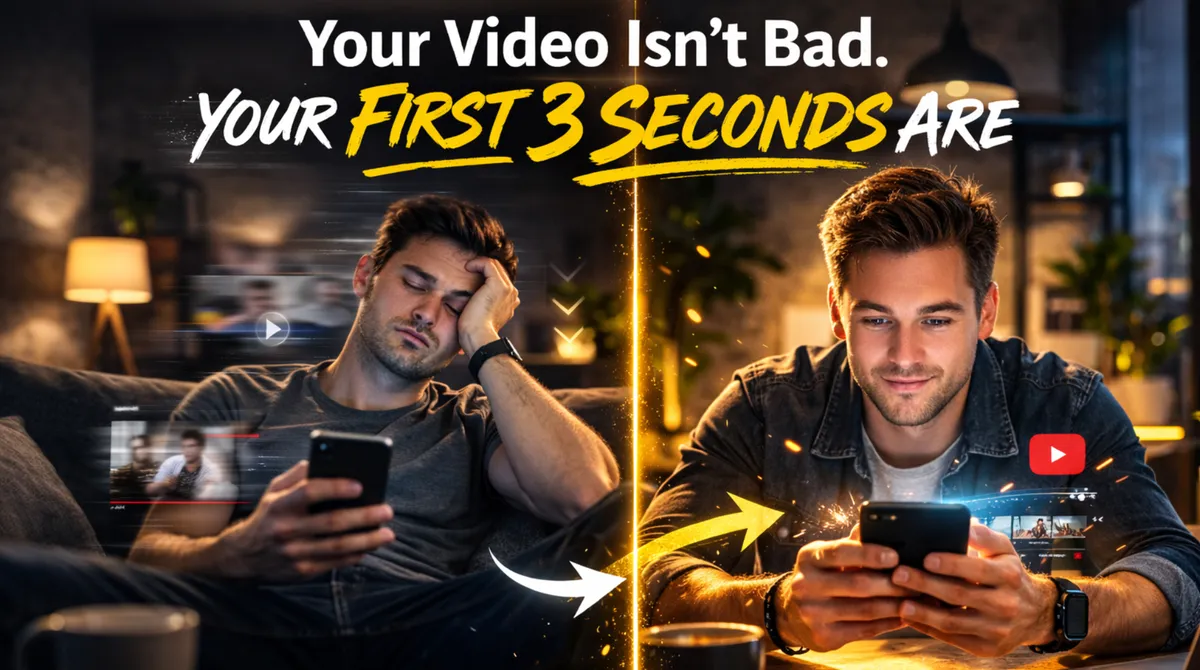
Better camera, better lighting, hours in the edit, and still no calls. Great visuals cannot rescue a weak script, and the whole thing is usually decided before the third second.

Updated 6 min read
In short
The scroll is a competition and you are entering late
Short-form video trained everyone, including you, to make a keep-or-skip decision almost instantly. That is not rudeness. It is a reasonable response to an infinite feed and a finite evening.
If your video takes longer than three seconds to reach the point, it is already buried. And a slow intro does not just cost you that viewer. It donates your reach to whoever started with clarity, because the platform is watching who stopped and reallocating accordingly.
Where the money usually goes wrong: people buy the camera, dial in the lighting, and spend three hours in the edit, then wonder why nothing converts. Production is the cheapest problem to solve and the least likely one to be the actual problem. The script is doing almost all of the work.
Sixty seconds, four jobs
Keep this open while you write. If a line does not serve the job of its window, cut it. That single rule fixes most scripts.
| Window | The job | What goes here | What kills it |
|---|---|---|---|
| 0 to 3 | Hook | The problem, stated flat out. No preamble. | Your name. A logo animation. Hey guys. Any of the three and you are done. |
| 4 to 15 | Setup | Why you are worth listening to, plus a specific promise of what they get. | A full résumé. Credibility is one sentence, not a career summary. |
| 16 to 45 | Value | One idea, packaged as a framework, numbered tips, or a short proof story. | The info dump. Four ideas at speed is the same as zero ideas. |
| 46 to 60 | Call to action | One specific next step, phrased as an instruction. | Hope that helps. This is where most business owners quietly throw the video away. |
Four hooks worth testing
Open with the problem, not with yourself. Attention comes before introductions, and it always has. Write all four for the same video, then pick the one that makes you slightly uncomfortable.
| Hook type | How it works | Sounds like |
|---|---|---|
| Problem, agitate, solution | Name the problem, let it sting for a beat, then signal that a fix is coming. | You are posting every day and getting nothing. It is not the algorithm. Here is what it actually is. |
| The surprising statement | Say something counterintuitive that the viewer wants to argue with. | Most brands are doing short-form video backwards. |
| The burning question | Ask the exact question tied to a pain they already carry. They stay for their own answer. | Why are your videos getting views but no sales? |
| The pattern interrupt | Break the expected rhythm visually and verbally at once. Start mid-sentence, hard cut, quick push in. | ...and that is the exact moment the client stopped replying. |
What actually goes in each window
Seconds 0 to 3 (hook): Stop the scroll
Three seconds is roughly eight words spoken at a natural pace. That is the entire budget. Spend it on the problem your viewer already has, not on who you are. Nobody has ever stayed for an introduction, and they will happily learn your name at second forty if the first three earned it.
Seconds 4 to 15 (setup): Earn trust, then make a promise
Two credibility moves, one sentence each. Then commit to what they get if they stay.
- Prove you have been in the arena. After producing content for brands and organizations for years...
- Show the work behind the insight. After breaking down dozens of videos that actually performed...
Then the retention promise: in the next forty-five seconds I will show you exactly how to structure a script so people stay and act. Specific enough that they can tell whether you delivered.
Seconds 16 to 45 (value): Deliver one idea, packaged
The common failure here is the info dump: four good ideas delivered fast, none of them retained. Package instead of pile.
- A framework. Step one, step two, step three, or a short acronym. Structure is what makes something repeatable to a friend.
- Tight numbered tips, paired with on-screen text so a viewer who looked away still knows where they are.
- A micro-story. Here is what I did, here is what changed. Proof beats promises, and people buy from people.
One core idea. One clear takeaway. If you have two, you have two videos.
Seconds 46 to 60 (CTA): Direct the next step
This is where most business owners fumble the whole thing. Do not end with hope that helps. The video is a sales tool. Tell them exactly what to do, once.
- Automated DM. Want my full script template? Comment SCRIPT and I will send it. Low friction, and the comment itself is a signal.
- Pinned comment. The checklist is pinned at the top, grab it. Keeps people on the platform, which the platform notices.
- Direct link. The full guide is linked below, free. Highest intent, lowest volume. Use it when the offer is genuinely worth leaving for.
On mid-roll CTAs: you can place a soft one around the fifteen second mark, right after the first piece of real value lands. Do that only when the value is genuinely front-loaded, and keep the end CTA identical. Two different asks in one video splits the audience and converts neither half.
The fill-in-the-blank script
Copy these five lines into a note on your phone and fill them in. If all five are answered, you have a script. Ten minutes, and you can shoot it today.
1. The problem, in eight words or fewer (seconds 0 to 3)
2. One sentence proving you have done this (seconds 4 to 9)
3. What they get if they stay (seconds 10 to 15)
4. The one idea, in three steps (seconds 16 to 45)
5. The single next step, as an instruction (seconds 46 to 60)
Consistency beats polish
The algorithm does not reward perfection. It rewards predictable, consistent value.
Which is good news, because polish is expensive and structure is free. A phone, a clear first line, and a script that respects the clock will outperform a beautifully lit video that takes twelve seconds to arrive at its point.
Use the framework and your videos stop feeling like ads. They start feeling like something useful, which is what actually moves a person toward the next step with you.